Your Right to a Cost of Borrowing Disclosure Before Signing a Loan in Canada
September 16, 2026
Understanding Cost of Borrowing Disclosures in Canada
Last Updated: September 2026
Before signing a loan agreement, you should be able to understand how much the credit will cost and how repayment will work.
A cost of borrowing disclosure in Canada can show important information such as the interest rate, annual percentage rate (APR), payment amount, payment schedule and applicable fees.
For federally regulated financial institutions, Canadian consumer-protection rules require certain information about loans and other credit products to be disclosed clearly. The exact requirements depend on the type of credit and financial institution. Provincial or territorial rules may apply when you borrow from other types of lenders.
Understanding these disclosures gives you a better chance of spotting expensive borrowing, unexpected fees or repayment terms that don’t fit your budget.
This is one part of your broader borrower rights in Canada.
What Is a Cost of Borrowing Disclosure?
A cost of borrowing disclosure explains important information about the credit you’re considering.
It isn’t simply a document telling you the interest rate.
Depending on the loan and lender, disclosure information may include:
- the principal amount
- annual interest rate
- APR
- loan term
- payment amount
- payment dates and frequency
- amortization period, where applicable
- applicable fees and other charges
- prepayment information
- default or NSF charges
- other information required for the particular credit product
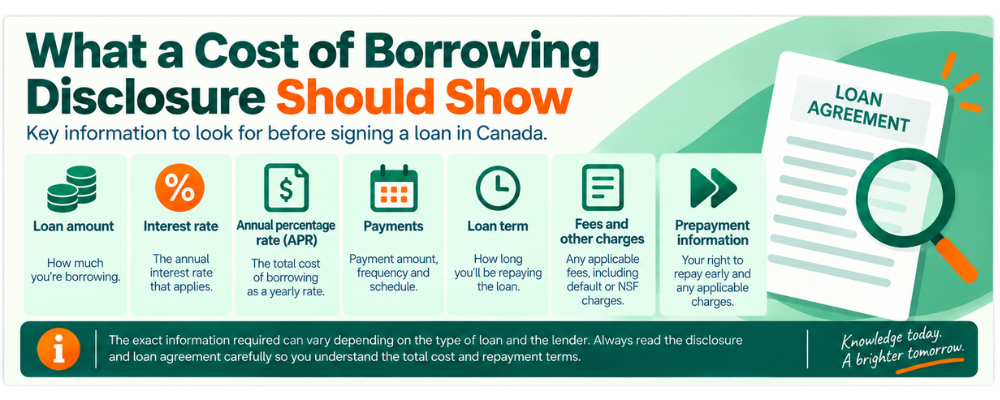
FCAC’s example information box for a fixed-rate personal loan includes the principal amount, annual interest rate, APR, term, date funds are advanced, payments, amortization, prepayment information and other fees.
The purpose is to give you important information about the credit agreement so you can understand what you’re agreeing to.
Why the APR Matters
The interest rate and APR aren’t necessarily the same thing.
Your annual interest rate tells you the rate of interest charged on the loan.
The annual percentage rate (APR) shows the cost of borrowing as a yearly rate and can include applicable non-interest charges.
This makes APR particularly useful when comparing credit products.
For example, two loans could advertise similar interest rates but have different borrowing costs if one has additional charges that are included when calculating APR.
Don’t compare loans using the advertised interest rate alone.
Look at:
- APR
- payment amount
- payment frequency
- fees
- term
- total borrowing cost
If you’re comparing borrowing options, our personal loans in Canada page explains other factors to consider.
When Must You Receive the Disclosure?
For credit agreements with federally regulated financial institutions, the timing of the initial disclosure depends on the type of credit.
For credit agreements other than loans secured by a mortgage on real property, federal regulations generally require the initial disclosure statement to be provided on or before the earlier of:
- making a payment, other than a disbursement charge; or
- the day you enter into the credit agreement.
Different timing rules apply to loans secured by a mortgage on real property.
The Financial Consumer Agency of Canada (FCAC) also recommends taking the time to read and understand a personal loan’s terms and conditions before signing.
Provincial or territorial requirements may apply when you’re dealing with a lender that isn’t federally regulated, so the exact disclosure rules aren’t identical for every loan in Canada.
What Should a Personal Loan Disclosure Tell You?
For a fixed-rate personal loan from a federally regulated financial institution, the information can include important details about the cost and repayment of the loan.
A useful disclosure should allow you to answer questions such as:
How much am I borrowing?
Check the principal amount rather than simply the amount you expect to receive.
What interest rate am I paying?
Look for the annual interest rate and how it applies.
What is the APR?
Don’t automatically assume this will always be identical to the stated interest rate.
How much are my payments?
Check both the amount and frequency.
How long will I be repaying the loan?
A smaller payment can look attractive but may come with a longer repayment period.
What other fees apply?
Look for applicable charges rather than focusing only on interest.
Can I repay the loan early?
Check the agreement for applicable prepayment rights or charges.
FCAC says federally regulated institutions must provide required information using language that is clear, simple and not misleading.
Fixed-Rate vs Variable-Rate Loan Disclosures
The information you receive can also depend on whether your loan has a fixed or variable interest rate.
With a fixed-rate loan, the interest rate generally stays the same for the agreed period.
With a variable-rate loan, the rate can change.
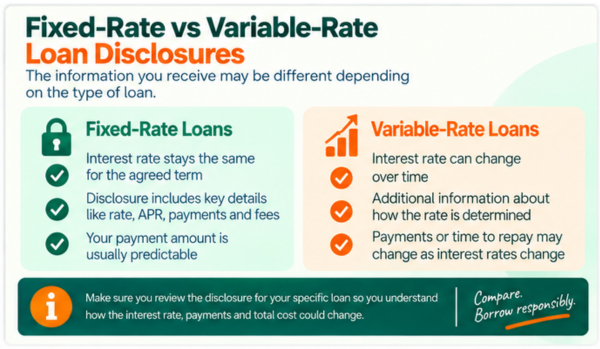
FCAC explains that additional information may need to be provided for variable-rate personal loans, including information about payments and the cost of borrowing. Where the rate is linked to another rate, such as prime, additional ongoing information may also be required.
This matters because the payment or time required to repay a variable-rate loan may change as interest rates change.
What About Lines of Credit?
Lines of Credit work differently from fixed loans, so their disclosures are different too.
For example, federal cost-of-borrowing rules for certain federally regulated institutions require initial Line of Credit disclosure to include information such as:
- the initial credit limit, if known
- the annual interest rate or how a variable rate is determined
- applicable non-interest charges
There are also ongoing disclosure requirements.
If you’re considering revolving credit, see our Line of Credit Canada page for an explanation of how these products work.
Don’t Confuse the Interest Rate With the Total Cost
This is one of the easiest mistakes to make when comparing loans.
Imagine Loan A has a slightly lower advertised interest rate than Loan B.
That doesn’t automatically mean Loan A will cost you less.
You also need to consider:
- applicable fees
- how much you’re borrowing
- how long you’re borrowing for
- how often payments are made
- whether the rate is fixed or variable
- whether you repay early
- the total amount you ultimately repay
This is why disclosure information is so important.
It gives you more than one number to compare.
8 Things to Check Before Signing a Loan
Before accepting a loan, check:
- Principal amount — How much are you actually borrowing?
- Annual interest rate — What interest rate applies?
- APR — What does the annualized borrowing cost show?
- Payments — How much will you pay and how often?
- Loan term — How long does the agreement run?
- Fees — Are there additional charges?
- Prepayment terms — What happens if you repay early?
- Default terms — What could happen if you miss a payment?
If something doesn’t match what you were told during the application process, don’t assume the agreement is correct just because it has been presented for signature.
Ask the lender to explain the difference before you accept the credit.
What If the Lender Doesn’t Give You Clear Disclosure?
First, ask the lender for clarification and keep copies of:
- the disclosure statement
- loan agreement
- emails or messages
- screenshots
- advertisements you relied on
- records of conversations where possible
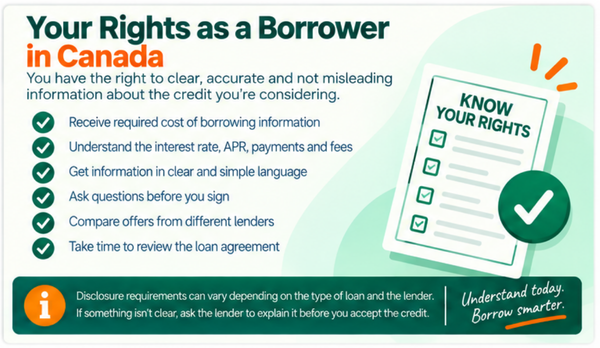
If you’re dealing with a federally regulated financial institution and believe it hasn’t followed its disclosure obligations, you can use its complaint-handling process.
FCAC supervises federally regulated financial institutions, but the appropriate complaint route can differ for provincially regulated lenders.
We’ve covered the complaint process separately in What to Do If a Lender Violates Your Consumer Rights in Canada.
Does This Right Apply to Every Lender in Canada?
Not under one single federal rule.
That’s an important distinction.
Federal consumer-protection requirements apply to federally regulated financial institutions, including banks and federal credit unions. Other lenders may instead be subject to provincial or territorial consumer-credit legislation and licensing requirements.
The exact disclosure requirements can therefore depend on:
- who you’re borrowing from
- the type of credit
- your province or territory
- whether the lender is federally or provincially regulated
So while borrowers across Canada have important disclosure protections, the legal framework isn’t identical for every lender or every loan.
Why You Should Compare the Disclosure Before Borrowing
A loan shouldn’t be chosen simply because the application is quick or because you’ve been approved.
Before accepting an offer, compare its actual borrowing terms with other options available to you.
If you want to compare providers rather than approaching one lender directly, you can explore the FatCat Loans lender network.
Approval isn’t guaranteed, and the lender you apply with will determine the rate, amount and terms available to you.
Frequently Asked Questions
What is a cost of borrowing disclosure in Canada?
A cost of borrowing disclosure provides important information about a credit agreement, which may include the interest rate, APR, payment information, term and applicable fees. The exact information required depends on the lender and type of credit.
Does a lender have to tell me the APR before I sign?
Federally regulated financial institutions have disclosure requirements for consumer credit products, including requirements relating to APR for applicable loans. The timing and information required depend on the type of agreement. Provincial or territorial rules may apply to other lenders.
Is APR the same as the interest rate?
Not necessarily. The interest rate represents the interest charged on the loan, while APR is an annualized measure of borrowing cost that can include applicable non-interest charges.
What fees should I check before accepting a loan?
Check your disclosure and agreement for applicable administration or service charges, NSF or default charges, prepayment terms and any other fees associated with the particular loan.
What should I do if I don’t understand my loan disclosure?
Ask the lender to explain the terms before accepting the agreement. Federally regulated financial institutions must provide required disclosure using language that is clear, simple and not misleading.
What can I do if I think a lender didn’t disclose the borrowing cost properly?
Keep your agreement, disclosure documents and relevant communications. Start with the lender’s complaint process. If the lender is federally regulated, FCAC provides information about your rights and the complaint process. For other lenders, the appropriate provincial or territorial regulator may apply.
Key Takeaway
A cost of borrowing disclosure isn’t paperwork to skip.
It can help you understand what you’re borrowing, what it costs, how you’ll repay it and what additional charges may apply.
For federally regulated financial institutions, Canadian rules require specific credit information to be disclosed clearly. Other lenders may be covered by provincial or territorial rules instead.
Read the disclosure alongside the loan agreement, question anything you don’t understand and compare the APR, payments, fees and total borrowing cost before accepting credit.

The FatCat Loans Editorial Team delivers clear, accurate, and unbiased guidance on loans, credit, and personal finance in Canada. Our writers follow strict editorial standards to ensure every article is trustworthy, well-researched, and easy to understand, helping readers make confident financial decisions.