
Credit Card Debt Consolidation Loans in Canada
December 06, 2024
Can a Credit Card Debt Consolidation Loan Save You Money?
Last Updated: November 2026
If you’re carrying balances on several credit cards, a credit card debt consolidation loan in Canada could help simplify your repayments and potentially reduce your interest costs. Instead of managing multiple card payments, you use one loan to repay the balances and then make regular instalments toward the new loan.
But consolidation does not automatically save money. Your credit history, income, existing debt, interest rate, lender fees and repayment term all affect whether the arrangement is worthwhile.
This guide explains how credit card consolidation loans work in Canada, what rates and terms to compare, your realistic chances of approval, and how to determine whether a new loan will actually improve your finances.
For a broader look at available solutions, explore our Debt Relief and Consolidation Canada guide.
What Is a Credit Card Debt Consolidation Loan?
A credit card debt consolidation loan is a personal or dedicated consolidation loan used to pay off one or more existing credit card balances.
For example, suppose you owe:
- Credit Card A: $4,000
- Credit Card B: $3,500
- Credit Card C: $4,500
Your combined balance is $12,000. If approved for a $12,000 consolidation loan, you could use the funds to repay all three cards and then make one scheduled loan payment.
The new loan does not erase your debt. It replaces the credit card balances with a different repayment obligation.
Consolidation is most useful when the new arrangement offers an affordable payment, a competitive total borrowing cost and a realistic path to becoming debt-free.
How Credit Card Consolidation Loans Work in Canada
The process generally involves five steps:
- Calculate your total debt: Add your credit card balances and confirm the current payoff amounts.
- Review your finances: Check your credit reports, income, monthly expenses and existing debt obligations.
- Compare loan offers: Evaluate interest rates, fees, repayment periods and total repayment amounts.
- Repay your cards: Use the approved loan proceeds to pay off the credit card balances. Some lenders may pay creditors directly.
- Repay the consolidation loan: Make scheduled instalments and avoid building new credit card balances.
Some consolidation loans have fixed interest rates and payments, while others may have variable rates. Confirm which structure applies before signing.
Credit Card Debt Consolidation Loan Rates in Canada
The interest rate you qualify for depends on your financial circumstances and the lender’s assessment.
Factors commonly considered include:
- Your credit report and repayment history.
- Your employment and income stability.
- Your existing monthly debt obligations.
- Your debt-to-income ratio and available income.
- The amount you want to borrow.
- Whether the loan is secured or unsecured.
Borrowers with stronger credit histories and affordable debt payments may have access to more competitive offers. Those with missed payments, high existing debt or unstable income may face higher rates, smaller offers or rejection.
Rather than relying on an advertised starting rate, compare the actual rate and total cost offered to you.
What Fees Should You Check?
Interest is not the only potential borrowing cost. Depending on the lender, a consolidation loan may involve:
-
- Loan origination or administration fees.
- Optional loan insurance premiums.
- Late-payment or returned-payment charges.
- Prepayment restrictions or charges, if permitted under the applicable loan agreement and law.
Check whether any fee is deducted from the loan proceeds. For example, a $12,000 approved loan with a $400 fee deducted upfront would provide only $11,600 toward your credit card balances.
Compare the disclosed annual percentage rate (APR), total repayment and amount actually available to repay creditors.
How Much Could You Save by Consolidating Credit Card Debt?
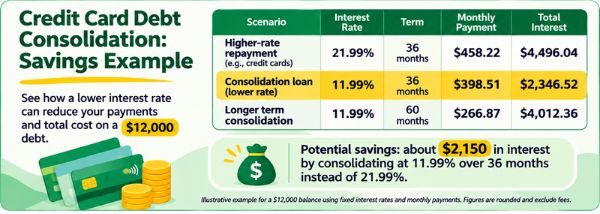
Consider a borrower with $12,000 in credit card debt. The following examples show how different rates and repayment periods affect the cost.
| Scenario | Interest Rate | Term | Monthly Payment | Total Interest |
|---|---|---|---|---|
| Higher-rate repayment | 21.99% | 36 months | $458.22 | $4,496.04 |
| Lower-rate consolidation | 11.99% | 36 months | $398.51 | $2,346.52 |
| Longer consolidation term | 11.99% | 60 months | $266.87 | $4,012.36 |
Illustrative calculations for a $12,000 balance using fixed nominal annual interest rates, monthly compounding and fully amortizing monthly payments. Figures are rounded and exclude fees, insurance, new purchases and missed payments. The first scenario assumes the credit card balance is repaid through fixed payments over 36 months, rather than minimum payments alone.
What Does This Comparison Show?
At 11.99% over 36 months, the borrower would pay approximately $2,150 less in interest than at 21.99% over the same period.
However, extending the 11.99% loan to 60 months reduces the monthly payment while increasing total interest compared with the 36-month consolidation option.
The key lesson: A lower monthly payment is not the same as a cheaper loan.
Before consolidating, compare the full repayment amount under your existing debt strategy with the new loan’s total payments and fees.
Can You Get a Credit Card Consolidation Loan With Bad Credit?
Yes, some lenders consider applicants with imperfect credit. However, approval is not guaranteed, and the terms may be less favourable.
Bad credit can make consolidation more difficult because lenders may see a greater risk of missed repayments.
Importantly, a loan that is approved at a very high rate may not improve your financial position.
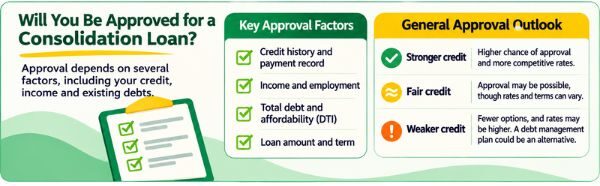
Realistic Approval Chances by Credit Profile
| Credit Situation | What to Expect |
|---|---|
| Strong credit history | Potential access to a wider selection of lenders and more competitive rates, subject to affordability. |
| Fair credit history | Some consolidation options may be available, although pricing and loan limits can vary considerably. |
| Poor credit history | Fewer options may be available, and offered rates may be too high to deliver savings. |
| Recent missed payments or collections | Approval may be more difficult, particularly when combined with high existing debt. |
| Insufficient income for repayments | Approval may be unlikely regardless of credit score; non-borrowing debt solutions may be more appropriate. |
These are general lending considerations, not lender-specific approval probabilities or guaranteed credit-score thresholds.
For more information about borrowing with damaged credit, see our bad credit loans Canada guide.
How Income and Debt-to-Income Ratio Affect Approval
Lenders usually want evidence that you can afford the proposed payment alongside your existing living expenses and financial commitments.
Your debt-to-income ratio (DTI) is one measure that may help them assess your existing repayment burden.
A simple monthly DTI calculation is:
Monthly debt payments ÷ gross monthly income × 100
For example, someone earning $4,500 per month before tax and making $1,350 in monthly debt payments has a DTI of 30%.
Different lenders calculate and assess affordability differently. Some consider housing expenses, household costs and other obligations separately.
There is no single DTI threshold that guarantees approval across Canadian consolidation lenders.
What Loan Terms Are Available?
Personal loans in Canada commonly have repayment terms measured in months or years. The Financial Consumer Agency of Canada describes many personal loans as having terms between six and 60 months, although actual product offerings vary.
A shorter term generally means higher monthly payments but less time for interest to accumulate.
A longer term can reduce monthly repayment pressure but may increase the total borrowing cost.
When comparing terms, ask:
- Can I afford the payment after essential expenses?
- How much interest will I pay over the full term?
- Are there any upfront or recurring fees?
- Can I make additional payments without penalties?
- What happens if I miss a payment?
Benefits of Credit Card Debt Consolidation
One Scheduled Payment
Combining several balances into one loan may make repayment dates easier to manage.
Potential Interest Savings
If the new loan has a lower total borrowing cost, consolidation may reduce the amount you pay to become debt-free.
A Clear Repayment End Date
An instalment loan generally provides a defined repayment schedule, unlike revolving credit card debt that can continue indefinitely when balances are repeatedly carried forward.
More Predictable Budgeting
A fixed-rate loan with fixed instalments can make monthly financial planning easier.
Less Administrative Stress
Managing fewer payment dates and balances may make it easier to stay organized, although the underlying debt still needs to be repaid.
Risks and Disadvantages of Consolidating Credit Card Debt
You Might Pay More Interest Overall
A longer repayment period or additional fees can offset the benefit of a lower interest rate.
You Might Not Qualify for a Better Rate
Applicants with weaker credit histories or high debt obligations may receive expensive offers or be declined.
You Could Build Up Credit Card Debt Again
Paying off your cards with a loan does not prevent you from using them again. New balances could leave you owing both the consolidation loan and additional credit card debt.
Your Credit Score May Change
A loan application may involve a hard credit inquiry. Opening a new account and changing your credit utilization may also affect your credit profile.
Over time, consistent on-time payments and lower revolving balances may help, but a score improvement is not guaranteed.
Secured Loans Put Assets at Risk
Using home equity to repay unsecured credit card debt introduces the possibility of losing your property if you cannot meet the secured loan obligations.
How to Compare Credit Card Consolidation Lenders
Before applying, compare lenders using the same borrowing amount and a similar repayment period wherever possible.
| What to Compare | Why It Matters |
|---|---|
| APR and interest rate | Helps establish the cost of borrowing. |
| Monthly payment | Must fit comfortably within your budget. |
| Loan term | Affects both payment size and total interest. |
| Upfront fees | May reduce the amount available to repay your cards. |
| Eligibility requirements | May include income, employment, credit and residency criteria. |
| Early repayment rules | Determine whether paying faster creates extra costs. |
| Creditor payment process | Some lenders may repay your credit cards directly. |
Check whether a lender offers an initial eligibility check without a hard credit inquiry. A full application may still involve a credit check.
You can explore available options through the FatCat Loans Canadian lender network. FatCat Loans is a loan-matching service, and approval or a suitable consolidation offer is not guaranteed.
Step-by-Step: How to Consolidate Credit Card Debt
- List your balances: Record each card’s balance, APR and minimum payment.
- Prepare a realistic budget: Identify the monthly amount you can consistently afford.
- Check your credit reports: Review them for errors before submitting applications.
- Estimate your total loan requirement: Borrow only what is needed to repay the debts you intend to consolidate, accounting for applicable fees.
- Compare repayment scenarios: Calculate total interest and fees, not just the monthly payment.
- Review eligibility: Consider whether your income and existing debt support the proposed payment.
- Apply carefully: Provide accurate income, identity and debt information.
- Repay your credit cards: Confirm the balances have been paid and check for any residual interest.
- Set up repayments: Consider automatic payments where suitable.
- Avoid rebuilding balances: Adjust your budget and credit card use to prevent additional debt.
Credit Card Consolidation Loan vs. Other Debt Solutions
A consolidation loan is not the only way to manage multiple credit card balances.
| Option | How It Works | Main Consideration |
|---|---|---|
| Personal consolidation loan | Replaces card balances with scheduled loan repayments. | Requires approval and a manageable total borrowing cost. |
| Balance transfer credit card | Moves eligible balances to a promotional interest rate. | Transfer fees and the promotional expiry date matter. |
| Personal line of credit | Uses revolving borrowing to repay existing cards. | Rates may vary and principal repayment requires discipline. |
| Debt management plan | A credit counsellor helps arrange payments to participating creditors. | Fees, creditor participation and credit-report consequences vary. |
| HELOC or home equity loan | Uses property equity to repay unsecured debt. | Your home may be at risk if you cannot repay. |
| Consumer proposal | A formal insolvency process administered by a Licensed Insolvency Trustee. | Has eligibility requirements and significant credit consequences. |
For a detailed overview, read our debt relief and consolidation guide.
When a Consolidation Loan May Not Be the Right Choice
A new loan may not solve the problem if you:
- Cannot afford the new payment after essential living expenses.
- Would pay a higher rate than on your existing credit cards.
- Need to borrow more to cover ordinary monthly expenses.
- Are already missing multiple debt payments.
- Would need to secure unsecured credit card debt against your home without fully understanding the risks.
In these situations, consider speaking with your creditors about hardship arrangements or contacting a reputable credit counselling agency.
A debt management plan may help some borrowers repay eligible unsecured debts through a structured arrangement, sometimes with reduced interest. It is not a new consolidation loan, and fees and credit consequences should be reviewed.
If your debts are unmanageable, a Licensed Insolvency Trustee can explain formal options, including consumer proposals.
The Financial Consumer Agency of Canada provides independent information about debt consolidation and its risks.
Frequently Asked Questions About Credit Card Debt Consolidation Loans
Can I consolidate credit card debt with bad credit in Canada?
Some lenders consider applicants with bad credit, but approval depends on income, existing debt and other eligibility requirements. Higher interest rates or fees may make a new loan unsuitable. Credit counselling or a debt management plan may be worth exploring if you cannot qualify for an affordable loan.
What interest rate can I get on a credit card consolidation loan?
The rate depends on your credit history, income, debt obligations, loan amount and lender. Compare personalized offers using the APR, fees, repayment term and total cost rather than relying on advertised starting rates.
Will a credit card consolidation loan hurt my credit score?
A loan application may cause a temporary score change because of a hard credit inquiry and new account. Paying down credit card balances and making loan payments on time may help your credit profile over time, but improvements are not guaranteed.
How long does it take to pay off a consolidation loan?
Repayment periods vary by lender and product. Many personal loans have terms ranging from several months to five years, while some products offer different terms. A longer repayment period may lower monthly payments but increase total interest.
Should I close my credit cards after consolidating?
Not necessarily. Closing accounts can affect your available credit and credit history, while keeping them open may create a temptation to borrow again. Consider your spending habits, annual fees and overall credit situation before deciding.
Is credit card consolidation worth it if my monthly payment is lower?
Not automatically. A lower payment may result from extending the repayment period, which can increase total interest. Compare the total repayment amount, all fees and the time needed to become debt-free.
Final Verdict: Are Credit Card Consolidation Loans Worth It?
A credit card debt consolidation loan can be a useful financial tool when it replaces expensive revolving debt with an affordable, structured repayment plan.
The strongest reason to consolidate is not simply having one monthly payment. It is securing a repayment arrangement that fits your budget and, ideally, reduces the total cost of becoming debt-free.
Before applying, review your credit position, compare personalized loan terms, calculate the full repayment cost and consider whether a non-borrowing solution would be more suitable.
Compare Your Loan Options
If a consolidation loan appears suitable for your circumstances, you can explore participating providers through FatCat Loans.

Submitting an application does not guarantee approval, a particular rate or savings.
Sources
- Financial Consumer Agency of Canada – Debt Consolidation
- Financial Consumer Agency of Canada – Personal Loans
- Financial Consumer Agency of Canada – Getting Help From a Credit Counsellor
- Financial Consumer Agency of Canada – Paying Back Your Debt
Editorial note: The loan examples are illustrative calculations, not actual lender offers. Interest rates, fees, repayment terms and eligibility requirements vary by lender and applicant.
Disclosure: This article is for general information and does not constitute financial advice. FatCat Loans is a loan-matching service, not a direct lender. Loan approval and terms are determined by participating providers. Always review the full agreement before accepting credit.

The FatCat Loans Editorial Team delivers clear, accurate, and unbiased guidance on loans, credit, and personal finance in Canada. Our writers follow strict editorial standards to ensure every article is trustworthy, well-researched, and easy to understand, helping readers make confident financial decisions.


