How Long Does Negative Information Stay on Your Credit Report in Canada?
September 07, 2026
Understanding How Long Credit Information Can Follow You
Last Updated: September 2026
Missed a payment several years ago and wondering why it’s still on your credit report? You’re not alone.
Negative information can remain on a Canadian credit report for several years. The exact length of time depends on the type of information, the credit bureau, your province and, in some cases, the circumstances involved.
In many cases, negative account information may stay on your credit report for up to six years. Bankruptcies, consumer proposals, credit inquiries and other records can have different reporting periods.
This guide explains how long negative information stays on a credit report in Canada, when information may disappear and what you can do if something on your report is wrong.
How Long Does Negative Information Stay on a Canadian Credit Report?
There isn’t one reporting period that applies to everything on your credit report.
As a general guide:
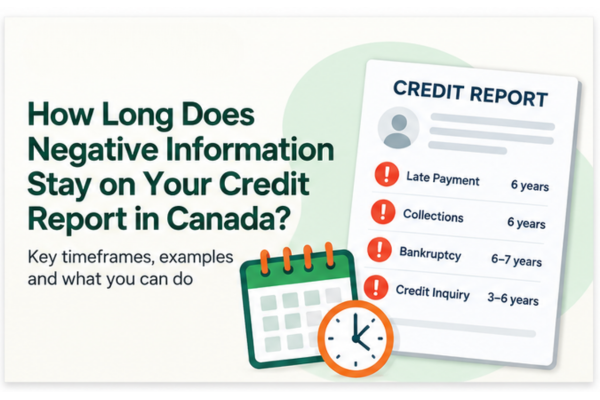
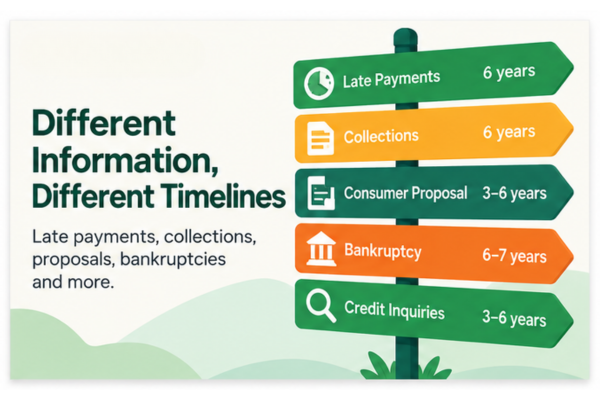
| Type of information | How long it may appear |
|---|---|
| Late or missed payments | Up to 6 years |
| Negative information on credit accounts | Up to 6 years |
| Accounts sent to collections | About 6 years |
| Hard credit inquiries | Equifax: 3 years; TransUnion: 6 years |
| Consumer proposal | 3 years after the included debts are paid, or 6 years after signing the proposal, whichever comes first |
| First bankruptcy | Usually 6 years after discharge; TransUnion uses 7 years in some provinces |
| Multiple bankruptcies | 14 years |
| Positive credit information | May remain longer than negative information |
These are general reporting periods rather than guaranteed removal dates.
Equifax and TransUnion are Canada’s two main credit bureaus. They can have different policies about how long particular information remains on a credit report.
Provincial rules can also affect reporting periods.
The Financial Consumer Agency of Canada (FCAC) explains how long different types of information may remain on your credit report and notes that the exact period can depend on the credit bureau and province.
How Long Do Late Payments Stay on Your Credit Report?
Late and missed payments can generally remain on a Canadian credit report for up to six years.
Your payment history is an important part of your credit record. If a lender reports that you didn’t make a payment as agreed, that information doesn’t disappear as soon as you catch up.
For example, suppose you missed payments on a credit card but later brought the account up to date. The historical late payments may still appear on your credit report during the applicable reporting period.
That doesn’t necessarily mean an old missed payment will affect every future credit decision in exactly the same way. Lenders use their own criteria when assessing applications.
How Long Do Collections Stay on Your Credit Report?
If an unpaid account is sent to a collection agency, the collection information may generally remain on your credit report for about six years.
Paying the collection is still important, but payment doesn’t necessarily make the history disappear immediately.
The account may instead be updated to show that it has been paid or settled.
This is an important distinction:
Paying a legitimate debt doesn’t normally erase the fact that it previously went to collections.
If you see a collection account that you don’t recognize or believe is incorrect, however, you can dispute the information.
How Long Do Hard Credit Checks Stay on Your Credit Report?
When you apply for credit, a lender may perform a hard credit inquiry. This can appear on your credit report.
Hard credit inquiries can stay on your Equifax credit report for 3 years and your TransUnion credit report for 6 years, according to the Financial Consumer Agency of Canada (FCAC).
A hard inquiry isn’t the same as a missed payment or collection account. It simply shows that an organization accessed your credit file in connection with a credit application or another permitted purpose.
Several hard inquiries within a short period can matter because they may suggest you’re seeking a lot of new credit.
Not every check is a hard inquiry, though.
Our Soft vs Hard Credit Checks in Canada guide explains the difference.
How Long Does a Consumer Proposal Stay on Your Credit Report?
A consumer proposal can remain on your credit report after you’ve finished making the required payments.
According to FCAC, Equifax and TransUnion remove a consumer proposal 3 years after you’ve paid all the debts included in the proposal, or 6 years after you signed the proposal, whichever comes first.
This means the removal date depends partly on how long it takes you to complete your proposal.
How Long Does Bankruptcy Stay on Your Credit Report in Canada?
A first bankruptcy is generally removed from your credit report 6 years after you’re discharged.
TransUnion keeps a first bankruptcy for 7 years after discharge in Newfoundland and Labrador, Ontario, Prince Edward Island and Quebec.
If you declare bankruptcy more than once, the credit bureaus may keep the information on your credit report for 14 years.
This is one reason it’s important to distinguish between:
- the length of the bankruptcy process
- the date you’re discharged
- how long the bankruptcy subsequently appears on your credit report.
They aren’t necessarily the same thing.
Does Paying a Debt Remove It From Your Credit Report?
Usually, not immediately.
This catches a lot of people out.
Imagine you have a collection account showing on your credit report. You pay the outstanding balance today.
The account may be updated to show that you’ve paid it, but the history doesn’t necessarily disappear tomorrow.
Similarly, bringing a late account up to date doesn’t automatically delete previous missed payments.
Accurate information can generally remain for the applicable reporting period even after you’ve dealt with the debt.
That doesn’t mean paying is pointless. An unpaid account and a paid account aren’t the same thing, and resolving outstanding debts can prevent the situation from continuing to get worse.
Can You Remove Negative Information Early?
You generally can’t have accurate negative information removed simply because you don’t like how it affects your credit.
Be particularly careful with companies promising that they can quickly “erase” legitimate negative information from your credit report for a fee.
There is an important exception:
Incorrect information can be disputed.
You should check for things such as:
- accounts that aren’t yours
- payments incorrectly shown as late
- debts you’ve already paid that still show the wrong balance
- duplicate accounts
- incorrect personal details
- unfamiliar credit inquiries.
You have the right to dispute information you believe is wrong.
What Should You Do If Negative Information Is Incorrect?
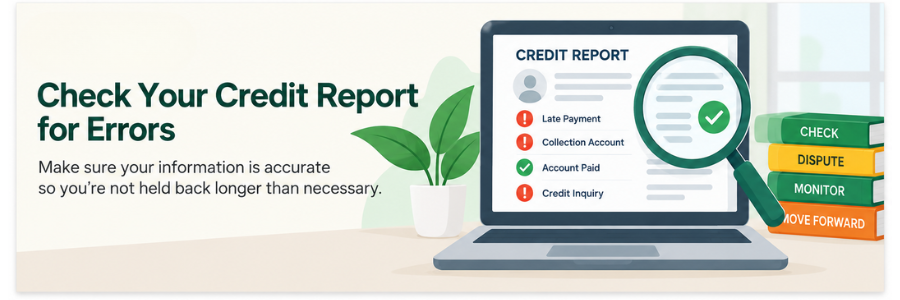
Start by getting your credit reports from both Equifax and TransUnion.
Our Free Credit Report Canada guide explains how to access them.
Then:
- Identify the error. Make sure you understand exactly what you believe is incorrect.
- Gather evidence. This might include statements, payment confirmations or correspondence with the creditor.
- Contact the credit bureau. Follow its dispute process.
- Contact the lender or creditor if necessary. The organization that supplied the information may need to investigate it.
- Check your report again. Make sure any agreed correction has been made.
Don’t dispute accurate information simply in the hope that it will be deleted.
Will Your Credit Score Improve as Negative Information Gets Older?
It can, but there is no guaranteed timetable.
Your credit score is based on information in your credit file, and many factors can affect it.
These may include your:
- payment history
- outstanding balances
- use of available credit
- length of credit history
- recent credit applications
- mix of credit accounts.
So you don’t necessarily need to wait until one negative item completely disappears before your credit situation can change.
Making payments on time and managing your existing accounts responsibly can help build a stronger recent credit history.
If that’s your goal, see Improve Your Credit Score Canada: 11 Smart Fixes (2026) for practical steps you can take.
Should You Check When Old Information Disappears?
Yes.
It’s worth checking your credit reports periodically, particularly if you know an old negative item should be approaching the end of its reporting period.
You don’t need to obsessively check your report every few days.
Instead, check it often enough to:
- spot information you don’t recognize
- find reporting errors
- make sure paid accounts are updated correctly
- watch for possible identity fraud
- see whether old information has been removed when expected.
Your Equifax and TransUnion reports aren’t necessarily identical, so it’s useful to check both.
Can Old Negative Information Stop You Getting a Personal Loan?
It can affect a lender’s assessment, but seeing negative information on your credit report doesn’t automatically mean every lender will decline you.
Lenders may consider several factors when assessing a personal loan application, including:
- credit history
- income
- existing debts
- affordability
- employment or income stability
- the lender’s own eligibility rules.
The age and seriousness of negative information may also matter to a lender.
For example, one old missed payment isn’t necessarily viewed in the same way as recent repeated missed payments or unresolved collection accounts.

Our Personal Loans Canada guide explains how personal loans work, what lenders may consider and what to compare before borrowing.
Don’t Wait for Your Credit Report to “Reset”
One of the biggest misconceptions about negative credit information is that you simply need to wait six years and everything starts again.
Credit reports don’t really work like that.
Different information can have different removal dates. New information is also continually being added to your file.
A better approach is to deal with problems you can control now.
That means:
- make payments by their due dates
- address outstanding debts
- avoid repeatedly applying for unnecessary credit
- check your reports for errors
- keep your balances manageable
- challenge information that genuinely isn’t correct.
Over time, older information may fall off your report while newer account activity builds your current credit history.
Frequently Asked Questions About Negative Information on Canadian Credit Reports
Does bad credit disappear after 6 years in Canada?
Not necessarily. Many types of negative account information may remain on a credit report for up to six years, but there isn’t one six-year rule covering everything. Bankruptcies, credit inquiries and other information can have different reporting periods.
How long do missed payments stay on a credit report in Canada?
Late or missed payments may generally remain on a Canadian credit report for up to six years. The exact reporting period can depend on the credit bureau and applicable provincial rules.
Does paying a collection remove it from your credit report?
Not necessarily. Paying a collection can update the account to show that it has been paid or settled, but accurate information about the collection may remain until the applicable reporting period ends.
Can I ask Equifax or TransUnion to remove negative information?
You can dispute information you believe is inaccurate. However, accurate negative information generally can’t be removed simply because it is hurting your credit score.
How long does bankruptcy stay on a credit report in Canada?
A first bankruptcy is generally removed 6 years after discharge. TransUnion keeps it for 7 years in Newfoundland and Labrador, Ontario, Prince Edward Island and Quebec. Multiple bankruptcies may remain for 14 years.
Do Equifax and TransUnion remove information at the same time?
Not always. Equifax and TransUnion can have different information and reporting policies, so an item may not necessarily disappear from both reports on exactly the same date.
The Bottom Line
A lot of negative information can stay on a Canadian credit report for around six years, but that’s not a universal rule.
Late payments, collections, credit inquiries, consumer proposals and bankruptcies can all have different reporting periods. The timing can also depend on the credit bureau, province and circumstances.
Rather than focusing only on when an old item will disappear, check that the information on your reports is accurate and deal with debts or missed payments you can address now.
If something is wrong, dispute it. If it’s accurate, concentrate on building a stronger recent credit history while you wait for the older information to reach the end of its reporting period.
This article is for informational purposes only and doesn’t constitute financial or legal advice. Credit-reporting periods can vary by credit bureau, province and circumstances. Check Equifax, TransUnion and applicable provincial requirements for information relating to your situation. FatCat Loans is a loan comparison platform, not a lender.

The FatCat Loans Editorial Team delivers clear, accurate, and unbiased guidance on loans, credit, and personal finance in Canada. Our writers follow strict editorial standards to ensure every article is trustworthy, well-researched, and easy to understand, helping readers make confident financial decisions.