
Debt Consolidation vs Consumer Proposal vs Bankruptcy in Canada
November 12, 2024
Comparing Your Options When Debt Becomes Difficult to Manage
Last Updated: September 2026
If you’re struggling with debt, you may be comparing debt consolidation vs consumer proposal vs bankruptcy in Canada.
All three can deal with debt, but they work very differently.
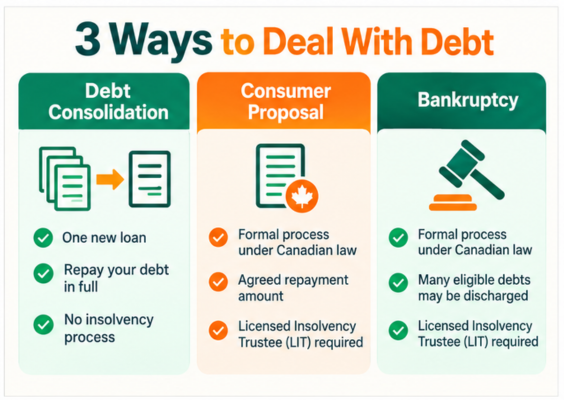
Debt consolidation generally means taking out a new loan to combine several debts into one payment. You still repay what you borrowed, plus applicable interest.
A consumer proposal is a formal insolvency process that lets you offer creditors a percentage of what you owe, more time to pay, or both.
Bankruptcy is also a formal insolvency process. It can release you from the legal obligation to repay most debts, but it can have more significant consequences for your assets, finances and credit history.
There isn’t one option that’s best for everyone. Your income, assets, debts and ability to repay all matter.
Debt Consolidation vs Consumer Proposal vs Bankruptcy at a Glance
| Feature | Debt Consolidation | Consumer Proposal | Bankruptcy |
|---|---|---|---|
| Formal insolvency process | No | Yes | Yes |
| Licensed Insolvency Trustee required | No | Yes | Yes |
| What happens to eligible debt? | Generally repaid in full | Repay an agreed amount | Many debts may be discharged |
| Interest | Charged on consolidation loan | Generally stops on included unsecured debts | Generally stops on included unsecured debts |
| Legal protection from unsecured creditors | No special protection | Yes | Yes |
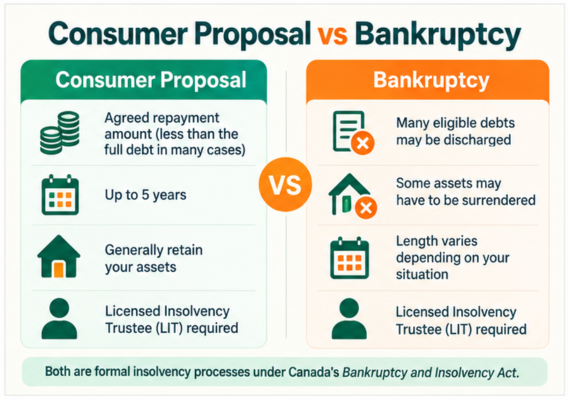
| Assets | Not surrendered through insolvency | Generally retained if proposal terms are met | Some assets may have to be surrendered |
| Length | Depends on loan | Up to 5 years | Depends on circumstances |
| Credit impact | Depends on loan and payment history | Significant | Significant |
| Public insolvency record | No | Yes | Yes |
The key difference is that debt consolidation is borrowing, while consumer proposals and bankruptcy are formal insolvency proceedings under Canada’s Bankruptcy and Insolvency Act.
The Office of the Superintendent of Bankruptcy (OSB) oversees Canada’s insolvency system and provides official information about consumer proposals and bankruptcy.
What Is Debt Consolidation?
Debt consolidation involves combining several debts into one.
One common approach is a debt consolidation loan. You borrow enough to repay some or all of your existing debts and then make payments on the new loan.
For example, instead of separately paying:
- two credit cards
- a personal loan
- a retail credit account
you might use one consolidation loan to pay those balances and then have one scheduled loan payment.
Consolidation may make repayment simpler and could reduce your borrowing costs if the new loan has a lower overall cost than the debts you’re replacing.
However, a lower rate isn’t guaranteed.
Approval and the terms offered can depend on the lender and your financial circumstances, including your income, existing debts and credit profile.
Our Consolidation Loans Canada pillar explains how consolidation loans work and what to compare before borrowing.
Pros of Debt Consolidation
- Combines several debts into one payment
- May reduce borrowing costs if you qualify for better terms
- Doesn’t involve filing for insolvency
- Can provide a structured repayment schedule
- You continue repaying your debts rather than settling them through insolvency
Cons of Debt Consolidation
- Doesn’t normally reduce the principal you owe
- Approval isn’t guaranteed
- A poor rate or long term could make consolidation expensive
- You may get into further debt if you run up cleared credit accounts again
- It doesn’t provide the legal creditor protection available through insolvency proceedings
What Is a Consumer Proposal?
A consumer proposal is a formal, legally binding insolvency process administered by a Licensed Insolvency Trustee (LIT).
The LIT works with you to make an offer to your creditors. You might offer to repay a percentage of what you owe, extend the time available to repay, or use a combination of the two.
A consumer proposal cannot have a term longer than five years.
Once a proposal is filed, you stop making payments directly to the unsecured creditors included in it. Certain collection actions, including wage garnishments and lawsuits by those creditors, are also stopped.
Unlike bankruptcy, you can generally keep your assets provided you continue making required payments to secured creditors and comply with your proposal.
Pros of a Consumer Proposal
- May allow you to repay less than the full amount owed
- Interest on included unsecured debts generally stops
- Provides legal protection from included unsecured creditors
- Can stop certain wage garnishments and legal proceedings
- You generally retain your assets
- Payments can be spread over a maximum of five years
Cons of a Consumer Proposal
- It’s a formal insolvency proceeding
- It has a significant effect on your credit history
- It becomes part of the public insolvency record
- Creditors must accept or be deemed to accept the proposal
- You must follow the proposal’s terms
- An LIT must administer it
For a closer look at the process, read our Consumer Proposal Canada guide.
What Is Bankruptcy in Canada?
Bankruptcy is a legal insolvency process for people who can’t repay their debts.
It must also be administered by a Licensed Insolvency Trustee.
When you file for bankruptcy, certain assets may be used to repay creditors. However, what you can keep depends partly on applicable federal and provincial or territorial rules.
Once you’re discharged, you’re generally released from the legal obligation to repay most debts that existed when you filed.
However, not every debt is discharged. Certain obligations, such as support payments and some court-imposed fines, can survive bankruptcy.
Bankruptcy also doesn’t necessarily mean that you’re finished in nine months.
For example, the OSB says a first bankruptcy may result in an automatic discharge after nine months where there is no surplus-income obligation and other conditions are met. With surplus-income obligations, that period can extend to 21 months. Different rules can apply to subsequent bankruptcies or where a discharge is opposed.
Pros of Bankruptcy
- Can discharge many unsecured debts
- Provides legal protection from most unsecured creditor collection actions
- May provide a way forward where repayment is no longer realistic
- Can sometimes be completed sooner than a consumer proposal
Cons of Bankruptcy
- Some assets may have to be surrendered
- Surplus-income payments may apply
- It significantly affects your credit history
- Bankruptcy becomes part of the public insolvency record
- Some debts aren’t discharged
- Duties and counselling requirements must be completed
Which Option Has the Biggest Effect on Your Credit?
All three can affect your credit, but not in the same way.
A consolidation loan is a new credit account. Applying may result in a hard credit inquiry, and your subsequent payment history can become part of your credit record.
Consumer proposals and bankruptcies are insolvency proceedings and have a much more substantial effect on your credit history.
According to the Financial Consumer Agency of Canada (FCAC), Equifax and TransUnion remove a consumer proposal:
- three years after you’ve paid all the debts included in the proposal; or
- six years after you signed the proposal,
whichever comes first.
A first bankruptcy is generally removed six years after discharge. TransUnion uses seven years after discharge in Newfoundland and Labrador, Ontario, Prince Edward Island and Quebec. Multiple bankruptcies may remain for 14 years.
Your credit report is only one factor to consider, though. Choosing a debt solution solely because it appears less damaging to your credit could leave the underlying debt problem unresolved.
When Might Debt Consolidation Make Sense?
Debt consolidation may be worth exploring when:
- you can still afford to repay your debts in full
- several payments are becoming difficult to manage
- you can qualify for a consolidation loan
- the new loan offers worthwhile terms
- you want to avoid a formal insolvency process
Before consolidating, compare the total cost, not simply the monthly payment.
A longer loan term could lower your monthly payment while keeping you in debt for longer.
If you can afford to repay your debts and want to explore consolidation through a personal loan, you can compare available loan options through FatCat Loans.

When Might a Consumer Proposal Be Considered?
A consumer proposal may be worth discussing with an LIT when repaying everything you owe is no longer realistic but you can afford an agreed repayment plan.
It can be particularly relevant when you need the legal protection of a formal insolvency process but want to avoid bankruptcy.
However, whether a proposal is appropriate — and what you would need to offer creditors — depends on your individual financial situation.
When Might Bankruptcy Be Considered?
Bankruptcy may be considered when debts have become unmanageable and other solutions aren’t workable.
But it shouldn’t be chosen simply because it appears to offer the fastest route out of debt.
Your LIT will consider factors such as:
- your income
- your debts
- your assets
- previous insolvencies
- your household circumstances
- your ability to make payments
Only a Licensed Insolvency Trustee can administer a bankruptcy or consumer proposal in Canada.
What Should You Compare Before Deciding?
Start with the numbers.
Write down your:
- unsecured debts
- secured debts
- interest rates
- minimum payments
- monthly income
- essential living expenses
- assets
Then ask a more important question:
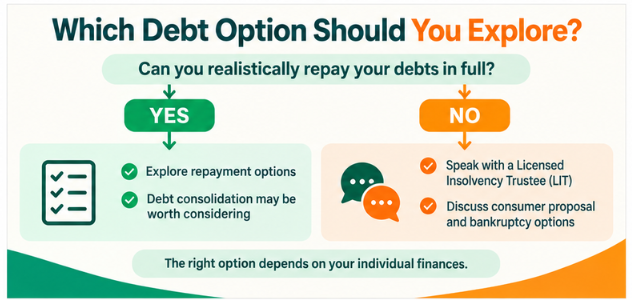
Can I realistically repay my debts in full?
If the answer is yes, consolidation or another repayment strategy may be worth investigating.
If the answer is no, borrowing more money may not solve the underlying problem. That’s when speaking to a Licensed Insolvency Trustee about formal options can be particularly important.
An LIT can assess your financial situation, explain the insolvency options available and discuss how they could affect you.
Are There Alternatives to These Three Options?
Yes. Debt consolidation, consumer proposals and bankruptcy aren’t the only ways to deal with debt.
Depending on your circumstances, you might also investigate credit counselling or a debt management plan (DMP).
A DMP is different from a consumer proposal. It is an informal arrangement typically set up through a credit counsellor and doesn’t provide the same legal protections as an insolvency proceeding.
Our Credit Counselling Canada guide explains how credit counselling works, while our Debt Management Programs in Canada guide takes a closer look at structured debt management plans.
Frequently Asked Questions
Is debt consolidation better than a consumer proposal?
Not necessarily. Debt consolidation may be more appropriate if you can afford to repay your debts and qualify for suitable loan terms. A consumer proposal is a formal insolvency option for people who cannot realistically repay their debts as originally agreed. The appropriate option depends on your circumstances.
Is a consumer proposal better than bankruptcy?
Neither is automatically better. A proposal generally allows you to retain your assets while making agreed payments to creditors. Bankruptcy works differently and may involve surrendering certain assets or making surplus-income payments. An LIT can explain how each would affect your situation.
Can I consolidate debt with bad credit?
Possibly. Lenders set their own approval criteria, and your credit history is only one factor they may consider. However, weaker credit can make it harder to qualify for favourable consolidation terms.
Do I need a Licensed Insolvency Trustee for debt consolidation?
No. A standard debt consolidation loan doesn’t require an LIT. Only Licensed Insolvency Trustees can administer consumer proposals and bankruptcies in Canada.
Does a consumer proposal stop collection calls?
Once a consumer proposal is filed, the stay of proceedings generally prevents included unsecured creditors from continuing collection action, including certain lawsuits and wage garnishments. Exceptions can apply.
Does bankruptcy clear every debt in Canada?
No. A bankruptcy discharge releases you from many debts, but some obligations can survive, including certain support payments, court fines and other debts specified by law.
Bottom Line
Debt consolidation, consumer proposals and bankruptcy solve different problems.
Debt consolidation may help when your debts are still repayable but you want to simplify them or potentially reduce borrowing costs.
A consumer proposal is a formal insolvency option that may allow you to repay part of what you owe while generally retaining your assets.
Bankruptcy may be considered when debt is no longer realistically manageable, but it can have more significant consequences for your assets and finances.
If you’re considering a consolidation loan, compare the cost and make sure the payments fit your budget.
If you’re considering a consumer proposal or bankruptcy, speak with a Licensed Insolvency Trustee so you can understand how each option would affect your specific situation.

The FatCat Loans Editorial Team delivers clear, accurate, and unbiased guidance on loans, credit, and personal finance in Canada. Our writers follow strict editorial standards to ensure every article is trustworthy, well-researched, and easy to understand, helping readers make confident financial decisions.


