
Personal Loans Ontario (2026): FSRA Rules, Rates & Top Lenders
July 30, 2026
How Personal Loans Work in Ontario
Last Updated: July 2026
Whether you’re consolidating debt, covering an unexpected expense, paying for home improvements or financing a major purchase, a personal loan can provide access to funds through fixed repayments over an agreed term.
Ontario has a wide range of banks, credit unions and alternative lenders offering personal loans with different loan amounts, interest rates and repayment terms. Choosing the right lender requires more than simply comparing monthly payments. It is equally important to understand the total borrowing cost, eligibility requirements and your rights as a borrower.
This guide explains how personal loans work in Ontario, how they are regulated, what types of loans are available, who can qualify and what to consider before submitting an application.
Personal Loans Ontario at a Glance
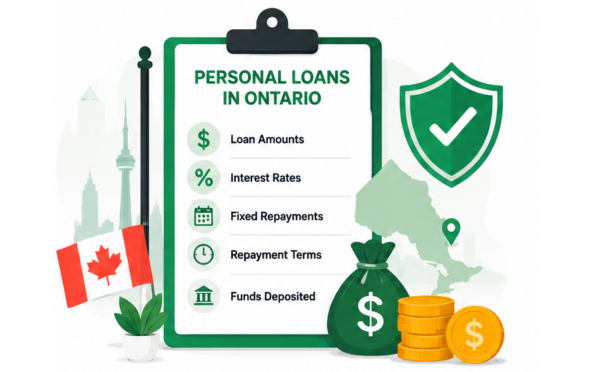
| Feature | Typical Information |
|---|---|
| Loan amounts | Approximately $500 to $50,000 or more, depending on the lender, loan type and applicant’s financial profile. |
| Repayment terms | Commonly range from 6 months to 7 years, although secured loans may offer longer terms. |
| Interest rates | Depend on the lender, credit profile, income, affordability and whether the loan is secured or unsecured. |
| Funding speed | Some lenders provide same-day or next-business-day funding after final approval and verification. |
| Application method | Many lenders allow applicants to complete the entire application online. |
| Security | Personal loans may be secured against an asset or provided without collateral. |
| Common uses | Debt consolidation, home improvements, vehicle repairs, medical expenses, moving costs and major purchases. |
What Are Personal Loans in Ontario?
A personal loan allows you to borrow a fixed amount of money and repay it over an agreed period through regular instalments.
Unlike a mortgage or vehicle finance agreement, a personal loan can generally be used for a wide range of legitimate personal expenses. Once approved, the funds are normally deposited into your bank account, although the exact payment process depends on the lender and loan purpose.
Most personal loans include:
- Fixed monthly or biweekly repayments
- A fixed or variable interest rate
- A predetermined repayment period
- A disclosed cost of borrowing
- A repayment schedule showing when each payment is due
Personal loans are available through banks, credit unions, loan and trust companies and alternative online lenders. The interest rate, amount available and approval requirements vary significantly between providers.
Many lenders allow borrowers to apply entirely online, upload documents digitally and sign the loan agreement electronically. However, an online application does not guarantee immediate approval or same-day funding.
How Are Personal Loans Regulated in Ontario?
Personal lending in Ontario is governed by a combination of federal and provincial laws. The regulator that applies depends on the type of lender and how the business is structured.
What Is FSRA?
The Financial Services Regulatory Authority of Ontario (FSRA) regulates several provincially supervised financial sectors in Ontario.
FSRA’s responsibilities include overseeing:
- Ontario credit unions and caisses populaires
- Provincially regulated loan and trust companies
- Mortgage brokerages, brokers and agents
- Insurance companies and insurance intermediaries
- Pension plans operating within its jurisdiction
FSRA does not regulate every lender offering personal loans in Ontario. Federally regulated banks are supervised under federal legislation, while other lenders may be subject to Ontario consumer protection laws and additional legal requirements.
Ontario Consumer Protection Rules
Ontario borrowers are protected by legislation requiring lenders to provide important information before a credit agreement is accepted.
Depending on the type of agreement, disclosures may include:
- The amount being borrowed
- The annual interest rate
- The annual percentage rate or APR, where applicable
- The total cost of borrowing
- The number and frequency of repayments
- Any administration, optional service or late-payment fees
- The circumstances in which additional charges may apply
- Any security or collateral attached to the loan
Read the full credit agreement before signing and request clarification if any fee, condition or repayment obligation is unclear.
Federal Criminal Interest Rate
Personal lenders must comply with the criminal interest provisions contained in the Criminal Code of Canada.
The federal criminal interest limit applies to the total cost of credit as defined by law. Borrowers should not assume that the advertised interest rate is the only cost involved. Certain fees and charges may also be relevant when determining the effective borrowing cost.
Be cautious of lenders that:
- Do not clearly disclose the cost of borrowing
- Pressure you to sign immediately
- Request a fee before releasing loan funds
- Guarantee approval without reviewing your finances
- Ask you to provide passwords or online banking login details outside a secure verification process
Types of Personal Loans Available in Ontario
Personal loans are not all structured in the same way. The right option depends on the amount you need, your credit profile, your income and whether you are willing to provide an asset as security.
Unsecured Personal Loans
An unsecured personal loan does not require you to pledge an asset as collateral.
Approval is generally based on factors such as:
- Your credit history
- Your credit score
- Your income
- Your employment or income stability
- Your existing debts
- Your monthly expenses
- Your ability to afford the repayments
Because the lender does not have an asset securing the loan, unsecured personal loans may carry higher interest rates than comparable secured loans.
Unsecured loans are commonly used for:
- Debt consolidation
- Home repairs
- Medical or dental expenses
- Vehicle repairs
- Moving costs
- Education expenses
- Major household purchases
Secured Personal Loans
A secured personal loan requires an acceptable asset to be used as security for the debt.
Depending on the lender, eligible security may include:
- Home equity
- Real estate
- Investments
- Other assets accepted by the lender
Providing security may allow an eligible borrower to access:
- A larger loan amount
- A lower interest rate
- A longer repayment period
- A lower monthly repayment
However, secured borrowing carries additional risk. If you fail to repay the loan according to the agreement, the lender may be able to take legal action against the secured asset.
Fixed-Rate Personal Loans
With a fixed-rate personal loan, the interest rate does not change during the agreed loan term.
This normally means:
- Your scheduled repayment stays consistent
- Budgeting is more predictable
- You can calculate the total repayment more easily
- Market interest-rate changes do not alter the agreed rate
Variable-Rate Personal Loans
A variable-rate personal loan has an interest rate that may change during the repayment period.
If the applicable benchmark or lender rate increases, your repayment amount or total borrowing cost may also increase. If rates fall, your borrowing cost may decrease.
Before accepting a variable-rate loan, confirm:
- How the rate is calculated
- How frequently it can change
- Whether your repayment amount will change
- Whether a higher rate would remain affordable
Secured vs. Unsecured Personal Loans in Ontario
| Feature | Secured Personal Loan | Unsecured Personal Loan |
|---|---|---|
| Collateral required | Yes. An eligible asset is used as security. | No collateral is normally required. |
| Interest rate | May be lower because the lender has security. | May be higher because the lender assumes more risk. |
| Loan amount | Larger amounts may be available to eligible borrowers. | The maximum amount may be lower. |
| Repayment term | Longer terms may be available. | Terms are often shorter than secured borrowing. |
| Main risk | The secured asset may be at risk if the loan is not repaid. | Missed payments can lead to fees, collection activity and credit-report damage. |
| Best suited to | Borrowers who need a larger amount and have an acceptable asset to secure the loan. | Borrowers who do not want to pledge an asset and can qualify based on income, credit and affordability. |
Who Can Apply for a Personal Loan in Ontario?
Each lender sets its own approval criteria. Meeting the basic requirements allows you to apply but does not guarantee that your application will be approved.
Typical eligibility requirements include:
- Being at least 18 years old
- Living in Ontario or otherwise meeting the lender’s residency requirements
- Having a regular and verifiable source of income
- Holding an active Canadian bank account
- Providing valid government-issued identification
- Meeting the lender’s credit and affordability requirements
Some lenders may accept income from:
- Full-time employment
- Part-time employment
- Self-employment
- Pension income
- Disability benefits
- Other recurring income accepted by the lender
The lender may request documents such as:
- Recent pay stubs
- Bank statements
- Tax documents
- Proof of address
- Government-issued identification
- Information about existing loans and credit commitments
Can You Get a Personal Loan With Bad Credit in Ontario?
Some Ontario lenders consider applications from borrowers with fair or poor credit. These lenders may place greater emphasis on income, employment stability, recent repayment history and overall affordability.
Bad-credit personal loans often carry higher interest rates because the lender considers the application to present a greater repayment risk.
Before accepting a higher-cost loan, compare:
- The interest rate
- The APR
- The total repayment
- Any administration or optional service fees
- The repayment term
- Whether the monthly instalment fits your budget
You can learn more about the available options in our bad credit loans Canada guide.
What Do Lenders Assess?
Lenders usually assess the full application rather than relying on a credit score alone.
They may consider:
- Your gross and net monthly income
- Your housing costs
- Your current loan and credit-card repayments
- Your payment history
- Your total outstanding debt
- Your employment history
- Your recent credit applications
- Your available income after essential expenses
A higher income does not automatically result in approval. The lender must still determine whether the proposed repayment is affordable alongside your existing financial commitments.
Personal Loan Amounts, Rates and Repayment Terms in Ontario
The amount you can borrow, the interest rate you receive and the time allowed for repayment depend on the lender and your financial circumstances.
Lenders assess each application individually. Two people applying for the same amount may receive different rates and terms.
How Much Can You Borrow?
Personal loans in Ontario commonly start at approximately $500. Some lenders offer unsecured loans of $20,000, $25,000 or more, while secured loans may provide access to significantly larger amounts.
The amount offered may depend on:
- Your regular income
- Your credit history and credit score
- Your existing financial commitments
- Your requested repayment term
- Whether the loan is secured or unsecured
- The value of any asset used as security
- The lender’s minimum and maximum loan limits
Do not borrow the maximum simply because it is available. Borrow only what you need and can afford to repay.
What Interest Rates Apply to Personal Loans in Ontario?
There is no single standard interest rate for personal loans in Ontario. Banks and credit unions generally reserve their lowest rates for applicants with strong credit, stable income and manageable existing debts.
Alternative lenders may accept a broader range of credit profiles, but their rates are often higher to reflect the additional lending risk.
Your personal loan rate may be affected by:
- Your credit score and repayment history
- Your income and employment stability
- Your debt-to-income ratio
- The loan amount
- The length of the repayment term
- Whether the interest rate is fixed or variable
- Whether the loan is secured against an asset
- Whether another person applies with you
Under the federal criminal interest provisions that took effect on 1 January 2025, the general criminal interest limit is 35% APR. The legal calculation considers interest and certain fees or charges included within the statutory definition of interest.
Most lenders charge well below this legal limit.
Borrowers with good credit often receive lower rates. Borrowers with weaker credit may receive higher rates.
Interest Rate vs. APR
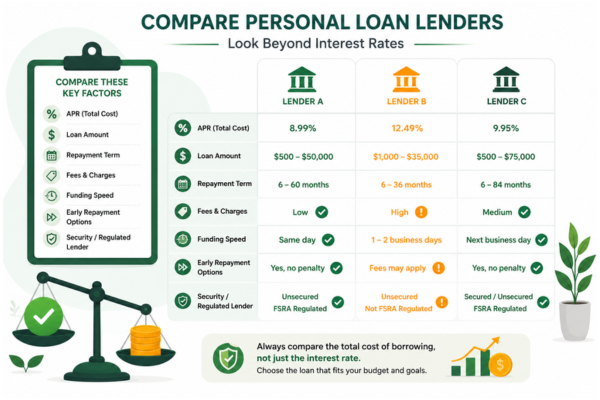
The advertised interest rate does not always show the full cost of the loan. When available, review the annual percentage rate or APR alongside the interest rate.
The APR is designed to provide a broader measure of borrowing cost and may account for applicable charges included in the calculation.
Before accepting a loan, confirm:
- The annual interest rate
- The APR
- The amount of each repayment
- The number of repayments
- The total interest charged
- Any mandatory fees
- The total amount you will repay
Do not compare loans using the monthly payment alone. A lower payment spread over a longer period can result in a higher total repayment.
How Long Can You Take to Repay a Personal Loan?
Personal loan terms commonly range from approximately 6 months to 7 years. Some secured products may offer longer repayment periods.
A shorter term generally means:
- Higher regular repayments
- Less interest paid over the full term
- Faster repayment of the debt
A longer term generally means:
- Lower regular repayments
- More interest paid over time
- A longer financial commitment
Choose the shortest term that gives you an affordable payment.
How the Loan Term Affects the Total Cost
The following simplified example shows why the repayment period matters. It is provided for illustration only and does not represent an actual lender offer.
| Loan | Illustrative Rate | Term | Approximate Monthly Payment | Approximate Total Repaid |
|---|---|---|---|---|
| $10,000 | 15% annually | 24 months | $485 | $11,637 |
| $10,000 | 15% annually | 48 months | $278 | $13,358 |
| $10,000 | 15% annually | 60 months | $238 | $14,274 |
In this example, extending the term reduces the monthly payment but increases the total amount repaid. Actual repayments depend on the lender’s calculation method, payment frequency, fees and final loan agreement.
Top Personal Loan Lenders in Ontario
Ontario residents can apply for personal loans through major banks, credit unions and alternative lenders. There is no single lender that is best for every applicant.
The right provider depends on:
- The amount you need
- Your credit profile
- Whether you own a home
- How quickly you require the funds
- The repayment you can afford
- Whether you prefer an online application or branch support
The information below is based on publicly advertised products and may change over time.
The lenders below are included as examples of well-known providers operating in Canada. FatCat Loans does not rank or endorse any lender as being better than another.
| Lender | Advertised Amounts | Loan Types | Application Options | Key Consideration |
|---|---|---|---|---|
| Fairstone | $500 to $60,000 | Secured and unsecured personal loans | Online and branch applications | Secured loans require qualifying home equity. |
| easyfinancial | Up to $20,000 unsecured and up to $150,000 through qualifying home equity products | Unsecured personal loans and home equity loans | Online and branch applications | Unsecured rates are generally higher than rates available to strong-credit bank borrowers. |
| Banks | Varies by institution and applicant | Primarily unsecured personal loans, with some secured credit options | Online, telephone and branch applications | The most competitive rates normally require stronger credit and income. |
| Credit unions | Varies by credit union | Secured and unsecured options may be available | Online or branch applications, depending on the institution | Membership requirements may apply. |
Fairstone Personal Loans
Fairstone offers secured and unsecured personal loans to Ontario borrowers. Its advertised personal loan amounts range from $500 to $60,000.
Fairstone provides:
- Unsecured personal loans
- Secured personal loans backed by qualifying home equity
- Online loan applications
- In-branch support
- Personalized loan quotations
Fairstone’s unsecured online loans may be suitable for applicants who do not want to pledge an asset. Its secured loans are designed for qualifying homeowners and may provide access to larger amounts or lower rates than an unsecured product.
Fairstone states that applicants can request an initial loan quote without affecting their credit score. A full application and final lending decision may still involve credit verification and additional documentation.
Funding may be available as soon as the same day or within 24 hours after approval, depending on the product, application time, document verification and banking arrangements. This is not guaranteed for every applicant.
Read our complete Fairstone Loans review for a closer look at its products, rates, eligibility requirements and alternatives.
easyfinancial Personal Loans
easyfinancial offers unsecured personal loans and home equity loans to Canadian borrowers, including Ontario residents.
Its unsecured personal loans are advertised in amounts from $500 to $20,000. Qualifying homeowners may be able to access larger amounts through a secured home equity loan.
easyfinancial advertises:
- Unsecured personal loans of up to $20,000
- Home equity loans of up to $150,000
- Unsecured personal loan rates starting at 29.99%
- Lower advertised rates for qualifying home equity loans
- No prepayment penalties on its advertised unsecured personal loans
- Online and branch-based applications
The rate and amount offered depend on the applicant’s credit profile, income, affordability and whether security is provided.
easyfinancial may be considered by borrowers who do not qualify for a conventional bank loan. However, its unsecured borrowing costs can be substantially higher than rates available through banks or credit unions to applicants with strong credit.
Before accepting an easyfinancial loan, compare the interest rate, total repayment and loan term against other available options.
See our detailed easyfinancial review for information about its rates, application requirements, benefits, risks and alternatives.
Banks and Credit Unions
Ontario residents should also consider banks and credit unions before choosing an alternative lender.
A bank or credit union may offer:
- Lower rates for borrowers with good or excellent credit
- Flexible payment frequencies
- Existing-customer discounts or pre-approved offers
- The ability to manage the loan through online banking
- Access to a local branch or financial adviser
However, traditional financial institutions may apply stricter credit, income and debt-service requirements. Approval can also take longer when additional documents or manual assessment are required.
Credit unions may require you to become a member before borrowing. Membership conditions vary between institutions.
How to Choose the Right Personal Loan Lender
There is no universal best personal loan lender in Ontario. A low-rate bank loan may be the strongest option for an applicant with excellent credit, while another borrower may require an alternative lender that considers a broader range of credit histories.
The best offer is generally the one that:
- Provides the amount you genuinely need
- Charges the lowest reasonable total borrowing cost available to you
- Offers a repayment that fits your budget
- Does not require unaffordable optional products
- Allows early repayment on acceptable terms
- Clearly discloses all fees and obligations
Do not choose a lender based only on speed. Cost, affordability and lender legitimacy matter more.
How to Compare Personal Loans in Ontario
Comparing several loan offers can help you identify differences that are not obvious from the advertised monthly payment.
Review the following factors before making a decision.
1. Interest Rate and APR
Start by comparing the interest rate and APR. A small difference in rates can materially affect the total interest paid on a larger or longer-term loan.
2. Total Cost of Borrowing
Check the dollar amount you will repay over the full term. This gives you a clearer picture than the regular payment alone.
3. Loan Term
Longer terms reduce the scheduled payment but normally increase the total interest cost. Choose the shortest term that provides a genuinely affordable repayment.
4. Mandatory and Optional Fees
Ask the lender to identify every charge connected with the loan.
Potential charges may include:
- Administration fees
- Late-payment fees
- Non-sufficient funds fees
- Broker fees
- Discharge or registration costs for secured lending
- Optional loan protection insurance
Loan insurance and protection plans should be clearly identified as optional when they are not required. Confirm how much the product adds to each payment and the total loan cost before agreeing to it.
5. Early Repayment Rules
Check whether you can make additional payments or repay the balance early without a penalty.
Early repayment can reduce interest, but the terms differ between lenders and loan products. Secured lending may involve additional discharge or registration costs even when no traditional prepayment penalty applies.
6. Fixed or Variable Rate
A fixed rate provides predictable payments. A variable rate may change during the term and can make the future borrowing cost less certain.
7. Payment Frequency
Personal loan payments may be collected:
- Weekly
- Biweekly
- Semi-monthly
- Monthly
Confirm the exact payment amount and frequency. A biweekly figure may appear lower than a monthly payment but is collected 26 times per year.
8. Lender Reputation
Check whether the lender provides clear contact information, loan disclosures, privacy terms and a complaints process.
Online reviews can help identify recurring service problems, but they should not replace a review of the lender’s official agreement and regulatory status.
9. Credit Check
Ask whether the initial quotation uses a soft credit check or a hard credit check.
A soft check does not affect your credit score. A full application may require a hard credit enquiry, which can be recorded on your credit report.
Avoid submitting several full applications at once. Multiple hard credit checks within a short period can affect your credit profile and may concern future lenders.
10. Monthly Affordability
Calculate whether the payment fits your budget after accounting for:
- Housing
- Utilities
- Food
- Transportation
- Insurance
- Childcare
- Existing debts
- Emergency savings
A loan is not affordable simply because it is approved. You must be able to repay it without using more credit.
Our personal loan comparison guide explains how to evaluate loan offers and avoid focusing only on the advertised monthly payment.
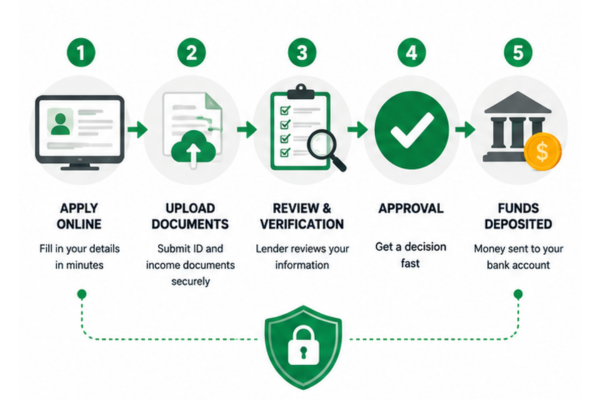
How to Apply for a Personal Loan in Ontario
Most Ontario personal loan applications can be started online. The exact process varies by lender, but applicants generally complete the following steps.
Step 1: Decide How Much You Need
Calculate the actual expense you need to cover. Avoid increasing the requested amount simply because a lender advertises a higher maximum.
Step 2: Review Your Budget
Work out how much you can repay each month after essential expenses and existing credit commitments.
Step 3: Check Your Credit Information
Reviewing your credit report before applying can help you identify errors, missed payments or high balances that may affect the lender’s decision.
You can request your credit report directly from Canada’s major credit bureaus. Checking your own report does not reduce your credit score.
Step 4: Compare Lenders
Compare banks, credit unions and alternative lenders based on total cost, eligibility and repayment flexibility.
Where possible, use quotation tools that state they will not affect your credit score before proceeding to a full application.
Step 5: Gather Your Documents
You may need:
- Government-issued identification
- Proof of Ontario address
- Recent pay stubs or other proof of income
- Bank statements
- Employment information
- Details of existing debts
- Property information for a secured application
Step 6: Complete the Application
Provide accurate and complete information. Incorrect income, employment or debt information can delay the application and may result in the offer being withdrawn.
Step 7: Review the Loan Offer
Before signing, review:
- The amount advanced to you
- The interest rate and APR
- The payment amount and frequency
- The first payment date
- The final payment date
- The total amount repayable
- All fees and optional products
- Early repayment conditions
- Consequences of a missed payment
Step 8: Sign and Receive the Funds
If you accept the offer, the agreement may be signed electronically or in a branch. Funds are generally deposited into your bank account once the lender completes its final checks.
Some lenders advertise same-day or next-business-day funding. Actual timing depends on final approval, document verification, the time of application and your bank’s processing schedule.
How to Improve Your Chances of Approval
No action can guarantee personal loan approval. However, the following steps can strengthen an application:
- Check your credit report for errors before applying.
- Pay outstanding bills on time.
- Reduce high credit-card balances where possible.
- Avoid making several credit applications within a short period.
- Request an amount that is proportionate to your income.
- Provide complete and accurate documents.
- Include all accepted sources of regular income.
- Consider a qualified co-applicant where the lender permits one.
- Consider secured borrowing only when you understand and can accept the risk to the asset.
A co-applicant may improve eligibility or help secure a lower rate, but both applicants become legally responsible for repaying the debt.
What Can a Personal Loan Be Used For?
Personal loans can generally be used for a broad range of personal expenses, subject to the lender’s terms.
Common uses include:
- Consolidating credit-card balances or other debts
- Home repairs and renovations
- Vehicle repairs
- Medical or dental treatment
- Moving and relocation expenses
- Education or professional training costs
- Wedding expenses
- Furniture and household appliances
- Unexpected family expenses
A personal loan should not be used to fund regular living expenses when there is no realistic plan to repay it. Borrowing to cover an ongoing budget deficit can create a cycle in which new credit is needed to make previous loan payments.
Using a Personal Loan for Debt Consolidation
Debt consolidation involves using one loan to repay several existing debts.
This may provide:
- One regular payment instead of several
- A fixed repayment date
- A potentially lower interest rate
- A clearer path to repaying the debt
Consolidation only reduces the cost of debt when the new loan’s interest rate, fees and total repayment are lower than the debts being replaced.
Closing or reducing the use of repaid credit accounts can also be important. Continuing to spend on cleared credit cards may leave you with both the consolidation loan and new revolving debt.
Learn more in our debt consolidation loans guide.
Advantages and Disadvantages of Personal Loans
A personal loan can help you pay for a large expense or combine several debts into one payment. However, it also creates a fixed repayment obligation that may last for several years.
Advantages
- Fixed payments: Many personal loans have set payments, which makes budgeting easier.
- Clear end date: The loan is repaid by a scheduled date when all payments are made on time.
- Lump-sum funding: You receive the approved amount for an eligible expense.
- No collateral for unsecured loans: You do not need to use your home or another asset as security.
- Possible savings: A personal loan may cost less than high-interest credit-card debt.
Disadvantages
- Interest costs: You repay more than the amount borrowed.
- Higher rates for weaker credit: Borrowers with poor credit may receive expensive offers.
- Missed-payment consequences: Late payments can result in fees, collection action and credit damage.
- Risk to collateral: A secured asset may be at risk if the loan is not repaid.
- Long-term commitment: Repayments may continue for several years.
Things to Consider Before Taking a Personal Loan
A personal loan should meet a clear financial need without making it difficult to pay for housing, food, utilities and other essentials.
Before borrowing, ask:
- Do I need the loan now?
- What is the smallest amount I need?
- Can I afford every payment?
- What is the total amount I will repay?
- Could I still pay if my income dropped?
- Is an asset being used as security?
- Are any added products or insurance optional?
Do Not Choose a Loan Based Only on Speed
Fast funding can be useful, but it should not be the main reason for choosing a lender. Compare the APR, fees, repayment term and total cost before signing.
Watch for Advance-Fee Loan Scams
Be cautious if a company guarantees approval or asks you to pay money before releasing the loan.
Warning signs include:
- Guaranteed approval regardless of income or credit
- Payment requests by gift card, cryptocurrency or wire transfer
- Pressure to act immediately
- No clear Canadian address or contact details
- Requests for online banking passwords
- No clear loan agreement or borrowing-cost disclosure
Never send an upfront payment to an unknown company in exchange for a promise that loan funds will be released.
Alternatives to Personal Loans in Ontario
A personal loan is not always the cheapest or most suitable option. Compare the following alternatives before borrowing.
Personal Line of Credit
A personal line of credit provides revolving credit up to an approved limit. You can withdraw funds when needed and interest is normally charged only on the amount used.
This may suit expenses that happen over time. However, variable rates and low minimum payments can make the debt take longer to repay.
Low-Interest Credit Card
A low-interest credit card may suit a smaller expense that can be repaid quickly. Compare the interest rate, annual fee and repayment period with the cost of a personal loan.
Balance Transfer Credit Card
A balance transfer card may offer a temporary low rate on eligible credit-card debt. Check the transfer fee, promotional period and rate that applies when the offer ends.
Home Equity Borrowing
Homeowners may be able to borrow through a home equity loan or home equity release option.
Rates may be lower because the loan is secured against the property. However, appraisal, legal or registration fees may apply, and the home is at risk if repayments are not maintained.
Credit Union Loan
An Ontario credit union may offer personal loans or lines of credit to qualifying members. Compare the rate, fees, membership requirements and total repayment.
Payment Plan
Some medical, dental, education and home-repair providers offer payment plans. A genuine interest-free plan may cost less than a personal loan if the payments are affordable.
Credit Counselling
If existing debts are becoming difficult to manage, another loan may not solve the problem. A reputable credit counsellor can review your budget and explain available options.
Read our guide to free credit counselling in Canada.
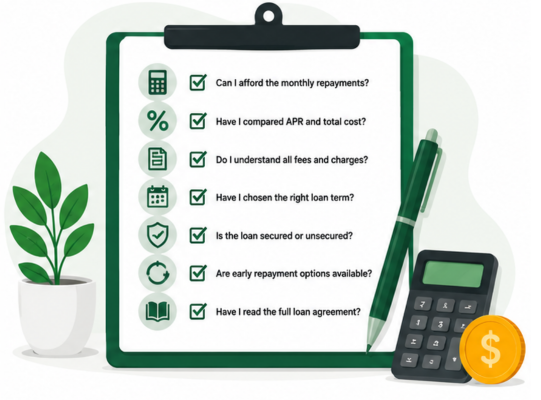
Final Checklist Before Applying for a Personal Loan
Before accepting a personal loan, confirm:
- The interest rate and APR
- The payment amount and frequency
- The total amount you will repay
- The loan term
- All mandatory fees
- Whether the rate is fixed or variable
- Whether early repayment is allowed
- Whether the loan is secured or unsecured
- What happens if you miss a payment
Do not sign until you understand every cost and repayment obligation.
Compare Personal Loans in Ontario Carefully
Ontario borrowers can apply through banks, credit unions and alternative lenders. Rates, amounts, approval rules and repayment terms vary widely.
Decide how much you need, compare the APR and total repayment, and choose a payment that fits your budget. Do not choose a lender based only on approval speed.
Check the lender’s legal name, read the full agreement and avoid companies that guarantee approval or request unexplained upfront payments.
FatCat Loans allows you to submit one online application and explore available options from participating lending partners. FatCat Loans is a comparison service and not a direct lender.

Frequently Asked Questions About Personal Loans in Ontario
What is the best personal loan lender in Ontario?
There is no single best lender. The right option depends on your credit history, income, loan amount and repayment budget. Compare the APR, fees, term and total repayment before applying.
Are personal loans regulated in Ontario?
Yes. The rules and regulator depend on the lender. Banks are regulated federally, while FSRA oversees specific Ontario financial sectors, including Ontario credit unions.
Does FSRA regulate every personal loan lender?
No. FSRA regulates specific financial sectors. Check the legal lender named in the agreement and confirm which consumer-protection rules apply.
What interest rates apply to Ontario personal loans?
Rates depend on your credit, income, debts, loan amount, term and whether the loan is secured. The general federal criminal interest limit is 35% APR, subject to federal definitions and exemptions.
How much can I borrow?
Personal loans may start at about $500. Some unsecured lenders offer $20,000 or more, while secured loans may provide larger amounts. Your final limit depends on affordability and lender rules.
Can I get a personal loan with bad credit?
Some lenders accept applicants with poor credit. Approval is not guaranteed and rates may be higher. Check the full borrowing cost before accepting an offer.
Can I apply online?
Yes. Many banks, credit unions and alternative lenders accept online applications. You may need to provide identification, proof of income and bank information.
How quickly can I receive the funds?
Some lenders offer same-day or next-business-day funding after final approval. Timing depends on document checks, the lender and your bank.
Will applying affect my credit score?
An initial quote may use a soft credit check. A full application may use a hard credit check that appears on your credit report.
Can I repay the loan early?
Many lenders allow early repayment, but fees and conditions vary. Check the loan agreement before signing.
Do I need collateral?
Not for an unsecured loan. A secured loan uses an asset, such as home equity, and that asset may be at risk if you do not repay the loan.
Is a personal loan better than a line of credit?
A personal loan suits a fixed expense and has a clear repayment schedule. A line of credit may suit ongoing expenses but can take longer to repay.
Can I use a personal loan for debt consolidation?
Yes. Consolidation can simplify payments, but it only saves money if the new loan has a lower overall cost than the debts being repaid.
Disclosure: This article is for general information only and is not financial, legal or credit advice. Rates, amounts, terms and eligibility rules vary by lender. FatCat Loans is a comparison service and not a direct lender. Approval is not guaranteed.

The FatCat Loans Editorial Team delivers clear, accurate, and unbiased guidance on loans, credit, and personal finance in Canada. Our writers follow strict editorial standards to ensure every article is trustworthy, well-researched, and easy to understand, helping readers make confident financial decisions.