Debt-to-Income Ratio Canada: What It Is and Why Lenders Look at It
August 17, 2026
Why Your Debt-to-Income Ratio Matters When You Apply for a Loan
Last Updated: August 2026
Your income matters when you apply for a loan in Canada. But lenders don’t just want to know how much money you earn.
They also want to know how much of that income is already committed to debt.
That’s where your debt-to-income ratio comes in.
Your debt-to-income ratio helps show whether you may have room in your budget for another payment. A lower debt load can make you look less risky to a lender, while high debt payments may make it harder to qualify for additional credit.
If you’re considering a personal loan, understanding this ratio before you apply can give you a much clearer picture of how a lender may view your finances.
Important: FatCat Loans is a loan comparison platform, not a lender. We do not make lending decisions or guarantee approval. Each lender uses its own eligibility, credit and affordability criteria.
What Is a Debt-to-Income Ratio?
A debt-to-income ratio compares your debt obligations with your income.
In simple terms, it answers this question:
How much of your income is already going towards debt?
The more of your income that is committed to existing debts, the less room you may have for another loan payment.
This matters because lenders want to know whether taking on another payment is realistic for your budget.
A borrower with a good salary can still have a high debt burden if they already have several loans, credit card balances or other monthly payments.
On the other hand, someone earning less may have a manageable debt load because they have fewer existing obligations.
That’s why income alone doesn’t tell the whole story.
How Is Debt-to-Income Ratio Calculated?
One common way to understand your monthly debt burden is to compare your monthly debt payments with your gross monthly income.
The basic calculation is:
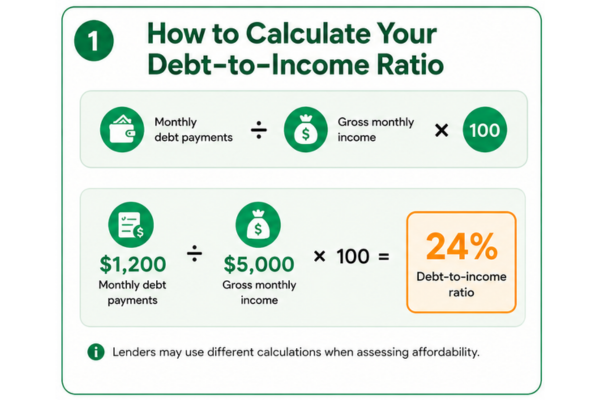
Monthly debt payments ÷ Gross monthly income × 100 = Debt-to-income percentage
Example
Suppose you earn $5,000 per month before tax.
Your regular monthly debt payments are:
- Car loan: $450
- Credit card minimum payments: $200
- Student loan: $250
- Personal loan: $300
Your total monthly debt payments are:
$1,200
Now divide $1,200 by your $5,000 gross monthly income:
$1,200 ÷ $5,000 × 100 = 24%
In this simplified example, 24% of your gross monthly income is going towards those debt payments.
However, lenders may calculate affordability differently depending on the type of credit you’re applying for. Mortgage lenders in Canada, for example, commonly use specific Gross Debt Service (GDS) and Total Debt Service (TDS) calculations.
See What a Loan Could Cost
Before applying, estimate how different loan amounts and repayment terms could fit into your budget.

Debt-to-Income Ratio vs GDS and TDS in Canada
This is where Canadian borrowers need to be careful.
You’ll often see the term “debt-to-income ratio” used online, especially on American websites. In Canada, mortgage qualification commonly focuses on two more specific measures:
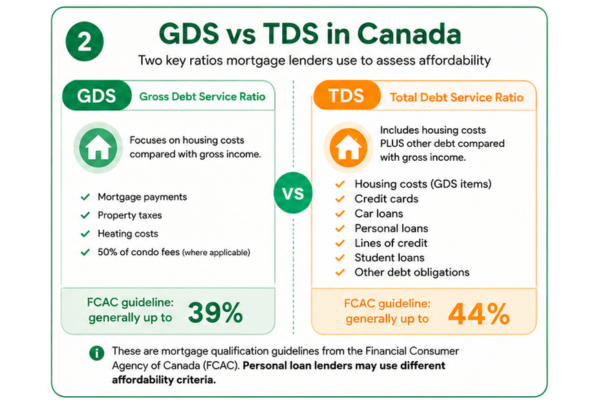
Gross Debt Service Ratio (GDS)
Your GDS ratio looks at how much of your gross household income is needed for housing costs, including eligible mortgage, property tax, heating and condo-related costs.
The Financial Consumer Agency of Canada (FCAC) says total monthly housing costs generally shouldn’t be more than 39% of gross household income when preparing to qualify for a mortgage.
Total Debt Service Ratio (TDS)
TDS goes further by considering housing costs alongside other debt obligations, such as credit cards, car loans, personal loans, lines of credit and student loans.
FCAC says your total debt load generally shouldn’t be more than 44% of gross income when preparing to qualify for a mortgage.
These figures are particularly relevant to mortgages. Personal loan lenders may use their own affordability models and lending criteria.
The key idea, however, is the same: how much of your income is already committed before another loan payment is added?
| GDS | TDS | |
|---|---|---|
| What it measures | Housing costs compared with gross income | Housing costs + other debt compared with gross income |
| Mortgage payments | ✓ | ✓ |
| Property taxes | ✓ | ✓ |
| Heating costs | ✓ | ✓ |
| 50% of condo fees | ✓ | ✓ |
| Credit cards | — | ✓ |
| Car loans | — | ✓ |
| Personal loans | — | ✓ |
| Lines of credit | — | ✓ |
| Student loans | — | ✓ |
| FCAC mortgage guideline | Generally ≤39% | Generally ≤44% |
Important: These are general mortgage qualification guidelines from the Financial Consumer Agency of Canada. Personal loan lenders may use different affordability calculations and lending criteria.
Why Do Lenders Care About Your Debt-to-Income Ratio?
Your income tells a lender how much you earn. Your existing debt helps show how much of that income is already committed.
For example, two borrowers might both earn $6,000 per month. If one has $600 in monthly debt payments and the other has $2,500, their ability to take on another payment may be very different.
Lenders may consider your existing debt when deciding:
- Whether to approve your application
- How much to lend
- What repayment term may be appropriate
- What rates or terms to offer
Your debt level is only one part of the assessment. Your income, credit history, employment, requested loan amount and other factors may also matter.
Affordability checks can also help protect borrowers from taking on repayments that leave too little for housing, food, transportation and other essential expenses.
What Is a Good Debt-to-Income Ratio in Canada?
There isn’t one universal DTI number that guarantees approval for every type of loan in Canada.
That’s important.
Different lenders and credit products use different criteria.
For mortgages, FCAC’s guidance provides the useful benchmarks discussed above: generally 39% for GDS and 44% for TDS.
Personal loan lenders, however, may assess your debt obligations differently.
As a general principle, a lower debt burden gives you more financial breathing room.
Rather than chasing a particular percentage, ask:
After all my current debt payments and essential expenses, can I comfortably afford another payment?
That’s the question that matters most to your financial health.
What Debts Can Affect Your Ratio?
Depending on how a lender performs its assessment, existing obligations may include:
- Mortgage payments
- Personal loans
- Auto loans
- Credit card payments
- Lines of credit
- Student loans
- Other regular credit obligations
Housing costs also play an important role in affordability, even when they aren’t technically a debt payment.
A lender may review your credit report and the information you provide in your application to understand your existing obligations.
Does Your Debt-to-Income Ratio Affect Personal Loan Approval?
It can.
When you apply for a personal loan, lenders generally want to understand how much you earn and how much of that income is already committed to debt.
A higher debt load may make it harder to qualify if another payment could put too much pressure on your budget.
Your debt level isn’t the only factor lenders may consider. Your credit history, income, employment, requested loan amount and other factors can also affect the decision.
If your existing debt is high, you may be offered a smaller amount or different terms, or your application may be declined.
For a broader look at eligibility, rates and how lenders assess applications, read our Personal Loans Canada guide.
Does Debt-to-Income Ratio Affect Your Credit Score?
Your debt-to-income ratio itself is not the same thing as your credit score.
Your credit report contains information about your credit accounts, balances and payment history. Lenders may use this information when deciding whether to lend you money.
High outstanding debt and being close to your credit limits can also negatively affect your credit score.
So, while your DTI and credit score are different measures, some of the financial behaviour behind them can overlap.
You could therefore have:
- A good credit score but a heavy debt burden
- A lower credit score but relatively little current debt
- Strong income but high monthly obligations
- Moderate income with very little existing debt
Lenders look at the bigger picture.
If you’re working on your overall credit profile as well as reducing debt, our guide on how to improve your credit score in Canada explains the practical steps that can help.
Canada’s Household Debt Is Already High
Debt affordability is an important issue for Canadian households.
Statistics Canada reported that household credit market debt reached $3.25 trillion in the first quarter of 2026. Credit market debt was equal to 179.6% of household disposable income, meaning Canadian households had roughly $1.80 in credit market debt for every $1 of disposable income.
The household debt service ratio was 14.75% during the same quarter.
These national figures aren’t the same as the ratio a lender calculates for an individual application. However, they show why managing debt and repayment affordability remains important for Canadian borrowers.
How Can You Lower Your Debt-to-Income Ratio?
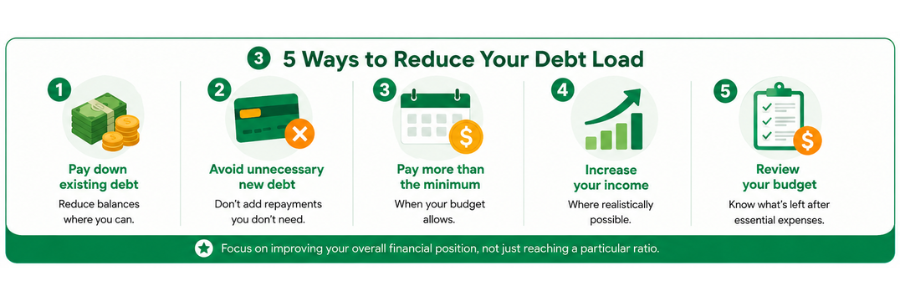
If your debt is putting pressure on your budget, there are several ways to improve your financial position.
Pay Down Existing Debt
Reducing existing balances can lower the amount of income committed to debt. Consider focusing on expensive debt first while continuing to make required payments on your other accounts.
Avoid Unnecessary New Debt
Taking on additional credit can increase your monthly obligations. If possible, avoid unnecessary borrowing while you’re trying to reduce your debt load.
Pay More Than the Minimum When You Can
Paying more than the minimum can help reduce balances faster, provided the extra payments comfortably fit your budget.
Increase Your Income
A sustainable increase in income may improve your overall affordability. This could include additional hours, a raise or reliable additional employment.
Review Your Budget
List your income, housing costs, debt repayments and essential expenses. Then look at what remains.
If another loan payment would leave very little room in your budget, that’s useful information to know before you apply.
Before You Apply for a Personal Loan
Before applying, take a few minutes to review your finances.
Ask yourself:
- How much do I genuinely need to borrow?
- What are my current monthly debt payments?
- How much is left after essential expenses?
- Can I comfortably afford another payment?
- Could I reduce existing debt before borrowing?
- Have I compared the total cost of different loan options?
It can also help to estimate the repayment before applying. Our loan calculator lets you explore different loan amounts and repayment terms to see how a potential payment could fit into your budget.
A lender’s approval doesn’t automatically mean a loan is right for your budget. Consider what you can comfortably afford before taking on another repayment.
Frequently Asked Questions
What is a debt-to-income ratio in Canada?
A debt-to-income ratio compares your debt obligations with your income. It helps show how much of your income is already committed to debt and whether you may have room for additional payments.
What is a good debt-to-income ratio in Canada?
There is no single DTI percentage that guarantees approval for every Canadian loan. For mortgages, FCAC says housing costs generally shouldn’t exceed 39% of gross household income for GDS, while total debt load generally shouldn’t exceed 44% for TDS. Other lenders may use different criteria.
How do I calculate my debt-to-income ratio?
One simple method is to add your monthly debt payments, divide that amount by your gross monthly income and multiply by 100. Individual lenders may use different calculations when assessing an application.
Does a high debt-to-income ratio mean I will be declined?
Not automatically. Lenders may consider income, credit history, existing debts, the amount requested and other factors. However, a heavy debt burden can make it harder to show that another payment is affordable.
Does debt-to-income ratio affect my credit score?
DTI itself is different from your credit score. However, high outstanding balances and being close to credit limits may negatively affect your credit score and can also contribute to a heavier debt burden.
Can paying off debt improve my chances of getting a loan?
It may help. Reducing existing debt can lower your monthly obligations and improve cash flow. Approval still depends on the lender’s full eligibility and credit assessment.
Final Thoughts
Your salary tells a lender how much you earn. Your debt load helps show how much of that income is already spoken for.
That’s why debt-to-income measures matter.
Before taking out another loan, look beyond whether you might qualify. Work out whether the new payment fits comfortably alongside your existing debts and essential expenses.
Ready to Compare Your Options?
If you’ve reviewed your budget and decided borrowing is right for you, FatCat Loans can help you compare loan options that may suit your needs.

Borrowing should solve a financial need without creating a bigger one.

The FatCat Loans Editorial Team delivers clear, accurate, and unbiased guidance on loans, credit, and personal finance in Canada. Our writers follow strict editorial standards to ensure every article is trustworthy, well-researched, and easy to understand, helping readers make confident financial decisions.