Canadian Borrower Rights: What the Law Says About Loan
August 19, 2026
Know Your Rights Before You Borrow
Last Updated: August 2026
Borrowing money is a legal agreement. When you accept a loan, you agree to repay the money according to the terms of the contract.
But lenders have responsibilities too.
Canadian laws provide borrowers with important protections around how loans are advertised, how borrowing costs are disclosed, how certain debts can be collected and how much interest can legally be charged.
The exact rights you have can depend on:
- The type of loan
- The lender you borrow from
- Whether the lender is federally regulated
- The province or territory where you live
- The terms of your loan agreement
This is important because there isn’t one single Canadian law covering every lender and every type of loan.
Banks and other federally regulated financial institutions must follow federal consumer protection requirements. Other lenders may be regulated mainly by provincial or territorial laws. Payday lending is also largely regulated at the provincial level.
Understanding these differences can help you know what to look for before signing a loan agreement — and what to do if something goes wrong.
Important: FatCat Loans is a loan comparison platform, not a lender or law firm. This guide provides general information about borrower protections in Canada and is not legal advice. Laws and individual circumstances vary. If you need advice about a specific legal issue, consider speaking with the appropriate regulator, consumer protection authority or qualified legal professional.
Quick Guide to Borrower Rights in Canada
| Your Right or Protection | What It Means |
|---|---|
| Clear loan information | Certain lenders must disclose important borrowing costs and terms |
| Interest-rate protection | Canada’s Criminal Code sets a criminal rate of interest |
| Consent | Federally regulated institutions generally need your express consent for financial products and optional services |
| Fair debt collection | Rules restrict certain collection practices |
| Complaint process | Regulated financial institutions and consumer authorities provide complaint routes |
| Credit information | You have rights relating to your credit report and correcting errors |
| Payday loan protections | Provincial rules may limit costs and regulate payday lenders |
| Provincial consumer protection | Additional rights vary depending on where you live |
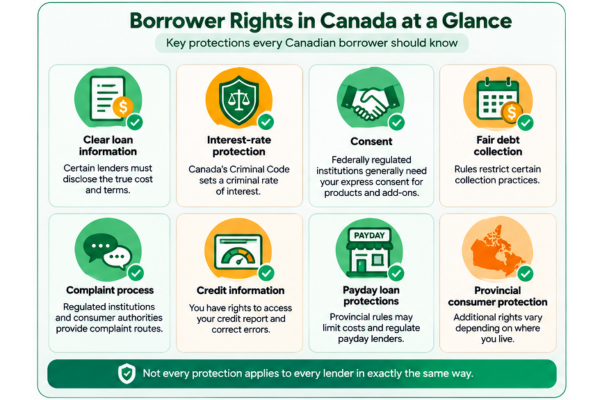
The most important thing to remember is that not every protection applies to every lender in exactly the same way.
Let’s look at how the system works.
Who Regulates Loans in Canada?
Canadian lending is regulated at both the federal and provincial or territorial level.
That can sound complicated, but there is a fairly simple reason.
Different types of financial institutions fall under different jurisdictions.
Federally regulated financial institutions include organizations such as banks and federal credit unions. The Financial Consumer Agency of Canada (FCAC) supervises federally regulated financial entities for compliance with federal consumer protection measures.
Other lenders may fall mainly under provincial or territorial regulation.
These can include certain:
- Credit unions
- Finance companies
- Alternative lenders
- Payday lenders
- Loan brokers
- Collection agencies
The exact rules depend on the lender, product and jurisdiction.
Federal vs Provincial Lending Laws
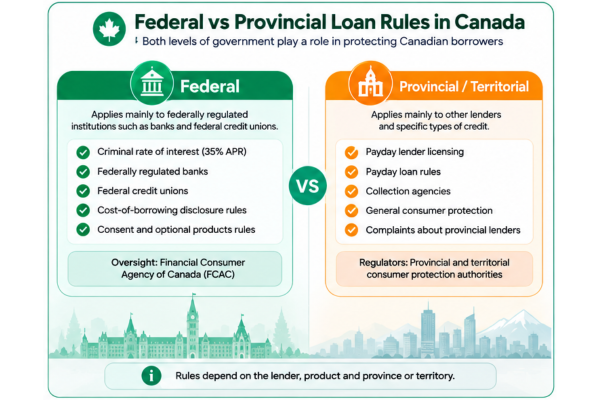
Here’s a simple way to understand the difference.
| Area | Federal Role | Provincial/Territorial Role |
|---|---|---|
| Criminal rate of interest | ✓ | |
| Federally regulated banks | ✓ | |
| Federal credit unions | ✓ | |
| Cost-of-borrowing rules for federally regulated institutions | ✓ | |
| Payday lender licensing | Usually ✓ | |
| Payday lending rules | Some federal law applies | ✓ |
| Collection agencies | Usually ✓ | |
| General consumer protection | Some federal protections | ✓ |
| Complaints | Depends on institution | Depends on jurisdiction |
The Office of Consumer Affairs maintains a directory of federal, provincial and territorial consumer affairs offices, which can help you identify the appropriate authority where you live.
This distinction matters throughout this guide.
A protection that applies when you borrow from a bank may not operate in exactly the same way when you borrow from a provincially regulated lender.
Your Right to Understand the Cost of a Loan
Before borrowing, you should be able to understand what the loan will cost.
This means looking beyond the amount deposited into your bank account.
The cost of a loan can include:
- Interest
- Administration or service charges
- Applicable fees
- Optional products
- Other borrowing costs
For personal loans from federally regulated financial institutions, disclosure requirements can include the loan amount, payment amount and frequency, term, annual interest rate, annual percentage rate (APR) and other applicable charges.
That information matters because two loans for the same amount can have very different total costs.
Interest Rate vs APR
These terms can be confusing.
The interest rate tells you the rate of interest charged on the loan.
The annual percentage rate (APR) is designed to provide a broader measure of the annual cost of borrowing and may include borrowing costs beyond the stated interest rate, depending on the applicable calculation.
That makes APR useful when comparing certain loan offers.
Don’t assume that the loan with the smallest monthly payment is automatically cheapest.
A longer repayment period can reduce each payment while increasing the amount you pay over the full term.
Before accepting an offer, compare:
- Amount borrowed
- APR
- Interest rate
- Fees
- Payment amount
- Number of payments
- Loan term
- Total cost of borrowing
Our loan calculator can also help you explore how different loan amounts and repayment terms may affect your payments before you borrow.
Canada’s 35% Criminal Interest Rate
Canada has a federal criminal interest-rate limit.
Section 347 of the Criminal Code currently defines the criminal rate as an annual percentage rate of interest that exceeds 35% on the credit advanced.
The 35% limit came into effect on January 1, 2025, replacing the previous criminal rate framework.
However, this is an area where the details matter.
There are specific rules, definitions and exemptions that can affect how the criminal rate applies to different credit arrangements. Payday loans in provinces with designated payday-loan regimes are also treated differently under the federal framework.
So you should not assume that every loan displaying a cost equivalent to more than 35% is automatically illegal without considering the type of credit and applicable law.
We’ve covered this subject separately in our guide to Canada’s 35% loan interest cap, including how the cap works and what borrowers should know.
What Must a Lender Tell You Before You Sign?
If you’re borrowing from a federally regulated financial institution, you have important disclosure rights.
For a personal loan, required information can include:
- Principal amount
- Payment amount
- Payment dates and frequency
- Loan term
- Whether the loan is open or closed, where applicable
- Annual interest rate
- How interest is calculated
- APR
- Applicable additional charges
- Information about optional services you accept
There are additional disclosure requirements depending on whether the loan has a fixed or variable rate.
The goal is simple: you should have important cost information before making a borrowing decision.
Before You Sign, Check These 8 Things
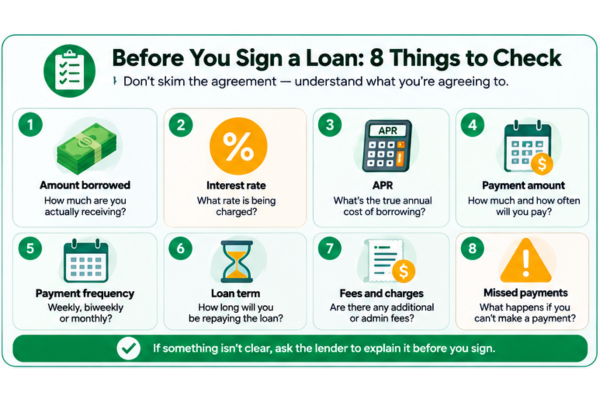
Don’t skim straight to the signature box.
Check:
- How much you’re borrowing
- The interest rate
- The APR
- Your payment amount
- How often you must pay
- The loan term
- Additional fees and charges
- What happens if you miss a payment
If something isn’t clear, ask the lender to explain it before you agree.
Never rely only on an advertisement or sales representative’s summary. The loan agreement contains the terms you’re agreeing to.
Your loan information should be clear and easy to understand. Federally regulated financial institutions must provide required information in a way that is clear, simple and not misleading. If important costs or terms are confusing, ask for clarification before agreeing to the loan.
You Have the Right to Give Consent
A lender shouldn’t simply add financial products you didn’t agree to.
Federally regulated financial institutions must obtain express consent before providing certain financial products and services, including loans and lines of credit.
This also applies to optional products or services added for a fee, such as some forms of loan insurance.
Importantly, agreeing to the loan doesn’t automatically mean you’ve agreed to every optional product attached to it. Banks must obtain separate consent for optional products and provide the required information.
If consent is given verbally, written confirmation must generally be provided without delay.
Before accepting optional insurance or another add-on, ask:
- Is this optional?
- What does it cost?
- What does it cover?
- Are there exclusions?
- Do I already have similar coverage?
- Can I cancel it?
A small monthly charge can become significant over a long loan term.
Can You Pay a Loan Off Early?
It depends on the loan and its terms.
Some loans allow you to repay part or all of the balance early. Others may have conditions or charges associated with early repayment.
For loans subject to federal cost-of-borrowing disclosure requirements, lenders may be required to disclose whether you have the right to repay the amount before maturity and, where relevant, how a prepayment charge is calculated.
Before signing a loan agreement, check:
- Whether additional payments are allowed
- Whether you can repay the full balance early
- Whether a prepayment charge applies
- How any charge is calculated
Don’t assume every personal loan works the same way.
If paying off a loan early is important to you, check this before accepting the agreement.
What Happens If You Miss a Loan Payment?
Missing a payment doesn’t make the debt disappear.
Depending on the agreement and circumstances, it may lead to:
- Late or returned-payment charges
- Additional interest
- Collection activity
- Information being reported to a credit bureau
- Damage to your credit history
- Default under the loan agreement
- Legal action in some circumstances
If you think you’re going to miss a payment, contact your lender as early as possible.
Waiting until several payments have been missed can reduce your options.
Explain the situation and ask whether the lender offers:
- A temporary payment arrangement
- A different payment date
- Another hardship option
- A revised repayment arrangement
The lender doesn’t necessarily have to agree to the arrangement you request, but contacting them early is usually better than ignoring the debt.
Your Rights When a Debt Goes to Collections
Debt collectors have rules too.
When a federally regulated financial institution collects a debt, it must provide information about the debt, such as the amount and type of debt, as well as information about anyone collecting it on the institution’s behalf.
The protections that apply depend partly on who owns or is collecting the debt.
For debts being collected by a federally regulated financial institution or someone acting on its behalf, federal rules restrict certain collection behaviour.
For example, federally regulated institutions generally cannot use threatening, abusive or intimidating language, apply undue pressure or threaten to make your failure to pay public.
There are also restrictions around contacting family, friends, employers and neighbours.
If a federally regulated institution sells the debt to a collection agency, provincial or territorial collection laws generally apply instead.
Can a Collector Contact Your Family?
There are restrictions.
Under federal rules applying to federally regulated financial institutions, they generally cannot contact family, friends, relatives or others about your debt simply to discuss what you owe.
There are exceptions, including situations where someone guaranteed or co-signed the loan or where you’ve given consent.
They may also contact someone for limited purposes such as obtaining your telephone number or address.
Provincial collection-agency rules may differ.
Can a Collector Contact Your Employer?
Federal rules also restrict this.
A federally regulated financial institution generally cannot contact your employer except for limited purposes such as confirming your employment, job title or business address.
There are also restrictions on contacting you at work unless certain conditions apply.
Again, if you’re dealing with a separate collection agency, check the rules in your province or territory.
Can a Lender Take Money From Your Bank Account?
This depends on the situation and the agreements involved.
Loan payments are often made through pre-authorized debits. If you’ve authorized a lender to collect payments from your account, payments may be withdrawn according to that authorization.
Some financial institutions also include a right of offset in their account or loan agreements. This may allow them to use money in another account you hold with the same institution, or in some cases an affiliated institution, to repay a debt you owe. Depending on the agreement, this may happen without advance notice or new permission from you.
That is different from a lender simply having unrestricted permission to take whatever it wants from your account.
If money has been withdrawn unexpectedly:
- Review your loan agreement
- Check any pre-authorized debit agreement
- Contact the lender or bank
- Ask for an explanation of the withdrawal
- Use the appropriate complaint process if you believe the withdrawal was improper
This is an area where the exact contract and applicable law matter.
Payday Loan Rights in Canada
Payday loans have their own rules.
Payday lenders operate under provincial or territorial requirements, and the rules are not identical across Canada.
FCAC states that payday lenders must follow the rules of the province or territory where they operate and must be licensed where licensing is required.
In provinces with payday-loan regulations, FCAC currently lists a maximum borrowing cost of $14 for every $100 borrowed. These provinces include Alberta, British Columbia, Manitoba, New Brunswick, Newfoundland and Labrador, Nova Scotia, Ontario, Prince Edward Island and Saskatchewan.
In other jurisdictions, different rules may apply, including the federal criminal interest-rate framework.
This is why borrowers should check the rules for their own province or territory, rather than relying on a general article that treats all of Canada as one payday-loan market.
Payday Loans Can Still Be Expensive
A legal loan isn’t necessarily an affordable loan.
FCAC illustrates that borrowing $300 for 14 days at $14 per $100 costs $42 — an annualized rate of approximately 365%.
That doesn’t mean the lender is necessarily charging an unlawful criminal rate. Payday lending operates under specific federal and provincial rules.
It does show why borrowers should consider the dollar cost and repayment date, not just whether the loan is legally available.
Do You Have a Cooling-Off Period?
This is another area where blanket advice can be dangerous.
There is no single cooling-off rule that lets every Canadian borrower cancel every type of loan within the same number of days.
Cancellation rights may depend on:
- Province or territory
- Type of credit
- Type of lender
- How the agreement was entered into
- Whether required information was provided
Some provincial payday-loan regimes provide cancellation rights, but the details differ.
Before assuming you can cancel a loan after signing, check your agreement and the rules in your jurisdiction.
Your Credit Report Rights Matter Too
Borrowing and credit reporting are closely connected.
Lenders may use information from your credit report when deciding whether to approve an application.
Your credit history can include information about:
- Credit cards
- Loans
- Lines of credit
- Payment history
- Balances
- Missed payments
- Accounts sent to collections
It’s a good idea to check your credit reports regularly and dispute information you believe is incorrect.
You can access your credit report online for free from Equifax and TransUnion. If you find information you believe is wrong, you have the right to dispute it, and verified errors must be corrected at no charge.
If improving your credit profile is a priority, our guide on how to improve your credit score in Canada explains practical steps you can take.
What Lenders Shouldn’t Do
The exact restrictions depend on the lender and applicable law, but certain behaviour should make you stop and investigate.
Be cautious if a lender:
Hides important fees or borrowing costs
Adds optional products without proper consent
Misrepresents the cost or terms of the loan
Uses threatening or abusive collection tactics
Encourages you to provide false information on an application
Borrowers should be given enough information to understand what they’re agreeing to. If a lender won’t clearly explain the cost or terms of a loan, don’t rush into a decision.
How to Spot a Predatory or Illegal Lender
High-cost credit and illegal lending aren’t automatically the same thing.
A loan can be expensive while still complying with applicable law.
The better question is whether the lender is transparent, properly regulated where required and following the rules that apply to the product.
Warning Signs to Watch For
Guaranteed Approval
Legitimate lenders still need to decide whether they are willing to lend to you.
Claims such as “100% guaranteed approval” should be treated cautiously.
Upfront Payment Requests
Be especially careful if you’re unexpectedly told to send money before the lender will release your loan.
Fraudsters may describe the payment as:
- Insurance
- Security
- Processing
- Tax
- Release fee
- Deposit
Verify who you’re dealing with before sending money or sensitive personal information.
Pressure to Act Immediately
Borrowing decisions shouldn’t require panic.
If someone tells you an offer will disappear within minutes unless you transfer money immediately, slow down and verify the lender.
No Clear Agreement
Don’t borrow without understanding:
- Who the lender is
- How much you’re receiving
- How much you’ll repay
- When payments are due
- What interest and fees apply
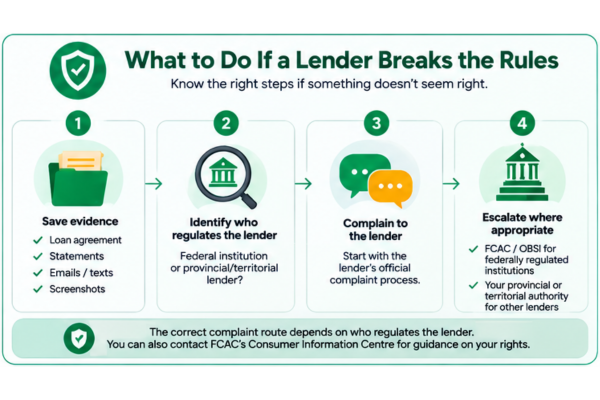
What to Do If You Think a Lender Has Broken the Rules
Start by gathering evidence.
Keep copies of:
- Your loan agreement
- Disclosure documents
- Emails
- Text messages
- Account statements
- Payment records
- Screenshots
- Letters
- Notes from telephone conversations
Then identify who regulates the lender.
That determines where your complaint should go.
Complaints About a Bank or Federally Regulated Institution
Start by making a complaint directly to the financial institution.
Federally regulated institutions must have complaint-handling processes.
FCAC oversees compliance with federal consumer protection obligations, including complaint-handling requirements, but FCAC does not resolve individual complaints for consumers.
Although FCAC does not decide individual disputes, its Consumer Information Centre can explain your rights and help you understand how a federally regulated institution’s complaint process works.
Depending on the complaint and institution, you may be able to escalate the matter to the Ombudsman for Banking Services and Investments (OBSI) for a free and impartial review.
That’s an important distinction:
FCAC supervises compliance. It isn’t your personal dispute-resolution service.
Complaints About Provincially Regulated Lenders
If the lender isn’t federally regulated, your provincial or territorial consumer protection authority may be the appropriate place to start.
The federal Office of Consumer Affairs provides a directory covering consumer authorities across Canada.
Depending on where you live, the relevant organization may be:
| Province/Territory | Consumer Authority |
|---|---|
| Alberta | Service Alberta and Red Tape Reduction – Consumer Services |
| British Columbia | Consumer Protection BC |
| Manitoba | Consumer Protection Office |
| New Brunswick | Financial and Consumer Services Commission |
| Newfoundland and Labrador | Digital Government and Service NL |
| Northwest Territories | Consumer Affairs |
| Nova Scotia | Service Nova Scotia |
| Nunavut | Consumer Affairs |
| Ontario | Consumer Protection Ontario |
| Prince Edward Island | Consumer Services |
| Quebec | Office de la protection du consommateur |
| Saskatchewan | Financial and Consumer Affairs Authority |
| Yukon | Consumer Services |
These organizations and names can change, so use the current federal directory or your provincial government website when you need to make a complaint.
Borrower Rights Don’t Remove Your Responsibilities
Consumer protection laws are important, but they don’t remove your obligations under a valid loan agreement.
As a borrower, you should:
- Provide accurate information when applying
- Read the agreement before accepting it
- Make payments when they’re due
- Keep your contact information current
- Contact the lender if you’re having difficulty paying
- Keep records of payments and correspondence
- Check statements for unexpected charges
- Avoid borrowing more than you can reasonably repay
Being protected by consumer law doesn’t mean you can simply stop paying a valid debt.
Likewise, owing money doesn’t mean a lender or collector can ignore the law.
Both things can be true at the same time.
Before You Borrow: Your Rights Checklist
Before accepting a loan, work through this checklist.
Know Who You’re Borrowing From
☐ I know the legal name of the lender.
☐ I’ve checked that the lender is properly licensed or regulated where required.
Understand the Cost
☐ I know how much I’m borrowing.
☐ I understand the interest rate and APR where applicable.
☐ I’ve checked all applicable fees.
☐ I know the total repayment amount or how to calculate it.
Understand the Repayments
☐ I know how much each payment is.
☐ I know when payments are due.
☐ I know how long I’ll be repaying the loan.
☐ I’ve checked what happens if I miss a payment.
Check the Fine Print
☐ I know whether optional products have been added.
☐ I’ve checked the early repayment terms.
☐ I understand how payments will be collected.
☐ I’ve asked about anything I don’t understand.
Check Your Budget
☐ The payment fits comfortably alongside my essential expenses.
☐ I’ve considered cheaper alternatives.
☐ I’m not borrowing more simply because a larger amount was offered.
☐ I’ve compared more than one option where possible.
If you don’t understand the agreement, don’t rush to sign it.
Comparing Loans Without Giving Up Your Rights
Consumer protection laws create minimum standards, but that doesn’t mean every compliant loan is equally suitable.
You still need to compare offers.
Look at:
- Total borrowing cost
- APR
- Interest rate
- Fees
- Loan term
- Payment amount
- Early repayment conditions
- Lender reputation
- Whether the payment fits your budget
If you’re new to personal borrowing, our Personal Loans Canada guide explains how these loans work and what lenders may consider when reviewing an application.
You can also use our loan calculator to explore different loan amounts and repayment periods before deciding what may fit your budget.
Frequently Asked Questions
What rights do borrowers have in Canada?
Canadian borrowers have protections relating to areas such as cost disclosure, interest rates, consent, debt collection and complaints. The exact rights depend on the lender, loan type and whether federal, provincial or territorial law applies.
What is the maximum legal interest rate on a loan in Canada?
Section 347 of Canada’s Criminal Code defines the criminal rate as an annual percentage rate of interest exceeding 35% on the credit advanced. Specific exemptions and special rules apply to some forms of credit, including certain payday loans.
Does a lender have to tell me all the fees before I borrow?
Federally regulated financial institutions have cost-of-borrowing disclosure obligations for personal loans, including requirements relating to interest, APR and applicable charges. Other lenders may be governed by provincial or territorial disclosure requirements.
Can a lender contact my employer if I don’t pay?
For debts being collected by federally regulated financial institutions or parties acting on their behalf, there are restrictions on contacting employers. Limited contact may be permitted for purposes such as confirming employment information, and other exceptions can apply. Provincial collection rules apply in other situations.
Can I cancel a loan after signing it?
Not necessarily. Canada doesn’t have one universal cooling-off period covering every loan. Cancellation rights depend on factors including the type of loan, lender and province or territory. Check your agreement and applicable local rules.
Where do I complain about a lender in Canada?
For a federally regulated institution, start with the institution’s complaint process. FCAC oversees federal consumer protection compliance but doesn’t resolve individual complaints. For provincially regulated lenders, contact the relevant provincial or territorial consumer protection authority.
Final Thoughts
Knowing your borrower rights can help you make better decisions before, during and after taking out a loan.
Canadian borrowers benefit from a combination of federal and provincial or territorial protections. These can affect the interest a lender may charge, what information must be disclosed, how certain debts can be collected and where you can complain when something goes wrong.
But your first line of defence is still understanding the agreement before you accept it.
Check the cost. Read the terms. Ask questions. Confirm who you’re dealing with. And never assume that being approved means a loan is affordable for your budget.
If you’ve reviewed your finances and decided borrowing is appropriate, you can compare your loan options through FatCat Loans to explore options that may suit your needs and budget.

Borrowing comes with responsibilities — but borrowers have rights too.

The FatCat Loans Editorial Team delivers clear, accurate, and unbiased guidance on loans, credit, and personal finance in Canada. Our writers follow strict editorial standards to ensure every article is trustworthy, well-researched, and easy to understand, helping readers make confident financial decisions.