Canada’s 35% Loan Interest Cap: What Borrowers Need to Know
July 03, 2026
Canada’s 35% Loan Interest Cap
Last updated: July 2026
Introduction
Canada’s lending landscape changed significantly on January 1, 2025, when new federal regulations lowered the maximum criminal interest rate for most consumer loans.
The federal government lowered the criminal interest rate from the equivalent of about 48% APR to 35% APR. In simple terms, most lenders in Canada can no longer legally charge borrowers more than 35% annual percentage rate on covered loans.
For Canadians considering a personal loan or other forms of credit, these changes could have a significant impact on borrowing costs and loan availability.
If you have ever compared personal loans, installment loans, payday loans, or alternative lending options, you know how confusing borrowing costs can be. A loan may look affordable because the monthly payment seems manageable, but the real cost can be much higher once interest, fees, and charges are included.
That is exactly why this new cap matters.
The 35% interest cap is intended to protect Canadians from excessive borrowing costs and reduce the risk of debt cycles caused by high-cost credit. It is especially important for borrowers with lower credit scores, limited credit history, irregular income, or urgent cash needs.
In this guide, Fat Cat Loans explains what Canada’s 35% loan interest cap means, which loans are affected, what borrowers should watch for, and how to compare loan offers more safely.
The information in this article is current as of the publication date but should not be considered legal, financial, or tax advice. Lending laws and regulations may change over time, and borrowers should consult a qualified professional regarding their individual circumstances.
What Is Canada’s 35% Loan Interest Cap?
Canada’s 35% loan interest cap refers to the new maximum criminal interest rate under the Criminal Code of Canada.
Before January 1, 2025, the criminal interest rate was 60% effective annual rate, which worked out to approximately 47–48% APR. Under the updated rules, the maximum rate is now 35% APR for most covered credit agreements.
The change was introduced by the federal government as part of a broader effort to fight predatory lending and make credit safer for consumers.
Official Government of Canada information explains that the purpose of the reform is to lower the criminal interest rate to 35% APR and cap the cost of borrowing on payday loans at $14 per $100 borrowed.

What Does “APR” Mean?
APR stands for annual percentage rate.
It is one of the most important numbers to understand before borrowing money.
APR is designed to show the annual cost of borrowing, including interest and certain fees. This matters because the advertised interest rate does not always tell the full story.
For example, one lender may advertise a lower interest rate but charge higher fees. Another lender may advertise a slightly higher interest rate but charge fewer fees. Looking only at the interest rate could lead you to choose the more expensive loan.
APR helps borrowers compare loans more fairly.
Here is a simple example:
| Loan | Amount Borrowed | Interest Rate | Fees | APR |
|---|---|---|---|---|
| Loan A | $5,000 | 24% | Low | 25% |
| Loan B | $5,000 | 20% | High | 32% |
Loan B has a lower interest rate, but once fees are included, it may cost more overall.
That is why borrowers should always ask: “What is the APR?”
Canadian lenders are required to provide borrowers with clear information about the cost of borrowing, including interest rates, fees, and repayment terms. To better understand your rights as a borrower, review the Financial Consumer Agency of Canada’s guide to cost of borrowing disclosures and consumer protections.
Why Did Canada Lower the Criminal Interest Rate?
The main goal is consumer protection.
High-cost credit can create serious problems for borrowers who are already under financial pressure. When someone needs money quickly for rent, car repairs, medical costs, groceries, or an emergency bill, they may feel they have no choice but to accept expensive credit.
The problem is that high-cost borrowing can snowball.
A borrower may take out a loan to solve one problem, then struggle with payments, then borrow again to cover the first loan. Over time, the borrower can become trapped in a cycle of debt.
Canada’s updated rules are intended to:
- Reduce excessive borrowing costs
- Discourage predatory lending
- Improve transparency
- Protect financially vulnerable consumers
- Encourage fairer lending practices
- Make loan costs easier to compare
This does not mean every loan will become cheap. It also does not mean every borrower will automatically qualify. Lenders still assess income, credit history, debt levels, employment, and repayment ability.
But the cap does create a clearer legal limit for many forms of credit.
Which Loans Are Affected by the 35% Cap?
The 35% APR cap generally applies to many consumer credit products in Canada, including:
- Personal loans
- Installment loans
- Certain lines of credit
- Some alternative lending products
- Some vehicle or retail financing agreements
- Other consumer credit agreements covered by the Criminal Code rules
The exact application can depend on the type of loan, the lender, the borrower, and the structure of the credit agreement.
For everyday borrowers, the key takeaway is this:
If you are applying for a personal loan or installment loan in Canada, the lender should clearly disclose the cost of borrowing, and the APR should generally not exceed the legal maximum unless a specific exemption applies.
Are Payday Loans Included?
Payday loans are treated differently from regular personal loans.
Under the federal regulations, payday loans in applicable jurisdictions are subject to a maximum cost of borrowing of $14 per $100 borrowed.
That means if you borrow $300 through a payday loan, the maximum cost would generally be $42.
However, payday lending is also regulated at the provincial level. Rules may vary depending on where you live.
Borrowers should be careful with payday loans because they are short-term products and can still be expensive even with a lower cost cap. A payday loan may solve an immediate cash shortage, but it can create pressure on your next paycheque.
Before choosing a payday loan, consider whether a lower-cost option is available, such as:
- A personal installment loan
- A payment plan with a bill provider
- A small loan from a credit union
- Employer salary advance programs
- Community support programs
- Credit counselling assistance
Are Any Loans Exempt?
Yes. Some credit arrangements may be exempt from the 35% cap or subject to different rules.
According to the Canada Gazette, certain commercial loans and pawn loans may qualify for exemptions.
Examples include:
- Some commercial loans between $10,000 and $500,000, which may have a different threshold
- Commercial loans above $500,000, which may be exempt
- Certain pawn loans under specific conditions
These exemptions are more relevant to business borrowers and specialized lending arrangements than to the average consumer applying for a personal loan.
If you are unsure whether a loan is covered, ask the lender for a written explanation and consider getting legal advice.
How the 35% Cap Helps Borrowers
The new regulations offer several potential benefits for Canadian borrowers, although the impact may vary depending on individual circumstances and the lender involved.
1. Lower Maximum Borrowing Costs
The most obvious benefit is that covered lenders cannot legally charge extremely high APRs above the new threshold.
For borrowers who may have previously faced rates near the old criminal interest limit, this could mean lower total repayment costs.
2. Better Protection Against Predatory Lending
Predatory lending often targets people who are in urgent need of money. Warning signs may include pressure tactics, confusing fees, unclear repayment terms, or promises that sound too good to be true.
A lower interest cap makes it harder for lenders to rely on extremely expensive credit as a business model.
3. More Transparent Comparisons
When APR is properly disclosed, borrowers can compare loan offers more clearly.
Instead of asking only, “Can I afford the monthly payment?” borrowers can ask:
- What is the total cost of borrowing?
- What is the APR?
- Are there fees?
- How long will repayment take?
- What happens if I miss a payment?
- Can I repay early without penalty?
4. Reduced Risk of Debt Spirals
Lower borrowing costs may help some borrowers pay down debt faster. This can reduce the chance of needing another loan just to keep up with payments.
That said, the cap is not a cure-all. Borrowing still needs to be handled carefully.
Could the Cap Make Loans Harder to Get?
Possibly.
This is one of the most important points for borrowers to understand.
When lenders cannot charge above a certain APR, some may become more selective about who they approve. This is because lenders price loans based partly on risk. Borrowers with lower credit scores or unstable income may be viewed as higher risk.
As a result, some lenders may:
- Require stronger income verification
- Reduce approval amounts
- Decline riskier applications
- Tighten underwriting standards
- Offer shorter repayment terms
- Require more documentation
This does not mean borrowers with bad credit have no options. It does mean borrowers should be prepared, compare lenders carefully, and avoid any company that promises guaranteed approval without reviewing their financial situation.
At FatCat Loans, we believe informed borrowers make better financial decisions. If you’re exploring your borrowing options, learn more about our personal loan solutions and financial education resources.

What Borrowers Should Check Before Accepting a Loan
Before accepting any loan offer, review the details carefully.
Here is a practical checklist.
Check the APR
Ask for the APR in writing. This gives you a clearer view of the annual cost of borrowing.
Check the Total Repayment Amount
Do not stop at the monthly payment. Ask how much you will repay in total by the end of the loan.
Review All Fees
Look for:
- Origination fees
- Administration fees
- Broker fees
- Late payment fees
- NSF fees
- Insurance charges
- Optional add-ons
Understand the Payment Schedule
Confirm:
- Payment amount
- Payment frequency
- First payment date
- Final payment date
- Whether payments are fixed or variable
Ask About Early Repayment
Some borrowers want to pay off a loan early. Ask whether early repayment is allowed and whether there are any penalties.
Read the Full Agreement
Do not rely only on advertising claims or verbal explanations. Read the agreement before signing.
Avoid Pressure
A reputable lender should give you time to review your options.
Compare Personal Loan Options in Canada
Understanding your options is an important part of responsible borrowing. If you’re considering a personal loan, our comparison service can help you review available loan options, borrowing costs, and repayment terms from participating lenders.

Fat Cat Loans is an independent loan comparison service and is not a lender.
How to Spot Predatory Lending
Even with stronger regulations, borrowers should stay alert.
Be cautious if a lender:
- Pressures you to sign immediately
- Refuses to explain the APR
- Avoids giving written terms
- Charges upfront fees before funding
- Guarantees approval without checking your situation
- Encourages you to borrow more than you need
- Tells you not to worry about repayment
- Uses confusing or aggressive language
- Has poor online transparency
- Does not provide clear contact information
A trustworthy lender should be transparent, professional, and willing to answer questions.
Example: Why APR Matters
Imagine you need to borrow $2,000 for an urgent car repair. You receive two loan offers:
| Loan Details | Offer 1 | Offer 2 |
|---|---|---|
| Loan Amount | $2,000 | $2,000 |
| Monthly Payment | $198 | $146 |
| Loan Term | 12 Months | 18 Months |
| APR | 29.9% | 24.9% |
| Total Repayment | $2,376 | $2,628 |
At first glance, Offer 2 may seem like the better choice because it has both a lower monthly payment and a lower APR.
However, because the repayment term is six months longer, you end up paying $252 more overall compared to Offer 1.
This example highlights why borrowers should never focus solely on the monthly payment when comparing loans. Instead, consider:
- The APR
- The total repayment cost
- The loan term
- Whether the monthly payment fits comfortably within your budget
A lower monthly payment can improve short-term cash flow, but it does not always mean the loan is the most affordable option in the long run. Before accepting any loan offer, take the time to compare the full cost of borrowing—not just the monthly payment.
What If You Already Have a High-Interest Loan?
If you already have a loan with a high interest rate, do not ignore it.
Start by reviewing your loan agreement. Look for:
- APR
- Interest rate
- Fees
- Payment schedule
- Remaining balance
- Prepayment rules
- Late payment terms
Then consider your options.
You may be able to:
- Contact your lender to discuss repayment support
- Refinance into a lower-cost loan
- Consolidate multiple debts
- Speak with a non-profit credit counsellor
- Create a debt repayment plan
- Prioritize high-interest balances first
If you’re looking to improve your borrowing options in the future, learn how to build a stronger credit profile and improve your credit score in Canada.
Improving your credit score may help you qualify for better loan terms in the future.
How Credit Score Affects Loan Options
Your credit score can influence the loans available to you.
Borrowers with stronger credit may qualify for:
- Lower APRs
- Higher loan amounts
- Longer repayment terms
- More lender options
Borrowers with weaker credit may face:
- Higher APRs
- Smaller loan amounts
- More documentation requirements
- Shorter repayment terms
- Fewer lender choices
The 35% cap helps limit the maximum rate on covered loans, but it does not remove credit risk from the lender’s decision.
That is why improving your credit profile can be valuable.
Helpful habits include:
- Paying bills on time
- Keeping credit card balances low
- Avoiding unnecessary applications
- Checking your credit report for errors
- Paying down existing debt
- Building a steady payment history
Alternatives to High-Cost Borrowing
Before taking a loan, consider whether another solution may work.
Depending on your situation, alternatives may include:
Payment Arrangements
If you owe money to a utility provider, landlord, insurer, or service provider, ask whether they offer payment plans.
Credit Counselling
Non-profit credit counselling agencies can help borrowers review budgets, debts, and repayment options.
Debt Consolidation
If you have multiple high-interest debts, consolidating them into one lower-cost payment may help.
If you’re managing multiple existing debts, our guide to debt consolidation loans in Canada explains how combining debts into a single payment may simplify repayment.
Emergency Savings
Even a small emergency fund can reduce the need for short-term borrowing.
Family or Community Support
This is not available to everyone, but in some cases, support from trusted family or community programs may be less costly than borrowing.
Lower-Cost Credit Products
Credit unions, banks, and responsible alternative lenders may offer lower-cost options than payday loans or high-fee products.
Responsible Borrowing Tips
The new cap is helpful, but responsible borrowing still matters.
Before borrowing, ask yourself:
- Do I truly need this loan?
- Can I afford the payments?
- What happens if my income drops?
- Is there a cheaper option?
- Am I borrowing for a need or a want?
- Will this loan improve or worsen my financial position?
A loan can be useful when it solves a short-term problem and fits your budget. But borrowing can become harmful if it is used to cover ongoing expenses without a repayment plan.
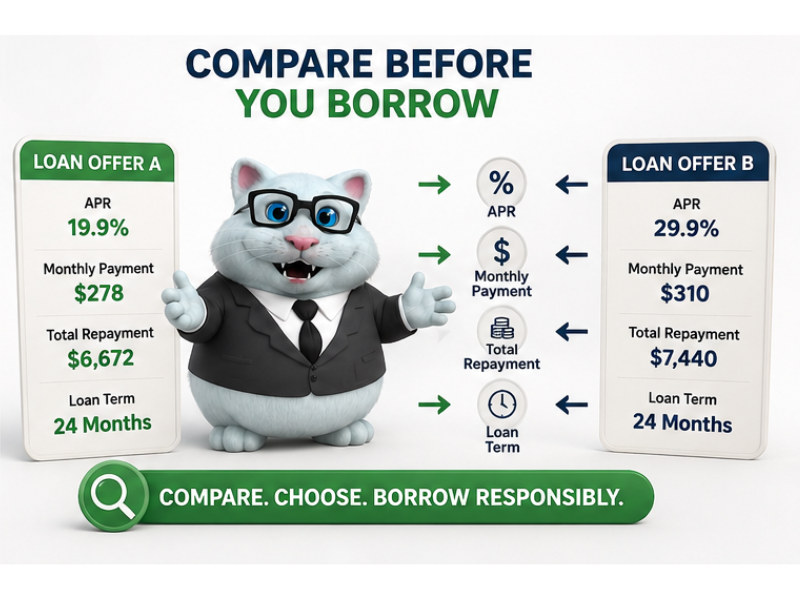
A good rule of thumb: borrow the smallest amount needed and choose the shortest term you can comfortably afford.
How FatCat Loans Supports Borrowers
FatCat Loans aims to help Canadians understand borrowing options clearly.
Our role is to make loan information easier to access and understand, especially for people who may not feel confident navigating traditional lending.
We encourage borrowers to:
- Compare loan offers
- Read all terms carefully
- Understand APR
- Avoid borrowing more than necessary
- Make payments on time
- Use credit as part of a broader financial plan
Looking for more financial guidance? Explore our personal loan solutions for Canadians, browse our financial education and money management resources, and learn how to improve your credit score to qualify for better borrowing opportunities in the future.
What This Means for the Future of Lending in Canada
Canada’s 35% interest cap is one of the most significant consumer lending changes in years.
The long-term effects are still developing. Borrowers may benefit from lower maximum costs and clearer protections. At the same time, some lenders may adjust their approval criteria or product offerings.
For consumers, the best approach is to stay informed.
The most important things to remember are:
- The cap applies to APR, not just the stated interest rate
- Fees can affect the true cost of borrowing
- Payday loans have separate cost rules
- Some commercial and specialized loans may be exempt
- Approval is still based on financial circumstances
- Borrowers should compare total repayment costs, not just monthly payments
Frequently Asked Questions
What is Canada’s new criminal interest rate?
As of January 1, 2025, Canada’s criminal interest rate is generally 35% APR for covered loans.
Does the 35% cap apply to personal loans?
In many cases, yes. Personal loans and installment loans are generally among the credit products affected, unless a specific exemption applies.
Does the cap mean all loans will be 35%?
No. The cap is a maximum, not a standard rate. Many borrowers may qualify for loans below 35% APR.
Is APR the same as interest rate?
No. APR includes interest and certain fees, making it a broader measure of borrowing cost.
Are payday loans capped at 35% APR?
Payday loans are treated differently. The federal regulations cap payday loan borrowing costs at $14 per $100 borrowed in applicable circumstances.
Can lenders still charge fees?
Yes, but certain fees may be included when calculating APR or cost of borrowing. Borrowers should review all fees before accepting a loan.
Will this make bad credit loans disappear?
Not necessarily. But some lenders may tighten approval standards because they can no longer price certain loans above the cap.
What should I do if I think a lender charged too much?
Review your agreement, ask the lender for clarification in writing, and consider contacting your provincial consumer protection office, a legal clinic, or a qualified financial professional.
Where can I learn more?
You can review official government information from the Government of Canada, Canada Gazette, and the Justice Laws Website. You can also visit the Fat Cat Loans blog for borrower education resources.
Final Thoughts
Canada’s 35% loan interest cap is designed to make borrowing safer and reduce the risk of predatory lending.
For borrowers, the new rules offer stronger protection, but they do not replace careful decision-making. A loan is still a financial commitment. Before signing, make sure you understand the APR, total repayment amount, fees, payment schedule, and consequences of missed payments.
The best loan is not always the one with the lowest monthly payment. It is the one that fits your budget, has transparent terms, and helps you move forward without creating unnecessary financial stress.
If you are considering a loan, take your time, compare options, and borrow only what you can afford to repay.
Sources and Further Reading
To help ensure readers have access to accurate and up-to-date information, the information in this article was sourced from the following government and regulatory resources:
- Government of Canada – Criminal Interest Rate Regulations
- Canada Gazette – Criminal Interest Rate Regulations (Official Publication)
- Justice Laws Website – Criminal Interest Rate Regulations (Full Legislative Text)
- Financial Consumer Agency of Canada – Borrowing Costs and Consumer Protection Resources
Related Resources from Fat Cat Loans

The FatCat Loans Editorial Team delivers clear, accurate, and unbiased guidance on loans, credit, and personal finance in Canada. Our writers follow strict editorial standards to ensure every article is trustworthy, well-researched, and easy to understand, helping readers make confident financial decisions.