Online Loans in Alberta: Rules & Top Lenders (2026)
November 19, 2026
Online Loans in Alberta: What Borrowers Should Know
Last Updated: November 2026
Online loans in Alberta let residents apply for personal loans, instalment loans and other financing options without visiting a branch. However, comparing lenders involves more than finding the fastest approval.
Alberta has specific consumer protection rules covering high-cost credit, payday loans and lender licensing. Understanding these rules can help you avoid excessive fees and choose a loan you can afford.
This guide compares online lenders in Alberta for 2026, explains the province’s 32% high-cost credit threshold and Canada’s 35% criminal interest-rate limit, and covers your rights as a borrower.
Ready to explore your options? Compare loans available in Alberta through FatCat Loans.
Online Loans in Alberta at a Glance
| Feature | What Alberta Borrowers Should Know |
|---|---|
| Loan types | Personal, instalment, consolidation, lines of credit and payday loans |
| Applications | Online through lenders or comparison services |
| Loan amounts | Depend on the lender, product and eligibility |
| Interest rates | Vary by credit profile, lender and loan type |
| Federal interest limit | Generally 35% APR, subject to exemptions |
| Alberta high-cost credit threshold | 32% or more under the provincial rules |
| Payday loan maximum | $1,500 for up to 62 days |
| Payday loan fee cap | $14 per $100 borrowed |
| Credit checks | Soft or hard inquiries, depending on the provider and application stage |
| Funding | May be same-day or take several business days |
| Provincial oversight | Service Alberta and Red Tape Reduction for applicable lending businesses |
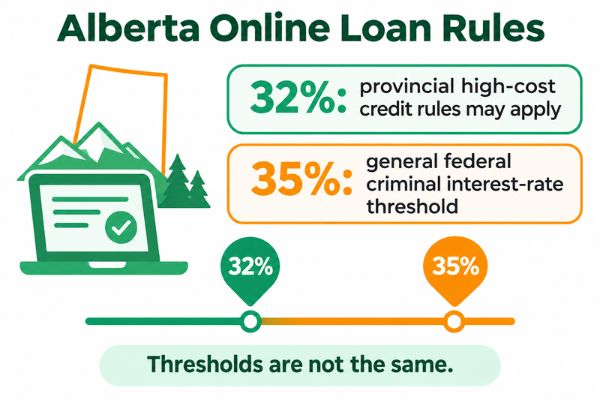
The 32% threshold identifies products subject to Alberta’s high-cost credit rules. It does not mean lenders can automatically charge any rate below the federal criminal interest limit.
How Do Online Loans Work in Alberta?
Applying for an online loan in Alberta usually involves choosing a loan amount, completing a digital application and providing proof of identity, income and banking details. The lender then reviews your eligibility and may perform a credit check. If approved, you’ll receive an offer showing the interest rate, fees and repayment schedule. Always review the total cost before accepting. Funding may take anywhere from the same day to several business days, depending on the lender and your bank.
Top Online Loan Providers to Compare in Alberta (2026)
There is no single best online lender for every Alberta borrower.
Someone with strong credit may find suitable financing through a bank or credit union. A borrower with weaker credit may need to consider an alternative lender.
The following are established Canadian providers or matching services worth comparing. Their inclusion is not a guarantee of approval, current Alberta availability or a particular rate.
| Provider | Type | Main Consideration |
|---|---|---|
| easyfinancial | Direct personal loan lender | Online and branch-based borrowing options |
| Fairstone | Direct personal loan lender | Secured and unsecured loan products |
| Spring Financial | Online financial services provider | Online personal loan options |
| Magical Credit | Alternative lender | Options for some borrowers with weaker credit |
| FatCat Loans | Loan matching service | Compare options from participating lenders |
| Banks and credit unions | Direct lenders | Worth checking for potentially lower-cost borrowing |
Provider availability, rates and eligibility can change. Confirm that the specific product is offered to Alberta residents and that any required licence is current.
How to choose: The right loan depends on your credit profile, income and repayment budget. Rather than applying to multiple lenders individually, you can start by exploring Alberta loan options through FatCat Loans. Our loan-matching service helps you explore options from participating lenders, so you can review available offers and compare borrowing costs before deciding whether to proceed. Approval and loan terms depend on the lender and your eligibility.
1. easyfinancial
easyfinancial offers personal loans through online applications and physical branches. It may be worth considering for Alberta borrowers who want an alternative to traditional bank financing. Interest rates and loan terms depend on individual eligibility, so compare the full repayment cost before applying.
Read our easyfinancial review for more information about its rates, eligibility and potential drawbacks.
2. Fairstone
Fairstone offers secured and unsecured personal loans, with online application options. It may suit borrowers looking for flexible loan amounts or repayment terms. However, secured borrowing can put pledged assets at risk if repayments are missed.
Our Fairstone review explains its loan products, borrowing costs and important considerations.
3. Spring Financial
Spring Financial provides online financial products, including personal loan options. Its digital application process may appeal to borrowers who prefer not to visit a branch. Check the exact product offered, as personal loans and credit-building products work differently.
See our Spring Financial review for a closer look at eligibility, costs and potential disadvantages.
4. Magical Credit
Magical Credit is an alternative lender that may consider applicants with weaker credit histories. Borrowers should still expect income and affordability checks, and loan costs may be higher than those offered by traditional financial institutions.
Read our Magical Credit review to explore its lending requirements and potential drawbacks.
5. FatCat Loans
FatCat Loans is a loan-matching service, not a direct lender. Alberta residents can use it to explore potential borrowing options from participating providers. Approval, rates and funding times depend on the lender and individual eligibility.
Explore our Canadian lender network or compare online loans in Alberta.
6. Banks and Credit Unions
Banks and credit unions are worth comparing, particularly if you have stable income and established credit. They may offer lower borrowing costs than some alternative lenders, although eligibility requirements can be stricter.
Always compare the APR, fees and total repayment amount before choosing a loan.
Alberta Consumer Protection Rules for Online Loans
Alberta’s consumer protection framework is one of the most important considerations when borrowing online.
Different rules apply to ordinary personal loans, high-cost credit products and payday loans.
Alberta’s Consumer Protection Act
Alberta’s Consumer Protection Act establishes rules intended to protect consumers from unfair business practices.
Related regulations cover certain lending agreements, business licensing, disclosures and prohibited conduct.
These rules can apply to online lending businesses as well as physical locations.
However, not every financial institution is regulated in the same way. Federally regulated banks, provincial credit unions and non-bank lenders can fall under different oversight systems.
This makes it important to identify the actual lender named in your agreement.
Alberta’s 32% High-Cost Credit Threshold
Under Alberta’s High-Cost Credit Regulation, certain credit products become high-cost credit when their applicable annual rate reaches 32% or more.
For fixed credit products, the threshold uses an annual rate that includes interest and mandatory costs.
For open credit products, such as certain lines of credit, the threshold uses the annual interest rate.
Products potentially covered include:
- Instalment loans.
- Vehicle title loans.
- Certain car loans.
- Lines of credit.
- Rent-to-own agreements.
- Other qualifying credit arrangements.
Businesses offering, arranging or entering into high-cost credit agreements must meet applicable provincial licensing and conduct requirements.
Online high-cost credit businesses must display their licences prominently at or near the top of their homepage.
Important: The 32% figure is a regulatory threshold, not a blanket maximum interest rate.
Canada’s 35% Criminal Interest-Rate Limit
Canada introduced a lower criminal interest-rate threshold effective January 1, 2025.
Under section 347 of the Criminal Code, the general criminal interest threshold is an annual percentage rate exceeding 35%, calculated under the statutory rules.
This applies broadly to consumer credit, subject to specific exemptions.
For Alberta borrowers, the distinction is:
| Rule | What It Means |
|---|---|
| Alberta 32% threshold | Triggers high-cost credit requirements for qualifying products |
| Federal 35% threshold | General criminal interest-rate limit, subject to exemptions |
| Alberta payday loan rules | Separate fee and consumer protection framework |
A loan may therefore be subject to Alberta’s high-cost credit regulation even when its APR does not exceed the federal criminal interest threshold.
Do not assume a lender is compliant simply because its advertised rate is below 35%. Mandatory fees, the credit product and the applicable legal calculation all matter.
What Must High-Cost Lenders Disclose?
Alberta’s high-cost credit rules require businesses to provide key loan information in a standard format.
They also address disclosure of optional related products and information borrowers receive during the loan term.
Before signing, make sure you understand:
- The total amount borrowed.
- The applicable interest rate and APR.
- Mandatory charges and fees.
- Repayment dates and amounts.
- The total repayment obligation.
- Optional insurance or related products.
- The consequences of missed payments.
If the agreement is unclear, ask for a written explanation before accepting it.
Prohibited Practices Under Alberta’s High-Cost Credit Rules
The provincial rules restrict certain conduct by high-cost credit businesses.
For example, these businesses cannot use misleading representations or engage in prohibited collection practices.
Alberta’s published guidance also identifies restrictions on harassment, certain third-party contacts and collection calls before 7 a.m. or after 10 p.m.
Borrowers who believe a lender has breached these rules can contact Alberta’s Consumer Contact Centre.
Lending rules vary by province. For an example of how borrowing options differ elsewhere in Canada, see our Personal Loans Ontario guide.
Payday Loans in Alberta: Different Rules Apply
Payday loans are not the same as ordinary personal or instalment loans.
In Alberta, payday loans are generally limited to $1,500, with repayment terms of 42 to 62 days. These loans follow separate provincial rules covering fees, licensing, repayment and cancellation rights.
Maximum Payday Loan Fees
Effective January 1, 2025, Alberta’s maximum payday loan fee is $14 per $100 borrowed.
For example:
| Amount Borrowed | Maximum Fee | Total Repayment |
|---|---|---|
| $300 | $42 | $342 |
| $500 | $70 | $570 |
| $1,000 | $140 | $1,140 |
These figures assume repayment on time. Additional permitted charges may apply if the borrower defaults.
A $500 payday loan can therefore cost $70 in fees over a short borrowing period.
That is a significant cost for temporary access to money.

Payday Loan Cancellation and Rollover Rules
Alberta borrowers generally have two business days to cancel a payday loan agreement, subject to the applicable cancellation requirements. Borrowers must return the principal within the required period.
Borrowers can also repay a payday loan early, in full or in part, without an early repayment penalty.
Alberta also restricts payday loan rollovers, which involve replacing an existing payday loan with another loan. If you’re struggling to repay, contact the lender before the due date to discuss available repayment arrangements.
Are Payday Loans Worth Considering?
Payday loans can be expensive relative to the amount borrowed and the short repayment period.
Before taking one, consider whether you can:
- Arrange a payment plan with a bill provider.
- Use a lower-cost bank or credit union product.
- Access an employer salary advance.
- Reduce or delay a non-essential expense.
- Seek help from a non-profit credit counsellor.
A payday loan should not be used as a long-term solution to ongoing financial difficulties.
How Much Do Online Loans Cost in Alberta?
The cost of an online loan depends on the amount borrowed, interest rate, repayment term and fees.
Two lenders may offer the same loan amount but very different total repayment costs.
Example: A $5,000 Online Loan
Consider a hypothetical $5,000 loan repaid over 24 months.
| Loan Detail | 12% Rate | 30% Rate |
|---|---|---|
| Loan amount | $5,000 | $5,000 |
| Term | 24 months | 24 months |
| Monthly payment | About $235 | About $280 |
| Total repayment | About $5,649 | About $6,710 |
| Total interest | About $649 | About $1,710 |
Illustrative example based on a $5,000 loan over 24 months, with equal monthly payments, a fixed annual interest rate calculated monthly and no additional fees. Figures are rounded. Actual lender offers may differ.
The higher-rate loan costs approximately $1,061 more in interest over two years.
That difference matters, especially when the borrower is already managing other monthly expenses.

Why a Lower Monthly Payment Is Not Always Better
A lender may offer a longer repayment term to reduce the monthly payment.
However, a longer term can increase the total interest paid.
Before choosing a loan, compare both the monthly payment and the total amount repayable.
For more detail, explore our guide to personal loans in Canada.
Can You Get Online Loans in Alberta With Bad Credit?
Some alternative lenders consider Alberta borrowers with poor or limited credit histories. Instead of relying only on your credit score, they may also review your income, existing debts and banking activity.
However, bad credit loans often come with higher borrowing costs, and approval is never guaranteed. Before applying, compare the APR, repayment term and total amount repayable.
You can explore bad credit loan options in Canada to understand the types of financing available.
How to Check Whether an Alberta Online Lender Is Licensed
Checking a lender’s credentials is one of the most useful steps you can take before applying.
Step 1: Identify the Legal Business Name
The name on a website may differ from the company’s registered legal name.
Look for the legal entity in the website footer, terms and conditions or loan agreement.
Step 2: Search Alberta’s Licensing Registry
Use Alberta’s official Find Out if a Business Is Licensed service.
Search using the lender’s legal business name.
Payday lenders and businesses covered by Alberta’s high-cost credit licensing requirements must hold the appropriate provincial licence.
Not every type of financial institution appears in this registry. If a business is absent, check whether it is regulated under a different framework before drawing conclusions.
Step 3: Check the Licence Details
Where a licence is required, confirm:
- The legal business name.
- The licence category.
- Whether the licence is active.
- Whether the details match the business offering the loan.
Alberta also requires online high-cost credit businesses to display their licences prominently at or near the top of their homepage. If you cannot find the required licence information, verify the business before applying.
A licence is not a government endorsement or a guarantee that the loan is suitable.
Step 4: Verify the Website and Contact Information
Check whether the business provides a genuine address, customer service details and clear loan disclosures.
Avoid websites that use misleading branding or pressure you to provide banking information immediately.
Step 5: Report Suspicious Activity
If you suspect an unlicensed lender or prohibited lending practices, contact Alberta’s Consumer Contact Centre.
Alberta Consumer Contact Centre
- Edmonton: 780-427-4088
- Toll-free in Alberta: 1-877-427-4088
You can also consult Alberta’s consumer alerts for warnings about problematic businesses and lending practices.
Online Loan Scams in Alberta: Warning Signs
Fraudulent loan websites may imitate legitimate lenders or attempt to collect personal and banking information. Before applying, watch for these warning signs:
- Guaranteed approval: Claims that everyone qualifies without proper checks.
- Upfront payment demands: Requests for gift cards, cryptocurrency or fees to release loan funds.
- Missing business details: No verifiable company name, address or licensing information.
- Pressure tactics: Demands to act immediately or share sensitive information.
Some legitimate lenders use secure bank-verification services, but you should always confirm the provider’s identity before sharing financial information.
Check Alberta’s official consumer alerts for warnings about suspicious businesses and lending practices.
How to Compare Online Loans Safely
Before accepting an online loan in Alberta, use this five-point checklist:
- Verify the lender: Confirm its legal business name and any required provincial licence.
- Compare borrowing costs: Check the APR, fees and total repayment amount, not just the monthly payment.
- Review affordability: Make sure repayments fit your budget without relying on further borrowing.
- Check the terms: Understand credit checks, privacy policies, repayment dates and early repayment conditions.
- Watch for scams: Avoid guaranteed-approval claims and demands for upfront payments to release funds.
Comparing several offers can help you identify a suitable loan without taking on unnecessary costs.
Frequently Asked Questions About Online Loans in Alberta
Are online loans legal in Alberta?
Yes. Online lending is legal in Alberta when businesses comply with applicable federal and provincial requirements. Certain lenders must hold provincial licences, including payday lenders and businesses offering high-cost credit.
What is the maximum interest rate for online loans in Alberta?
Canada’s general criminal interest-rate threshold is an APR exceeding 35%, subject to legal exemptions. Alberta also has high-cost credit rules that apply to qualifying products at annual rates of 32% or more. These are different legal thresholds.
Can I get an online loan in Alberta with bad credit?
Some alternative lenders consider borrowers with weaker credit histories. However, they may charge higher rates, and approval depends on income, affordability and other lending criteria.
How much can payday lenders charge in Alberta?
As of 2026, the maximum payday loan fee is $14 per $100 borrowed. For example, a $500 payday loan may carry a maximum borrowing fee of $70, excluding any additional permitted default charges.
How do I check if an online lender is licensed in Alberta?
You can search Alberta’s official business licensing registry using the lender’s legal name. If the business does not appear, check whether it falls under a different regulatory system or contact Alberta’s Consumer Contact Centre.
Can I get same-day online loan funding in Alberta?
Some lenders may provide same-day funding after approval. However, identity checks, income verification, application timing and bank processing can cause delays. Same-day funding is not guaranteed.
Final Verdict: Are Online Loans in Alberta Worth Considering?
Online loans can be a convenient option for Alberta residents, but the best choice depends on affordability, lender legitimacy and total borrowing costs.
Before applying, compare several offers, check the lender’s credentials and understand your repayment obligations. Alberta’s consumer protection rules provide important safeguards, particularly for payday loans and high-cost credit products.
Compare Online Loan Options in Alberta
If you’re considering borrowing, FatCat Loans can help you explore options through participating lenders serving Alberta.
Compare Available Loans in Alberta
FatCat Loans is not a direct lender. Approval, rates, loan amounts and funding times depend on the participating provider and your individual eligibility.
Sources and Further Reading
- Government of Alberta – High-Cost Credit Regulation
- Government of Alberta – High-Cost Credit Business Licence
- Government of Alberta – Payday Loans
- Government of Alberta – Payday Loan Business Licence
- Government of Alberta – Consumer Alerts
- Service Alberta – Find Out if a Business Is Licensed
- Government of Canada – Criminal Code, Section 347
- Financial Consumer Agency of Canada – Personal Loans
Editorial disclosure: FatCat Loans is a Canadian loan-matching service, not a direct lender. We may receive compensation from participating lenders. The lender comparisons in this guide are based on publicly available information and are not a guarantee of product availability, approval or pricing.
Financial disclosure: This article provides general educational information and is not personalized financial or legal advice. Borrowers should confirm current lender terms, licensing requirements and applicable laws before entering into a loan agreement.

The FatCat Loans Editorial Team delivers clear, accurate, and unbiased guidance on loans, credit, and personal finance in Canada. Our writers follow strict editorial standards to ensure every article is trustworthy, well-researched, and easy to understand, helping readers make confident financial decisions.