Provincial Personal Loan Laws: Ontario vs. BC vs. Alberta vs. Quebec
October 23, 2026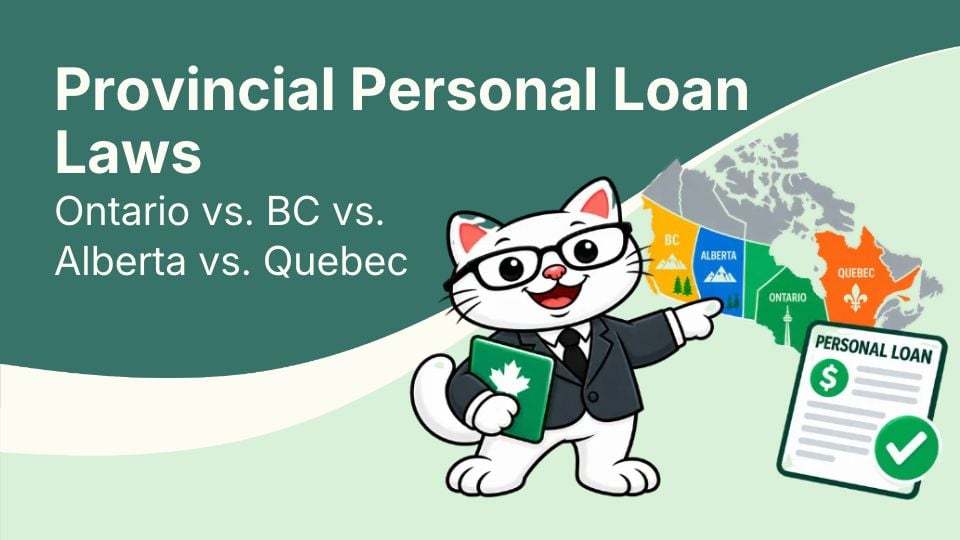
Understanding Personal Loan Rules Across Four Provinces
Last Updated: October 2026
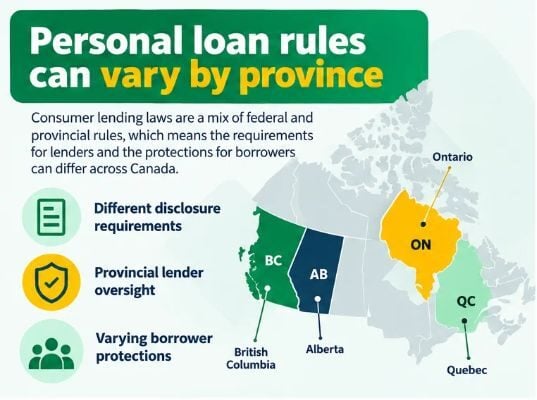
Personal loan laws by province in Canada can affect what lenders must disclose, which businesses need a licence and what protections you have when borrowing.
If you live in Ontario, British Columbia (BC), Alberta or Quebec, you may encounter different consumer-credit rules even when applying for a similar loan.
Some lending laws apply across Canada. Others depend on your province, the lender and the type of credit agreement.
This guide compares four provinces to help you understand the rules before signing a personal loan, instalment loan or line of credit agreement.
For a broader explanation of Canadian lending protections, read our guide to borrower rights in Canada.
Ontario vs. BC vs. Alberta vs. Quebec: Personal Loan Rules Compared
The following table highlights important differences for consumer borrowing.
| Area | Ontario | British Columbia | Alberta | Quebec |
|---|---|---|---|---|
| General credit rules | Consumer Protection Act, 2002 | Business Practices and Consumer Protection Act | Consumer Protection Act | Consumer Protection Act |
| Loan disclosures | Cost-of-borrowing and credit-agreement requirements | Written terms and cost disclosures | Credit disclosures, including special high-cost rules | Prescribed consumer-credit contract information |
| High-cost credit | Applicable general credit and federal rules; product-specific requirements | Specific licensing and disclosure regime | Specific licensing and disclosure regime | Special high-cost credit protections and permit requirements |
| Cancellation | Depends on the agreement and applicable law | Depends on the agreement and applicable law | Depends on the agreement and applicable law | Specific cancellation rights for covered money-loan contracts |
| Consumer authority | Consumer Protection Ontario | Consumer Protection BC | Service Alberta | Office de la protection du consommateur |
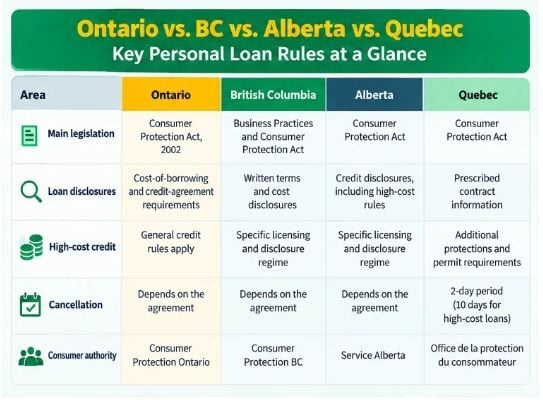
These are broad comparisons, not a complete list of legal requirements.
The rules may differ for a federally regulated bank, provincial credit union, non-bank lender or loan broker.
Why Do Personal Loan Laws Differ Across Canada?
Canada has both federal and provincial laws affecting consumer borrowing.
Federal law addresses matters such as criminal interest rates. Federally regulated banks also have specific disclosure and consumer-protection obligations.
Provinces regulate many consumer transactions and may impose additional requirements on lenders, brokers and credit agreements.
For example, a personal loan from a federally regulated bank may be subject to federal banking rules, while a loan from a provincial non-bank lender may also be subject to provincial consumer-credit legislation.
This distinction matters because you cannot assume that every lender offering loans in the same province follows exactly the same regulatory framework.
Does Canada Have a Maximum Personal Loan Interest Rate?
The federal Criminal Code generally prohibits charging interest at a criminal rate.
Since January 1, 2025, the general criminal-interest threshold has been 35% APR, subject to applicable exceptions.
This is a federal rule, not a separate maximum set by each province.
However, the legal maximum is not a recommended borrowing rate. A loan can be expensive even when its interest rate is legally permitted.
Before accepting an offer, compare the annual percentage rate, fees, repayment period and total amount repayable.
For details about the borrowing process, see our guide to personal loans in Canada.
Ontario: Personal Loan Rules and Consumer Protections
Ontario’s Consumer Protection Act, 2002 contains rules affecting consumer credit agreements and loan-brokering services.
Ontario has also passed replacement consumer-protection legislation. Borrowers should check the current rules when entering into an agreement, as commencement dates and transitional provisions may affect which requirements apply.
Borrowers should pay particular attention to disclosure documents, borrowing costs and any fees charged by intermediaries.
Loan Agreements and Borrowing Costs
Ontario’s consumer-credit framework includes requirements relating to the disclosure of borrowing costs.
Depending on the agreement, information may include the amount borrowed, interest, payment obligations and applicable fees.
The aim is to help consumers understand what they are agreeing to before accepting credit.
Do not rely only on an advertisement showing a monthly payment. Ask for the full cost of borrowing.
Ontario Loan Broker Protections
Ontario also has specific rules for certain loan-brokering agreements.
Under the Consumer Protection Act, 2002, a loan broker generally cannot require or accept payment for arranging a loan before the consumer receives the credit.
Under the Consumer Protection Act, 2002, consumers can generally cancel a covered loan-brokering agreement without giving a reason until 10 days after receiving a written copy of the agreement. This does not automatically give the borrower the same cancellation right for the loan itself.
These rules are especially relevant when a company promises to find you a lender in exchange for a fee.
Be cautious if someone demands an upfront payment to guarantee loan approval.
What Should Ontario Borrowers Check?
Before signing, confirm the lender’s identity, the amount you will receive, the total borrowing cost and whether any broker is involved.
If a business is arranging credit rather than lending directly, make sure you understand its role.
British Columbia: Credit Agreements and High-Cost Loan Rules
British Columbia has consumer-credit rules under its Business Practices and Consumer Protection Act.
The province also has a specific regulatory framework for high-cost credit products.
Written Loan Agreements
BC government guidance explains that borrowers should receive a written agreement showing the loan’s charges and terms.
Important details include the loan amount, interest rate, fees, repayment schedule and consequences of missing payments.
Review these terms before signing, especially if a lender has made promises verbally.
High-Cost Credit Licensing in BC
Consumer Protection BC regulates businesses that offer, arrange, provide or facilitate covered high-cost credit products.
This can include certain instalment loans and lines of credit.
Under BC’s framework, covered fixed-credit products generally qualify as high-cost when their annual percentage rate (APR) exceeds 32%. For covered open-credit products, such as certain lines of credit, the threshold is based on an annual interest rate (AIR) above 32%.
The federal criminal-interest rules also apply, subject to relevant exceptions.
BC requires businesses involved in covered high-cost credit to hold the appropriate licence and follow additional consumer-protection requirements.
Why Does This Matter?
A loan advertised as an instalment loan may still fall under high-cost credit rules.
Borrowers should check the lender’s licensing status and carefully review all required disclosures.
The label used in an advertisement does not determine which laws apply.
Alberta: Personal Loans and High-Cost Credit Protections
Alberta regulates consumer credit under its Consumer Protection Act and related regulations.
It also has specific requirements for businesses offering high-cost credit.
What Counts as High-Cost Credit in Alberta?
Alberta’s High-Cost Credit Regulation applies to certain fixed and open credit products with an annual rate of 32% or more.
For covered fixed-credit agreements, the threshold considers the annual percentage rate, including applicable mandatory borrowing costs.
For covered open-credit agreements, the regulation uses the annual interest rate.
The framework can apply to instalment loans, title loans, lines of credit and certain other credit products.
Payday loans are regulated separately.
Licensing Requirements
Alberta requires businesses offering or arranging covered high-cost credit to hold the appropriate provincial licence.
The requirements can apply to online businesses as well as physical lending locations.
Alberta also requires certain licensing information to be displayed, helping consumers identify regulated businesses.
Additional Borrower Protections
High-cost credit businesses in Alberta must follow rules about presenting loan information, disclosing optional products and dealing with borrowers.
The regulation also prohibits certain misleading and harassing practices.
These protections are particularly important when borrowers are considering expensive credit products.
Before applying, check whether the lender is properly licensed and whether the repayment amount fits your budget.
Quebec: Personal Loan Contracts and Consumer Rights
Quebec has a detailed consumer-credit framework under its Consumer Protection Act.
Its rules can affect how money-loan contracts are presented, whether borrowers can cancel them and what obligations apply to lenders.
Credit Contracts and Repayment Ability
Quebec has rules requiring covered lenders to assess a consumer’s ability to repay before entering into certain credit agreements.
Credit contracts must also comply with applicable disclosure and contract requirements.
These protections are designed to help consumers understand their obligations and reduce unsuitable lending practices.
Can You Cancel a Personal Loan in Quebec?
Quebec provides a specific cancellation right for covered contracts for the loan of money.
According to the Office de la protection du consommateur, consumers generally have two days after both parties possess a copy of the contract to cancel without fees, subject to the applicable requirements.
Covered high-cost money-loan contracts have a longer 10-day cancellation period.
If you have already received the money, you must return it to cancel under the relevant rules.
Not every financial product or lender is necessarily covered by the same provisions, so check which legal framework applies.
Quebec High-Cost Credit Rules
Quebec also imposes additional requirements on covered high-cost credit contracts.
Businesses entering into these agreements may need a permit from the Office de la protection du consommateur.
Borrowers should check the lender’s permit status and understand the credit charges before signing.
Can You Cancel a Personal Loan After Signing?
Cancellation rights are not identical across Canada.
A consumer should not assume that every personal loan has a standard two-day or 10-day cooling-off period.
The answer depends on the province, lender, credit product and applicable legislation.
Quebec provides specific cancellation rights for covered money-loan contracts.
Ontario has cancellation rights for certain loan-brokering agreements, but cancelling a broker agreement is not necessarily the same as cancelling the underlying loan.
In BC and Alberta, borrowers should check the rules that apply to their particular agreement rather than assume a universal cancellation period.
If you want to cancel a loan, contact the lender promptly and ask for written confirmation of the applicable requirements.
How Do Provincial Rules Affect Online Loans?
Applying online does not automatically remove provincial consumer protections.
A lender operating through a website may still have to comply with licensing and consumer-credit requirements in the provinces where it offers regulated products.
However, a lender may not offer the same products in every province.
Loan availability, eligibility and applicable terms can vary.
Before applying, confirm that the lender serves your province and that you understand the total repayment obligation.
Our guide to online loans in Canada explains the application process and what to check before borrowing.
If you’re comparing loan options, check that the lender serves your province and review the full borrowing cost before applying.

What If a Lender Breaks Provincial Consumer-Protection Rules?
If you believe a lender has broken the rules, start by gathering your documents.
Keep copies of your agreement, disclosures, payment records, emails and any advertising that influenced your decision.
Contact the lender and explain the problem in writing.
If it cannot be resolved, the appropriate complaint route depends on the lender and province.
- Ontario: Consumer Protection Ontario may assist with matters under provincial consumer-protection legislation.
- British Columbia: Consumer Protection BC handles complaints involving businesses and activities within its regulatory authority.
- Alberta: Service Alberta provides information about consumer complaints and regulated businesses.
- Quebec: The Office de la protection du consommateur provides consumer guidance and complaint information.
For complaints about federally regulated banks, the applicable federal complaint-handling process may be more appropriate.
You can also read our guide to Canadian borrower rights and lender obligations.
What About Payday Loan Laws?
Payday loans have their own provincial rules and should not be confused with ordinary personal or instalment loans.
Those rules can include different fee limits, repayment requirements and cancellation protections.
Because this article focuses on personal and instalment credit, we have covered payday borrowing separately.
For a province-by-province explanation, see our guide to payday loan laws in Canada.
How to Compare Personal Loans Across Provinces
Regardless of where you live, the safest approach is to compare the full agreement rather than focusing on the advertised interest rate alone.
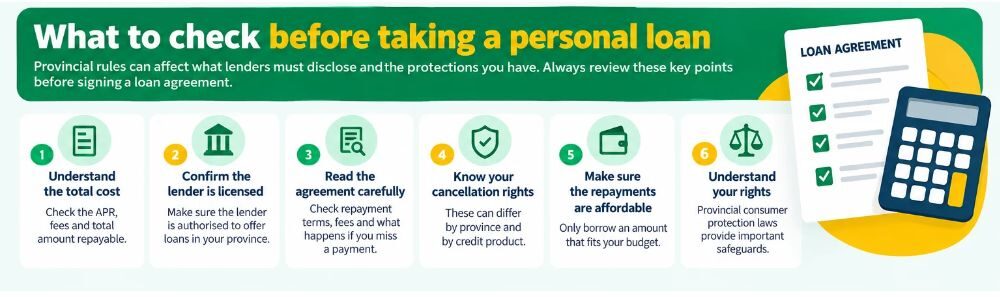
Before accepting a personal loan:
- Confirm the lender operates legally in your province.
- Compare the APR and total borrowing cost.
- Check whether additional fees or optional products apply.
- Understand the repayment dates and total amount repayable.
- Review the consequences of missed payments.
- Ask about cancellation and early repayment rights.
- Make sure the payments are affordable.
You can also explore our Canadian lender network to understand the lending partners and borrowing options available through FatCat Loans.
Lender availability varies, and an application does not guarantee approval.
Frequently Asked Questions
Are personal loan laws the same in every Canadian province?
No. Federal rules apply to certain aspects of lending, but provinces also have consumer-protection laws. Disclosure requirements, lender oversight, high-cost credit rules and cancellation rights can differ.
Does Ontario have different personal loan rules from British Columbia?
Yes. Both provinces regulate consumer credit, but BC has a specific high-cost credit licensing framework. Ontario also has particular protections for covered loan-brokering agreements.
Are high-cost instalment loans regulated in Alberta?
Yes. Alberta has a High-Cost Credit Regulation covering certain credit products with an annual rate of 32% or more. Covered lenders must follow licensing and consumer-protection requirements.
Can I cancel a personal loan in Quebec?
Quebec provides cancellation rights for covered money-loan contracts. The usual period is two days, while covered high-cost money-loan contracts have a 10-day period. The requirements depend on the agreement and applicable law.
Do online lenders have to follow provincial lending laws?
Online lenders may be subject to provincial licensing and consumer-credit requirements when offering regulated products. The applicable rules depend on the lender, product and province.
Where can I complain about a personal loan lender?
Start by contacting the lender. If the issue remains unresolved, check the relevant provincial consumer-protection authority or the federal complaint process if the lender is a federally regulated bank.

Final Thoughts
Personal loan laws are not identical across Ontario, British Columbia, Alberta and Quebec.
While federal rules create some common standards, provincial legislation can affect lender licensing, disclosures, high-cost credit and cancellation rights.
BC and Alberta have specific high-cost credit frameworks. Ontario has important consumer-credit and loan-brokering protections. Quebec has detailed money-loan contract rules, including cancellation rights for covered agreements.
Before borrowing, check which rules apply to your lender and credit product.
Most importantly, compare the full borrowing cost and make sure the repayments fit your budget.
Sources
- Financial Consumer Agency of Canada – Personal Loans: Know Your Rights
- Ontario – Consumer Protection Act, 2002
- Consumer Protection BC – High-Cost Credit Products
- Government of Alberta – High-Cost Credit Regulation
- Quebec Consumer Protection Office – Modifying or Cancelling a Money-Loan Contract
Disclaimer: This article provides general information and is not legal or financial advice. Consumer-credit laws vary by jurisdiction, lender and product. Check current provincial requirements and your credit agreement before making a borrowing decision.

The FatCat Loans Editorial Team delivers clear, accurate, and unbiased guidance on loans, credit, and personal finance in Canada. Our writers follow strict editorial standards to ensure every article is trustworthy, well-researched, and easy to understand, helping readers make confident financial decisions.