What to Do If a Lender Violates Your Consumer Rights in Canada
September 11, 2026
How to Make a Complaint About a Lender in Canada
Last Updated: September 2026
If you believe a lender has violated your consumer rights in Canada, you don’t have to simply accept what happened. You may be able to complain directly to the lender, escalate the complaint and, depending on the type of financial institution involved, contact a regulator or independent complaints body.
The correct process depends on who the lender is and how it is regulated.
For federally regulated financial institutions such as banks and federal credit unions, the Financial Consumer Agency of Canada (FCAC) oversees compliance with federal consumer protection requirements. However, FCAC does not resolve individual disputes or order compensation for individual consumers.
That distinction is important.
Quick answer: Start by making a formal complaint directly to your lender and keep records of everything. If you’re dealing with a bank and the issue isn’t resolved, you may be able to escalate it to the Ombudsman for Banking Services and Investments (OBSI). You can also contact FCAC for information about your rights and the complaint process.
Our Canadian Borrower Rights guide explains the broader protections that may apply when you borrow money in Canada.
Who Protects Borrowers in Canada?
There isn’t one regulator that handles every consumer loan complaint in Canada.
Which organization is relevant depends on the lender and the issue.
Financial Consumer Agency of Canada
The Financial Consumer Agency of Canada (FCAC) supervises federally regulated financial entities, including banks and federally regulated trust, loan and insurance companies.
It oversees compliance with federal consumer protection laws, including requirements relating to complaint handling.
FCAC can also help consumers understand their rights and the complaint process.
But remember:
FCAC doesn’t resolve your individual dispute with a lender and doesn’t award you compensation.
Provincial and Territorial Regulators
Some lenders and credit providers are regulated provincially rather than federally.
For example, a complaint involving a provincially regulated credit union or certain alternative lenders may need to follow a provincial or territorial process rather than the federal bank complaint process.
FCAC itself advises consumers that they may need to contact their provincial or territorial regulator depending on the institution involved.
This is why the first question should be:
Who regulates the lender I’m complaining about?
What Could Count as a Consumer-Rights Problem?
A disagreement with a lender doesn’t automatically mean your rights have been violated.
However, you may have reason to investigate further if you believe there has been a problem involving things such as:
- fees or charges you weren’t expecting
- inaccurate or misleading information
- required disclosures not being provided
- problems with how your complaint was handled
- unauthorized transactions or account activity
- issues involving your personal information
- collection practices
- problems with loan cancellation rights where applicable
- interest or borrowing costs that you believe may not comply with applicable law
Different federal, provincial and territorial rules can apply, so don’t assume the same rights apply to every loan or lender.
If your concern relates specifically to how your personal information was collected, used or shared during a loan application, see our PIPEDA and Your Loan Application guide.
What to Do If You Think a Lender Has Violated Your Rights
The exact process varies, but these steps provide a useful starting point.
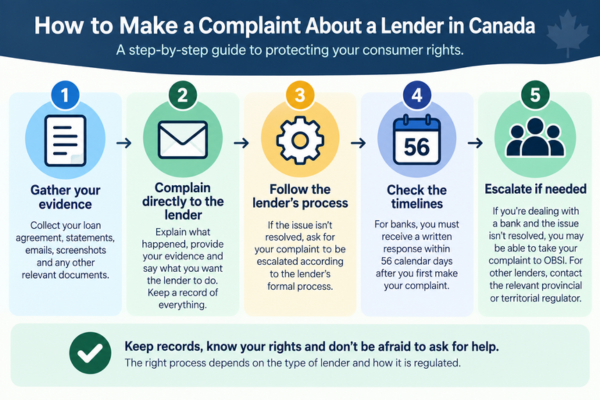
Step 1: Gather Your Evidence
Before contacting the lender, collect everything relevant to the dispute.
That might include:
- your loan agreement
- account statements
- emails
- text messages
- screenshots
- advertisements or offers you relied on
- payment records
- dates and times of conversations
- names of employees you spoke with
- copies of previous complaints
Write down exactly what happened and what you want the lender to do about it.
For example, you might be asking for:
- an incorrect fee to be refunded
- an account error to be corrected
- an explanation of a charge
- inaccurate information to be corrected
- another specific resolution
FCAC recommends recording the key facts, relevant dates and names, supporting details and the outcome you’re seeking before making a bank complaint.
Step 2: Complain Directly to the Lender
Your first formal step will usually be to contact the lender itself.
Explain:
what happened → why you believe there’s a problem → what evidence you have → what you want done
Try to make the complaint in writing, or keep written notes if you complain by telephone or in person.
Ask for:
- a complaint or reference number
- written acknowledgement
- the lender’s complaint-handling procedure
- the name or department dealing with your complaint
For federally regulated banks, complaint-handling information must be made available to consumers.
Don’t rely solely on telephone conversations.
Keep your own copy of every document you send or receive.
Step 3: Follow the Lender’s Internal Complaint Process
If the first person you contact can’t resolve the problem, ask for the complaint to be escalated according to the institution’s formal complaint process.
Banks must explain their complaint-handling process and provide information to help consumers follow it.
The exact internal structure varies between institutions.
This is also why you shouldn’t simply search for a senior executive’s email address and bypass the lender’s complaint procedure. Following the documented process gives you a clearer record if the dispute later needs to be escalated.
How Long Does a Bank Have to Resolve a Complaint?
For banks, there is an important 56-day rule.
A bank must provide a written response within 56 calendar days after you first make your complaint.
Keep a record of the date your complaint was first submitted.
That date matters because it can determine when you are entitled to take the complaint outside the bank.
Step 4: Escalate an Unresolved Bank Complaint to OBSI
If your complaint involves a bank, federal credit union or authorized foreign bank and the internal process hasn’t resolved the matter, the next organization to know is the:
Ombudsman for Banking Services and Investments (OBSI).
OBSI is independent from the banks and provides consumers with a free and impartial review of eligible complaints. All banks and federal credit unions must participate in OBSI.
You can generally contact OBSI on the earlier of:
- more than 56 calendar days after you first complained to your bank, or
- when your bank provides its detailed written response and closes your complaint.
You therefore don’t necessarily have to wait the full 56 days if the bank has already closed the complaint and you’re unhappy with its response.
OBSI can review the dispute and recommend a resolution.
According to FCAC, OBSI must generally provide its final written recommendation within 120 calendar days after receiving the information it needs to deal with the complaint.
Step 5: Understand Where FCAC Fits In
This is where people can easily misunderstand the process.
FCAC isn’t an ombudsman for individual loan disputes.
FCAC supervises federally regulated financial institutions to determine whether they’re meeting their legal consumer-protection obligations.
Information about complaints can help FCAC identify compliance problems and broader trends affecting consumers.
Its Consumer Information Centre can also:
- explain your rights when dealing with a bank
- explain the bank complaint process
- provide information about financial products and services
- help you understand where a complaint should be made.
So think of the roles this way:
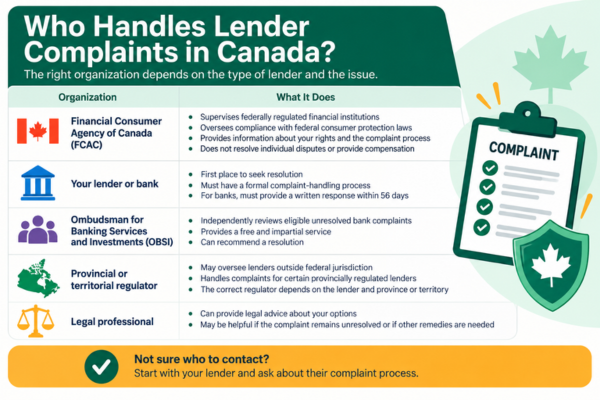
| Organization | What It Does |
|---|---|
| Your lender/bank | First place to seek resolution |
| OBSI | Independently reviews eligible unresolved bank complaints |
| FCAC | Supervises federal compliance and provides consumer information |
| Provincial/territorial regulator | May oversee lenders outside federal jurisdiction |
| Legal professional | Can advise on legal remedies and individual rights |
Step 6: Contact the Appropriate Provincial or Territorial Authority if Necessary
Not every lender is federally regulated.
If you’re dealing with a provincially regulated lender, the complaint process may be different.
FCAC specifically notes that consumers may need to take a complaint to a provincial or territorial regulator, including where a provincial credit union is involved.
Before making a regulatory complaint, identify:
- the lender’s legal business name
- the province or territory involved
- what type of financial institution it is
- whether it is federally or provincially regulated
- which regulator oversees that type of lender.
This prevents you from sending the complaint to an organization that has no jurisdiction over it.
What If Your Complaint Is About a Payday or Alternative Lender?
This distinction is particularly relevant to FatCat Loans readers.
Don’t assume the bank → OBSI process applies automatically to every online, payday or alternative lender.
These lenders may be subject to provincial licensing and consumer-protection requirements, and the appropriate regulator and complaint route can depend on the province and product.
Check the lender’s licence or registration where applicable and use the consumer-protection resources for your province or territory.
This is also one reason to research a lender carefully before borrowing rather than focusing only on approval speed.
Our Avoid Loan Scams in Canada guide explains some of the warning signs to check before giving a lender personal or banking information.
Can FCAC Get Your Money Back?
FCAC doesn’t resolve individual complaints or provide compensation to consumers.
That doesn’t mean reporting a potential compliance issue is pointless.
Consumer information helps FCAC monitor federally regulated institutions and identify patterns and potential compliance problems.
But if your objective is an individual remedy — such as recovering money or resolving a dispute — you need to follow the applicable complaint process rather than expecting FCAC to decide your case.
For eligible banking complaints, that can ultimately include OBSI.
What If the Complaint Still Isn’t Resolved?
Your options depend on the circumstances.
If you’ve completed the relevant complaint process and remain dissatisfied, you may wish to obtain independent legal advice about any other remedies available to you.
FCAC also notes that consumers can consult a legal professional if their bank complaint remains unresolved, although this may involve a cost.
Don’t delay seeking legal advice where a limitation period or other legal deadline might apply.
How to Write an Effective Lender Complaint
Keep the complaint factual.
A useful structure is:
What happened: Explain the problem in chronological order.
Evidence: Identify the agreement, transaction, communication or other information supporting your complaint.
Impact: Explain how the problem affected you.
Resolution requested: State clearly what you want the lender to do.
Supporting documents: Attach copies rather than sending originals where possible.
Avoid making the complaint unnecessarily emotional or burying the important facts in a very long account.
A clear timeline can make a complicated dispute much easier to understand.
Your Rights When Complaining to a Bank
If you’re dealing with a federally regulated bank, the complaint itself comes with protections.
Among other requirements, banks must provide information about their complaint process and acknowledge the date they received your complaint in writing. They must also provide information about OBSI and FCAC.
The bank must provide its detailed written response within the applicable 56-day period.
These requirements matter because a complaint process shouldn’t leave a consumer indefinitely waiting without knowing what happens next.
For a broader explanation of Canadian borrowing protections, see our Canadian Borrower Rights guide.
Where to Get Help With a Financial Complaint
For a federally regulated institution, FCAC’s Consumer Information Centre can help you understand your rights and the complaint process.
As of September 2026, FCAC lists:
English: 1-866-461-FCAC (3222)
French: 1-866-461-ACFC (2232)
Outside Canada: 613-960-4666
FCAC also provides an online contact form and postal contact options.
For an unresolved eligible bank complaint, contact OBSI.
For provincially regulated lenders, identify the relevant provincial or territorial consumer-protection or financial-services authority.
Frequently Asked Questions
Does FCAC investigate individual complaints against lenders?
FCAC supervises federally regulated financial entities and uses complaint and compliance information as part of that work. However, FCAC doesn’t resolve individual disputes or provide compensation to individual consumers. Its Consumer Information Centre can help explain your rights and the complaint process.
Should I complain to FCAC or my lender first?
If you have a problem with a federally regulated financial institution, start by making a complaint directly to the institution using its complaint-handling process.
How long does a bank have to deal with my complaint?
A bank must provide a written response within 56 calendar days after you first make your complaint.
When can I take my complaint to OBSI?
You can generally escalate a bank complaint to OBSI once the bank has provided its detailed written response and closed the complaint, or when more than 56 calendar days have passed since you first complained, whichever happens earlier.
Does OBSI charge consumers?
No. OBSI provides eligible consumers with a free and impartial complaint-review service.
What if my lender isn’t federally regulated?
You may need to follow a provincial or territorial complaint process instead. The appropriate authority depends on the type of lender and where it operates.
Final Checklist: If You Believe a Lender Has Violated Your Rights
Before you finish, make sure you’ve:
- gathered your loan agreement and supporting evidence
- written down the important dates
- identified exactly what you’re complaining about
- stated the resolution you’re seeking
- complained directly to the lender
- kept copies of correspondence
- obtained your complaint/reference number
- followed the lender’s escalation procedure
- identified whether the lender is federally or provincially regulated
- kept track of applicable complaint deadlines
- considered independent legal advice if necessary
The biggest mistake is assuming that FCAC itself is where every Canadian lender complaint gets resolved.
It isn’t.
The right route depends on the lender. For banks, start with the bank’s complaint process and escalate eligible unresolved disputes to OBSI. FCAC’s role is to supervise federal consumer-protection compliance and help consumers understand their rights and complaint options.

The FatCat Loans Editorial Team delivers clear, accurate, and unbiased guidance on loans, credit, and personal finance in Canada. Our writers follow strict editorial standards to ensure every article is trustworthy, well-researched, and easy to understand, helping readers make confident financial decisions.