How to Avoid Loan Scams in Canada: Red Flags & Lender Checklist
October 30, 2025
How Can You Spot a Loan Scam in Canada?
Last Updated: August 2026
Loan scams often look convincing. A fake lender may have a professional website, use Canadian contact details or promise fast access to money when you need it most.
The warning signs usually appear in how the loan is offered, what you’re promised and what you’re asked to do before receiving the money. Guaranteed approval, pressure to act quickly, requests for money to release loan funds and unverifiable company details are all reasons to stop and investigate further.
A legitimate-looking website alone does not prove that a lender is genuine. Before applying, verify who you’re dealing with, read the loan agreement carefully and understand the interest rate, fees and repayment terms.
This guide explains the most common loan scam red flags in Canada, how to check whether a lender appears legitimate and what to do if you’ve already sent money or personal information.
People with weaker credit may be particularly attracted to offers promising easy approval. If you’re having difficulty qualifying, our Bad Credit Loans Canada guide explains how bad-credit borrowing works, what lenders may consider and what to compare before accepting an offer.
Common Loan Scams Targeting Canadians
Loan scams can take several forms. Some of the most common include:
- Advance-fee scams: You’re told to send money before promised loan funds can be released.
- Guaranteed approval scams: The company claims everyone qualifies regardless of their circumstances.
- Fake lender websites: Fraudsters copy legitimate branding, company details or loan terminology to appear genuine.
- Phishing: Fake loan offers are used to collect banking, identification or other sensitive information.
- Identity theft: Stolen personal information may be used to access accounts or apply for credit in your name.
If you see guaranteed-approval claims, our Guaranteed Approval Loans Canada guide explains these offers and the warning signs to watch for.
Important: Don’t submit sensitive information through links in unexpected loan messages. Find the company’s website independently and verify who you’re dealing with first.
10 Red Flags of a Loan Scam
| Red Flag | Why You Should Be Cautious |
|---|---|
| Guaranteed approval | Legitimate lenders have eligibility and approval criteria. |
| Payment required to release the loan | Requests to send money before promised funds are released are a major warning sign. |
| Gift card or cryptocurrency payment | Unusual or difficult-to-reverse payment methods are commonly associated with scams. |
| Pressure to act immediately | Scammers often create urgency to stop you from researching the offer. |
| Unsolicited loan offer | Be cautious about unexpected offers through text, email, social media or messaging apps. |
| No clear loan agreement | You should understand the amount borrowed, interest, payments, fees and other important terms before accepting credit. |
| Company details can’t be verified | A lender should have business and contact information you can independently check. |
| Suspicious website or email address | Look for misspellings, copied branding and domains that don’t match the company. |
| Sensitive information requested through DMs or text | Personal and financial information should be handled through appropriate secure channels. |
| The offer sounds too good to be true | Extremely low rates or easy approval despite every circumstance deserve extra scrutiny. |
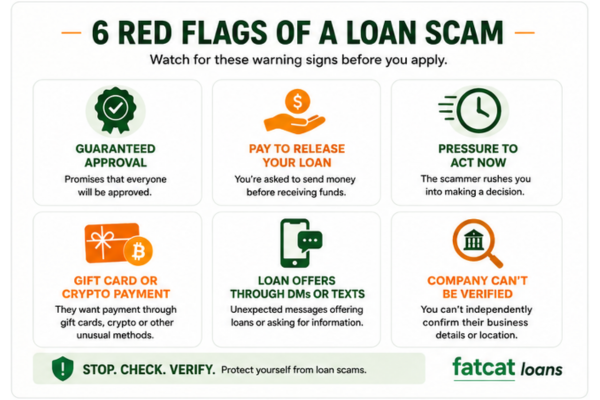
One warning sign doesn’t automatically prove that a company is fraudulent. However, multiple red flags are a strong reason to stop the application and verify the lender independently before continuing.
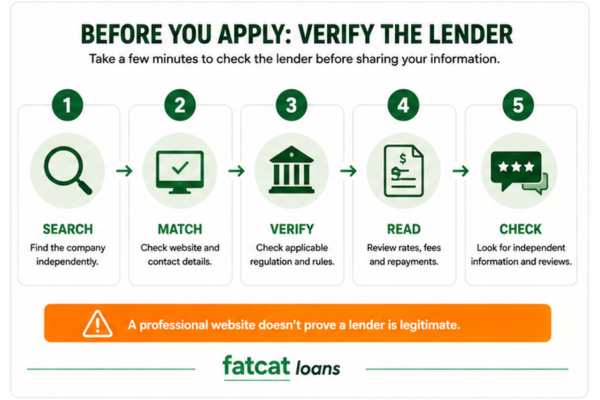
How to Verify a Lender in Canada
Before providing personal information or accepting a loan, take a few minutes to check who you’re dealing with.
1. Search the Company Independently
Don’t rely on links sent by email, text or social media. Find the company independently and check that its website, phone number, business name, address and email domain match the information you’ve been given.
2. Check Who Regulates the Lender
Financial services in Canada may be regulated federally, provincially or territorially depending on the lender and product.
Banks are federally regulated, while other lenders may fall under provincial or territorial rules.
If you’re unsure, check the relevant provincial or territorial consumer-affairs office for information about lending rules in your area.
3. Read the Loan Terms Before Agreeing
Don’t focus only on the amount you’ll receive or the monthly payment.
Before agreeing, check the amount borrowed, interest rate, fees, repayment amount, loan term and total borrowing cost.
For federally regulated lenders such as banks, FCAC outlines information that must be provided when taking out a personal loan, including the loan amount, interest rate, term, payment amount and applicable fees.
4. Check the Website — But Don’t Rely on the Padlock Alone
A secure connection is important when submitting financial information online.
Look for https:// and make sure the domain is spelled correctly.
However, HTTPS does not prove that the business itself is legitimate. Scam websites can also use encrypted connections.
5. Look for Independent Information
Search beyond testimonials on the lender’s own website. Look for independent reviews, complaints or fraud warnings. Reviews can also be manipulated, so treat them as one part of your checks rather than proof that a lender is legitimate.
Verified Lender Checklist
Before applying, work through this checklist:
Company checks
☐ I can verify the company’s name and contact details
☐ The website address matches the company I’m researching
☐ I’ve checked which regulator or consumer-protection rules may apply
☐ I’ve searched for independent information about the company
Loan checks
☐ The loan amount is clearly stated
☐ The interest rate and applicable fees are disclosed
☐ I know the repayment amount and schedule
☐ I understand the total borrowing cost
☐ I’ve received or can review the loan terms before accepting
Scam checks
☐ I’m not being promised guaranteed approval
☐ I’m not being pressured to make an immediate decision
☐ I’m not being told to send money to release promised loan funds
☐ I’m not being asked to pay using gift cards or cryptocurrency
☐ I’m submitting sensitive information only through an appropriate secure process
If you can’t verify the company or understand exactly what you’re agreeing to, don’t continue until you’ve checked it independently.
What Information Might a Legitimate Lender Ask For?
Not every request for personal or financial information is suspicious. Depending on the lender and loan, you may be asked for your identity and contact details, employment, income, existing debts, banking information and permission to check your credit.
The important question is who is requesting the information and how you’re being asked to provide it.
Verify the company before submitting sensitive information. Be particularly cautious if someone unexpectedly asks for passwords, PINs, verification codes or remote access to your device.
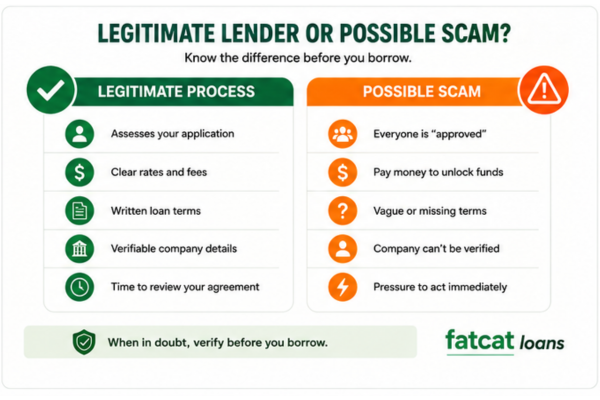
Loan Scam vs Legitimate Lender: What’s the Difference?
Some scam offers are designed to look almost identical to genuine loan offers. These differences can help you decide when further checks are needed.
| Legitimate Lending Process | Possible Loan Scam |
|---|---|
| Assesses your application | Promises everyone will be approved |
| Provides identifiable company details | Company is difficult to verify |
| Provides loan terms for you to review | Terms are vague, missing or constantly changing |
| Explains rates, payments and applicable fees | Focuses only on how quickly you’ll get money |
| Uses an appropriate application process | Asks for sensitive information through DMs or unsolicited messages |
| Gives you an opportunity to review the agreement | Pressures you to act immediately |
| Provides funds according to the loan agreement | Demands money to “unlock” or release promised funds |
| Uses normal payment methods | Demands gift cards, cryptocurrency or unusual transfers |
Remember: No single website feature, review or piece of contact information proves that a lender is legitimate. Look at the full picture and independently verify anything that doesn’t seem right.
Looking for borrowing options? Compare loan options available through FatCat Loans’ lending partners.

What to Do If You’ve Been Scammed by a Fake Lender
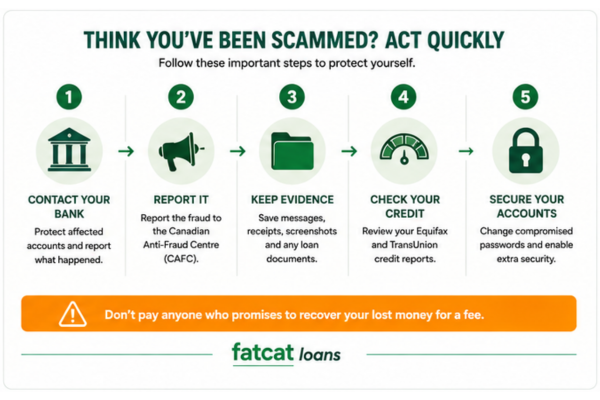
If you’ve sent money or sensitive information to a suspected loan scammer, act quickly:
- Contact your bank or financial institution. Explain what happened and ask how to protect your accounts.
- Report the fraud to the Canadian Anti-Fraud Centre (CAFC). Attempted scams can also be reported.
- Contact local police if appropriate, particularly if you’ve lost money or experienced identity theft.
- Keep evidence, including messages, screenshots, website addresses, payment receipts and loan documents.
- Check your Equifax and TransUnion credit reports for accounts or activity you don’t recognize.
- Protect compromised accounts. Change affected passwords and consider fraud alerts if your identity may have been stolen.
Use independently verified contact details when contacting your bank or other organizations — not phone numbers or links supplied by the suspected scammer.
Watch Out for Loan Scam Recovery Scams
Fraud victims may be targeted again by someone claiming they can recover the lost money.
The scammer may impersonate law enforcement, a government agency or the Canadian Anti-Fraud Centre and demand another payment for supposed fees, taxes or administration.
The CAFC warns that the CAFC and police will not ask you to send money as part of an investigation.
Never send more money to someone who claims you must pay them to recover money already lost to fraud.
Using a Loan Comparison Platform Safely
Before using a loan comparison platform, check whether it is a lender or comparison service, how your information will be used and whether it may be shared with lending partners.
FatCat Loans is a loan comparison platform, not a lender. We don’t make lending decisions or guarantee that you’ll receive a loan offer.
If you receive an offer from a lender, review the lender’s agreement, interest rate, fees and repayment terms before accepting.
If poor credit is making it harder to find borrowing options, learn how bad credit loans work and what to compare before applying.

Frequently Asked Questions About Loan Scams in Canada
How can I tell if a loan company is legitimate in Canada?
Check the company’s business details independently, confirm its website and contact information, find out which federal, provincial or territorial rules apply, and read the loan agreement before accepting. Be cautious if the company can’t be verified or won’t clearly disclose its loan terms.
Is guaranteed loan approval a scam?
Not every use of the word “guaranteed” proves fraud, but promises that everyone will be approved regardless of their circumstances are a major warning sign. Legitimate lenders have eligibility and approval criteria.
Should I pay money before receiving a loan?
Be very cautious if you’re told to send money to secure, unlock or release promised loan funds, particularly if payment is requested through gift cards, cryptocurrency or another unusual method. Stop and independently verify the company before paying anything.
What should I do if I’ve given a loan scammer my banking information?
Contact your financial institution immediately and explain what information was shared. Change compromised passwords, monitor your accounts and consider checking your credit reports. If identity theft is suspected, contact Equifax and TransUnion about adding fraud alerts. FCAC recommends contacting financial institutions and both credit bureaus when financial information has been compromised.
Where do I report a loan scam in Canada?
You can report fraud and cybercrime through Canada’s National Fraud Reporting System, which is jointly managed by the RCMP and Canadian Anti-Fraud Centre. You may also need to contact your financial institution and local police depending on what happened.
Can someone take out a loan using my identity?
Yes. Stolen personal information may be used to apply for credit in someone else’s name. Check your credit reports for accounts or inquiries you don’t recognize and report suspected fraud promptly.
Final Thoughts: Stop and Check Before You Borrow
Loan scams often rely on urgency and the promise of easy access to money. This can be especially tempting if you’ve already struggled to qualify elsewhere.
Before accepting an offer, verify the company, read the loan agreement and understand the costs. Be particularly cautious about guaranteed approval, pressure to act immediately or requests to send money to release promised funds.
If you’ve already sent money or sensitive information to a suspected scammer, contact your financial institution and report the incident as soon as possible.
Disclosure: This article is for informational purposes only and does not constitute financial or legal advice. FatCat Loans is a loan comparison platform, not a lender. We don’t make lending decisions or guarantee approval. Always verify a lender independently and review the terms of any credit agreement before accepting an offer.

The FatCat Loans Editorial Team delivers clear, accurate, and unbiased guidance on loans, credit, and personal finance in Canada. Our writers follow strict editorial standards to ensure every article is trustworthy, well-researched, and easy to understand, helping readers make confident financial decisions.