Alternative Lenders Canada: Who They Are and What They Charge
July 01, 2026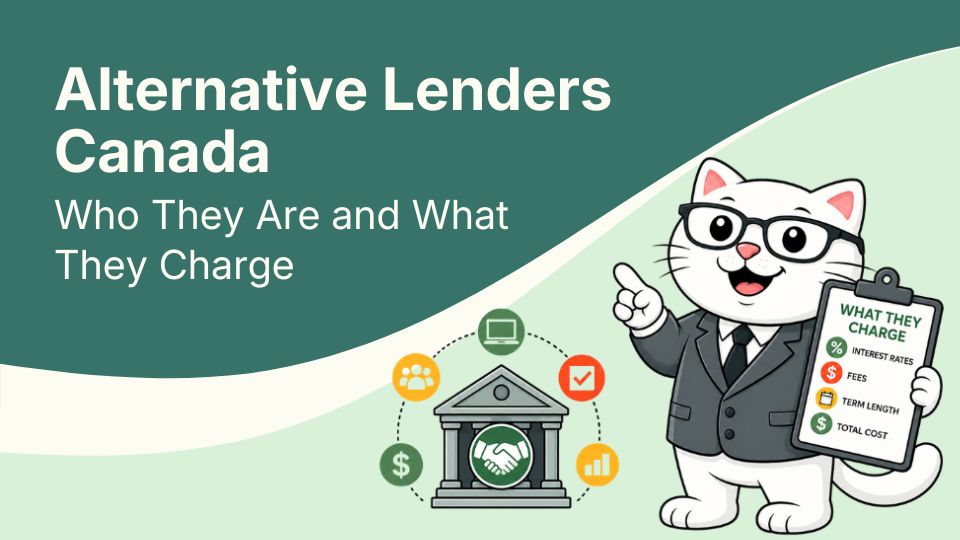
Alternative Lenders Canada: Who They Are and What They Charge
Published July 2026
Alternative lenders Canada is a term used for lenders outside the major banks that offer borrowing options to Canadians with different credit profiles. These lenders may help borrowers who have fair credit, bad credit, limited credit history, self-employment income, or past financial issues.
If you have been declined by a bank, or if you do not qualify for the lowest advertised rates, an alternative lender may be worth considering. These lenders often look beyond your credit score and review your income, employment history, banking activity, existing debts, and ability to repay.
This guide explains who alternative lenders are, what they usually charge, how near-prime lending fits in, and how to compare loan offers safely before you borrow.
What Are Alternative Lenders in Canada?
Alternative lenders are financial companies that provide loans outside the traditional banking system. They may operate online, through broker networks, through private lending channels, or through specialised finance companies.
Unlike major banks, alternative lenders often use more flexible approval criteria. This does not mean approval is guaranteed. It simply means they may consider more than your credit score.
Alternative lenders may review:
- Your monthly income
- Your employment stability
- Your recent banking history
- Your debt-to-income ratio
- Your credit score and payment history
- The loan amount you are requesting
- Your ability to repay without financial hardship
This can make alternative lenders useful for borrowers who are financially stable now but have credit issues from the past.
If your credit score is already low, read our complete guide to bad credit loans in Canada before applying.
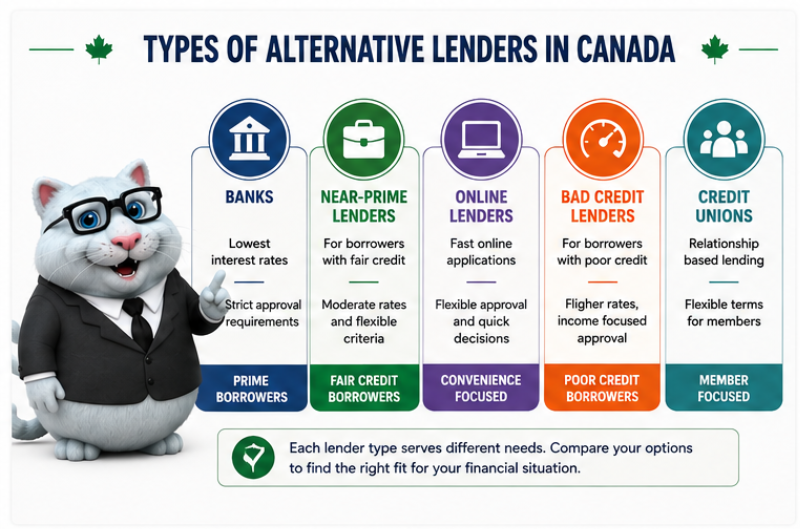
Types of Alternative Lenders in Canada
Not all alternative lenders are the same. Some focus on near-prime borrowers, while others work with borrowers who have poor credit or need fast online decisions.
| Type of Alternative Lender | Best For | Typical Features |
|---|---|---|
| Near-prime lenders | Borrowers with fair credit | Moderate rates, flexible approval |
| Bad credit lenders | Borrowers with poor credit | Higher rates, income-based approval |
| Online lenders | Fast applications | Digital forms, quick decisions |
| Installment lenders | Fixed repayment schedules | Regular payments over several months |
| Credit unions | Local borrowers and members | Relationship-based lending |
| Private lenders | Special cases or secured loans | May require collateral |
The right option depends on your credit profile, income, province, loan purpose, and ability to repay.
Near-Prime Lenders: Who They Are and What They Charge
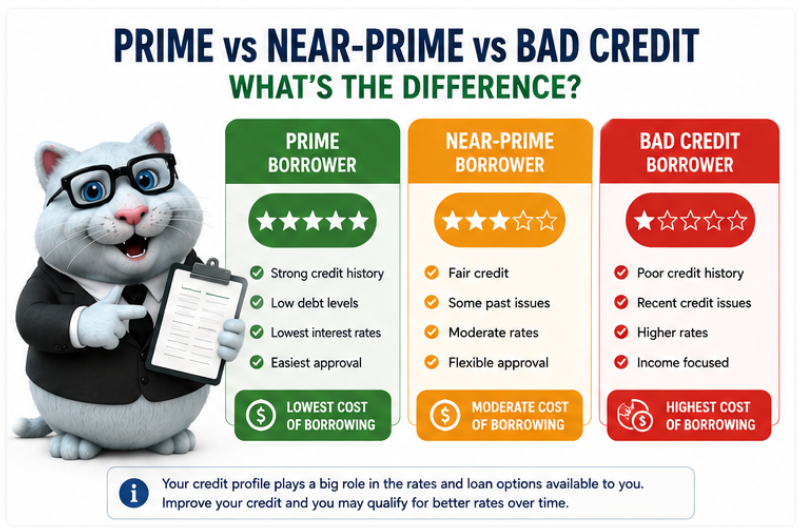
Near-prime lenders are one type of alternative lender. They serve borrowers who are not strong enough for prime bank rates but are not always considered deeply subprime.
A near-prime borrower may have:
- Fair credit rather than good or excellent credit
- Some missed payments in the past
- High credit card balances
- A limited credit history
- Stable income but weaker credit
- A completed consumer proposal or older bankruptcy
Near-prime lenders usually charge more than banks, but they may charge less than high-cost bad credit lenders. Their goal is to serve borrowers who sit in the middle: not prime, but not the highest risk.
There is no single official near-prime credit score range used by every Canadian lender. Each lender sets its own rules. Some focus strongly on credit score, while others place more weight on affordability and current income.
Alternative Lenders vs Banks: What Is the Difference?
The main difference between banks and alternative lenders is how they assess risk.
Major banks usually prefer borrowers with strong credit, stable income, low debt, and a clean repayment history. Alternative lenders may accept a wider range of borrowers, but they usually charge more to reflect the added risk.
| Feature | Major Banks | Alternative Lenders |
|---|---|---|
| Approval criteria | Stricter | More flexible |
| Credit score importance | High | Moderate to high |
| Application process | May take longer | Often faster online |
| Interest rates | Usually lower | Usually higher |
| Best for | Strong credit borrowers | Fair, limited, or damaged credit |
Alternative lenders can be helpful, but they are not always the cheapest option. If you can qualify with a bank or credit union at a lower rate, that may be better.
What Do Alternative Lenders Charge in Canada?
Alternative lender rates in Canada vary widely. The rate you receive depends on your credit profile, income, debt level, loan amount, repayment term, province, and whether the loan is secured or unsecured.
As a general guide, alternative lenders may charge higher rates than banks because they often work with borrowers who carry more risk.
| Borrower Type | Possible APR Range | Notes |
|---|---|---|
| Near-prime borrower | 12%–35% | Fair credit, stable income |
| Bad credit borrower | 19%–35% | Lower score or past credit issues |
| Secured borrower | Lower to moderate | Collateral may reduce lender risk |
| Very high-risk borrower | Higher cost products | May have fewer safe options |
These ranges are examples only. Actual offers vary by lender and borrower profile.

In Canada, lenders must follow applicable federal and provincial rules. The federal criminal interest rate was lowered to 35% APR from January 1, 2025, with certain exemptions and separate payday loan rules. Borrowers should always review the full cost of borrowing before accepting a loan.
For official consumer guidance, visit the Financial Consumer Agency of Canada guide to personal loans.
Example Alternative Loan Costs
The monthly payment is important, but it does not show the full cost of the loan. A longer term may lower your monthly payment, but it can increase the total amount you repay.
| Loan Amount | APR | Term | Approx. Monthly Payment | Approx. Total Repaid |
|---|---|---|---|---|
| $3,000 | 24.9% | 24 months | $160 | $3,840 |
| $5,000 | 29.9% | 36 months | $212 | $7,632 |
| $10,000 | 34.9% | 48 months | $390 | $18,720 |
These examples are for illustration only. Actual rates, payments, fees, and approval terms vary by lender.
Always compare the total amount repaid, not only the monthly payment.
Who Qualifies With Alternative Lenders?
Alternative lenders often focus on affordability. That means they want to know whether you can repay the loan based on your current finances.
You may qualify if you have:
- A regular source of income
- An active Canadian bank account
- Proof of identity
- Proof of address
- Recent bank statements or pay stubs
- Enough income left after bills and debt payments
You may find approval harder if you have recent missed payments, frequent NSF transactions, unstable income, or too much existing debt.
If you need fixed payments over time, compare installment loan options before choosing a shorter-term product.
Are Alternative Lenders the Same as Bad Credit Lenders?
Not always. Some alternative lenders work mainly with near-prime borrowers. Others specialise in bad credit loans. There is overlap, but the terms are not exactly the same.
Alternative lenders may serve:
- Near-prime borrowers with fair credit
- Bad credit borrowers with lower scores
- Self-employed borrowers
- New Canadians with limited credit history
- Borrowers who need faster online decisions
- Borrowers who want non-bank loan options
Bad credit lenders are usually a smaller part of the wider alternative lending market. If your credit challenges are serious, compare options on our bad credit loans Canada page.
What Fees Should You Watch For?
Interest is not the only cost. Some alternative lenders may charge additional fees that increase the total cost of borrowing.
Before signing, check for:
- Administration fees
- Origination fees
- Brokerage fees
- Optional insurance costs
- Late payment fees
- NSF fees
- Early repayment penalties
- Loan renewal or refinancing fees
A lower advertised rate is not always cheaper if the loan includes extra fees. Compare the APR, monthly payment, and total repayment amount together.
How to Compare Alternative Lenders in Canada
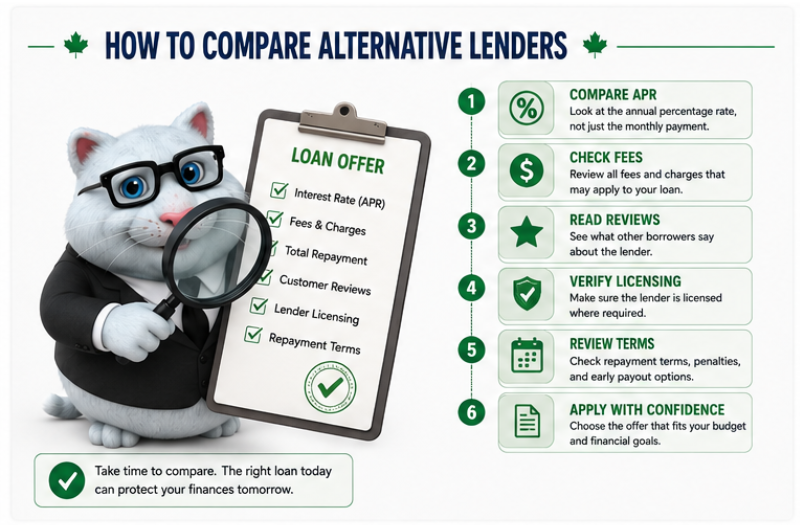
Do not choose a lender based only on speed. Fast funding can help in an emergency, but affordability matters more.
Use this checklist before accepting an offer:
- What APR are they offering?
- What is the total amount you will repay?
- Are there upfront or hidden fees?
- Can you repay early without penalty?
- Does the lender report payments to credit bureaus?
- Is the lender licensed where required?
- Are the monthly payments realistic?
- Does the lender clearly explain the agreement?
If you are comparing lenders online, our guide to online loans in Canada explains how online applications and approvals usually work.
When an Alternative Lender May Make Sense
An alternative lender may be worth considering when you have a real financial need and a realistic repayment plan.
Common reasons include:
- Emergency car repairs
- Urgent household bills
- Medical or dental expenses
- Debt consolidation
- Replacing several smaller debts with one payment
- Rebuilding credit with on-time payments
If debt repayment is your main goal, review our page on debt consolidation loans in Canada.
When to Avoid Alternative Lenders
An alternative loan may not be right if it makes your financial situation worse.
You may want to avoid borrowing if:
- You cannot afford the monthly payment
- You need a new loan to repay another loan
- You are borrowing for non-essential spending
- The lender asks for money before funding
- The total repayment amount is unclear
- You feel pressured to sign quickly
No loan should create more stress than the problem it is meant to solve.
How to Improve Your Chances of Approval
You may improve your chances by applying for a realistic amount and showing that repayments fit your budget.
Before applying:
- Check your credit report for errors
- Reduce credit card balances where possible
- Avoid several hard credit applications in a short period
- Keep your banking activity stable
- Prepare proof of income
- Choose a loan amount you can afford
- Compare more than one lender before accepting
Alternative lenders can be flexible, but they still need to see that the loan is affordable.
Are Alternative Lenders Safe?
Many alternative lenders in Canada operate legally and follow applicable federal and provincial rules. However, not every lender is trustworthy.
Be careful with lenders that:
- Promise guaranteed approval
- Ask for upfront fees before funding
- Request gift cards or cryptocurrency
- Refuse to provide a written agreement
- Hide the APR or total repayment amount
- Pressure you to sign immediately
A safe lender should clearly explain the loan amount, rate, fees, repayment schedule, and total cost before you agree.
Final Thoughts
Alternative lenders in Canada can provide useful options for borrowers who do not qualify with major banks. They may be especially helpful for people with fair credit, bad credit, limited credit history, or non-traditional income.
However, these loans usually cost more than bank loans. Before borrowing, compare the APR, fees, repayment term, monthly payment, and total amount repaid. Make sure the loan solves a real need and fits your budget.
If your credit challenges are more serious, start with our complete Bad Credit Loans in Canada guide. You can also compare available bad credit loan options through FatCat Loans.
Frequently Asked Questions
What is an alternative lender in Canada?
An alternative lender is a non-bank lender that may offer loans to borrowers who do not meet traditional bank approval requirements. These lenders may consider income, employment, banking history, and affordability alongside credit score.
Are alternative lenders safe?
Many alternative lenders are safe and operate legally in Canada. Borrowers should still check that the lender is transparent, provides a written agreement, and clearly explains the total cost of borrowing.
Do alternative lenders check credit?
Many alternative lenders check credit, but some may use soft checks during pre-qualification. Others may complete a hard credit check before final approval.
What interest rates do alternative lenders charge?
Rates vary by lender, borrower profile, province, loan amount, and repayment term. Alternative lenders usually charge more than banks because they often work with borrowers who have fair, limited, or damaged credit.
Can I get approved by an alternative lender with bad credit?
Possibly. Some alternative lenders work with bad credit borrowers, but approval depends on income, affordability, banking history, existing debt, and lender criteria.
Are alternative lenders better than banks?
Not always. Banks often offer lower rates for strong credit borrowers. Alternative lenders may be better for borrowers who need flexible approval, faster online applications, or options outside traditional banks.
Disclosure: This article is for informational purposes only and does not constitute financial advice. Loan terms, rates, fees, and eligibility vary by lender and province. FatCat Loans is a loan comparison platform, not a lender. Always review lender agreements carefully before accepting any loan.

The FatCat Loans Editorial Team delivers clear, accurate, and unbiased guidance on loans, credit, and personal finance in Canada. Our writers follow strict editorial standards to ensure every article is trustworthy, well-researched, and easy to understand, helping readers make confident financial decisions.