Guarantor Loans Canada: How They Work, Who Qualifies & Co-Signer Risks
August 26, 2026
Can a Guarantor Help You Get a Loan in Canada?
Last Updated: August 2026
Getting approved for a personal loan can be difficult if you have bad credit, limited credit history or income that doesn’t meet a lender’s requirements.
One possible option is applying with another person who is willing to take responsibility for the debt if you don’t repay it.
You may hear this described as a guarantor loan, co-signed loan or joint loan. If you’re looking for a personal loan with a co-signer in Canada, you’re generally looking for the same type of borrowing arrangement, although the person’s legal responsibilities can differ depending on the agreement.
Having someone else involved can strengthen an application because the lender may consider that person’s income, credit history and financial position alongside yours.
But there’s an important catch.
Co-signing isn’t simply providing a reference or saying that someone is trustworthy. Depending on the loan agreement, the person signing with you may become legally responsible for repaying the debt.
Important: FatCat Loans is a loan comparison platform, not a lender. We don’t make lending decisions or guarantee approval. Whether a lender accepts a guarantor or co-signer, and the responsibilities that person assumes, depend on the lender and loan agreement.
Guarantor Loans in Canada at a Glance
| Feature | What to Know |
|---|---|
| What is it? | A loan involving another person who takes on repayment responsibility |
| Who may consider one? | Borrowers who can’t qualify comfortably on their own |
| Does every lender allow it? | No |
| Can it improve approval chances? | Potentially, but never guarantees approval |
| Is the other person responsible for the debt? | Potentially yes — check the agreement carefully |
| Can their credit matter? | Yes |
| Can missed payments create problems? | Yes |
| Should someone co-sign casually? | No |
The exact legal responsibility depends on what the person signs. Don’t assume that every product marketed as a guarantor, joint or co-signed loan works identically.
What Is a Guarantor Loan?
A guarantor loan generally involves another person agreeing to take financial responsibility if the borrower doesn’t meet the loan obligations.
In Canada, you may also see terms such as co-signer, co-applicant, co-borrower or joint borrower. These terms aren’t necessarily legally identical.
For example, the Financial Consumer Agency of Canada (FCAC) says someone who co-signs a loan as a joint borrower with a federally regulated financial institution becomes equally responsible for repaying the unpaid balance.
The important point is to read the actual loan agreement rather than relying on the label. Both people should understand exactly what they’re responsible for before signing.
How Do Guarantor Loans Work?
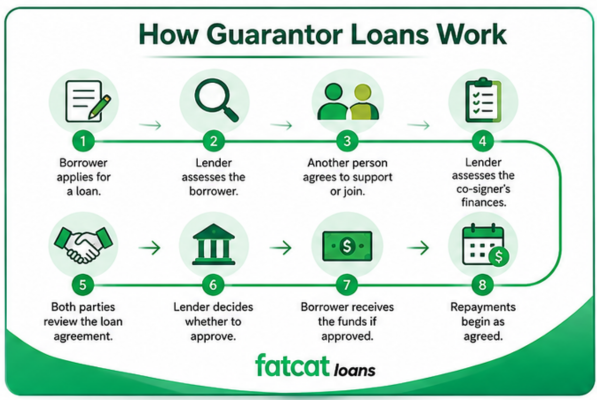
The process varies between lenders, but a co-signed or guarantor loan may work like this:
- The borrower applies for a loan.
- The lender assesses the borrower.
- Another person agrees to support or join the application.
- The lender assesses that person’s finances too.
- Both parties review the loan agreement.
- The lender decides whether to approve the application.
- The borrower receives the funds if approved.
- Repayments begin according to the agreement.
Normally, the intention is for the primary borrower to make the payments.
But if repayments are missed, the other person may become responsible under the agreement.
That’s why agreeing to co-sign should be treated as a genuine borrowing decision — not simply helping someone fill out an application.
Why Would a Lender Ask for a Guarantor or Co-Signer?
A lender wants reasonable confidence that a loan will be repaid.
FCAC says lenders generally look for regular income, a bank account and permanent address when assessing personal-loan applicants. Most lenders also perform a credit check and may consider existing debts.
An applicant may struggle to qualify alone because of:
- Poor credit
- Limited credit history
- Low income
- High existing debt
- Irregular income
- Previous missed payments
- A thin Canadian credit file
Adding someone with stronger credit, income or overall finances may strengthen an application, but it doesn’t guarantee approval.
If you’re struggling to qualify because of your credit history, our Bad Credit Loans Canada guide explains other borrowing options and what lenders may consider.
Who Qualifies for a Guarantor Loan?
There is no single eligibility standard for guarantor or co-signed loans in Canada. Each lender sets its own requirements.
The borrower may need to provide:
- Government-issued identification
- Proof of income
- Canadian address
- Employment details
- Bank information
- Details of existing debts
The lender may also check the borrower’s credit history.
The guarantor or co-signer will normally be assessed too. Depending on the lender, this could be a spouse, partner, parent, other relative or even a close friend.
Lenders may consider the second person’s:
- Credit history
- Income
- Existing debts
- Employment
- Overall ability to repay the loan
Being related to the borrower doesn’t automatically make someone an acceptable co-signer.
Most importantly, the person should be financially capable of taking responsibility for the debt if required.
Can a Guarantor Help You Get a Loan With Bad Credit?
Potentially.
A financially stronger guarantor or co-signer may strengthen an application with lenders that allow this type of arrangement.
However, it doesn’t guarantee approval. The lender may still consider your income, existing debt, credit history and overall affordability.
A co-signer should therefore be viewed as another part of the lender’s assessment — not a way to bypass lending requirements.
If you’re considering alternative lending because mainstream credit isn’t available, compare the total cost carefully rather than focusing only on whether you can get approved.
If you’re exploring borrowing options with a weaker credit history, you can also compare bad credit loan options available through participating lenders.

Guarantor vs Co-Signer: What’s the Difference?
This is one of the most confusing parts of the subject.
In everyday conversation, people often use guarantor and co-signer to mean roughly the same thing.
Contractually, they may not be.
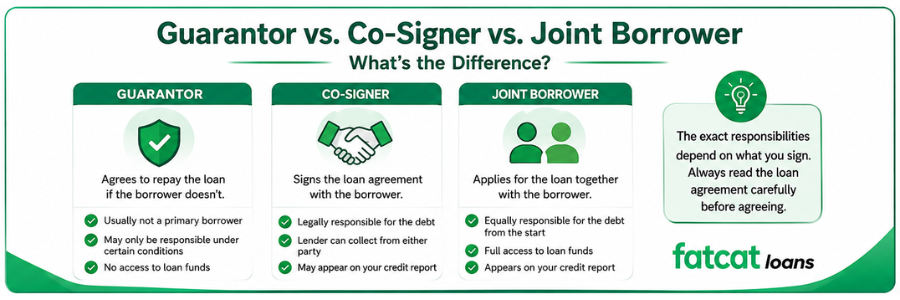
A co-signer or joint borrower may share responsibility for the debt from the beginning.
A guarantor arrangement may instead specify circumstances in which the guarantor becomes responsible.
The exact wording of the agreement matters.
FCAC states that when you co-sign a loan as a joint borrower, you become equally responsible for repaying the unpaid balance.
So don’t ask only:
“Am I the guarantor?”
Ask:
“Under this agreement, exactly what am I legally responsible for and when can the lender require me to pay?”
That is the question that matters.
What Are the Risks of Co-Signing a Loan?
This is the section every potential co-signer should read carefully.
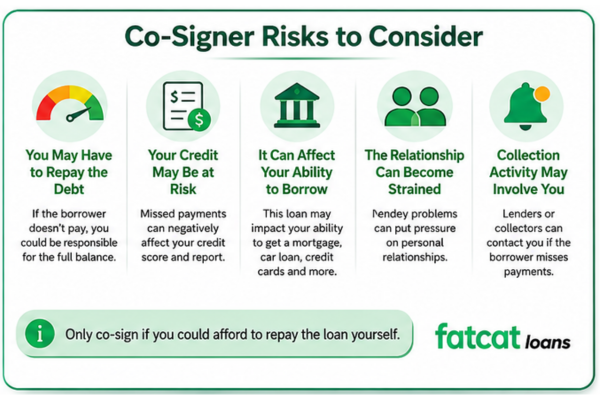
1. You May Have to Repay the Debt
The biggest risk is also the simplest.
If you’re legally responsible under the agreement and the other borrower doesn’t pay, you may have to.
FCAC explicitly says a joint borrower becomes equally responsible for repaying the unpaid balance.
Don’t co-sign based on the assumption:
“They’ll definitely make every payment.”
Instead ask:
“Could I afford this loan myself if they stopped paying?”
If the answer is no, signing is a serious financial risk.
2. Your Credit May Be at Risk
A joint credit obligation may affect your own credit profile.
Missed payments or other negative activity associated with an account you’re responsible for can create problems when you later apply for credit yourself.
Before signing, ask the lender:
- Will this account appear on my credit report?
- How are missed payments reported?
- Will applying involve a hard credit inquiry?
Don’t guess.
3. It Can Affect Your Ability to Borrow
Taking responsibility for another debt can matter when you apply for:
- A mortgage
- Car financing
- Credit cards
- A personal loan
- A line of credit
Future lenders may consider your existing financial obligations when assessing affordability.
That can matter even if the original borrower has always made the payments.
4. The Relationship Can Become Strained
Money problems can put serious pressure on personal relationships.
Job loss, separation or unexpected expenses could leave the borrower unable to pay, turning a personal relationship into a financial dispute.
Discuss what would happen in this situation before signing.
5. Collection Activity May Involve the Co-Signer
If a debt isn’t paid, the lender may be able to contact someone who guaranteed or co-signed it.
FCAC’s debt-collection guidance specifically notes an exception allowing contact with a person who has guaranteed or co-signed the loan regarding that debt.
Co-signing doesn’t make you invisible if something goes wrong.
What Rights Does a Co-Signer Have?
If you are a joint borrower with a federally regulated financial institution, you have important disclosure rights.
FCAC says every joint borrower has the right to receive:
- Information about interest and other borrowing costs
- The same ongoing statements provided to the other borrowers
Joint borrowers can give up certain disclosure rights, but specific consent requirements apply.
This matters.
If you’re responsible for a debt, receiving statements can help you see whether payments are being made rather than discovering a problem months later.
Maintaining access to statements can help a joint borrower monitor the loan and identify missed payments or other problems sooner.
Questions to Ask Before You Co-Sign
Before signing, ask the lender:
- What exactly am I signing? Am I a guarantor, co-signer or joint borrower?
- Am I responsible for the entire unpaid balance?
- When can the lender require me to make payments?
- Will the loan appear on my credit report?
- Will I receive account statements?
- What happens if the borrower misses a payment?
- Can I be removed from the loan later?
Finally, ask yourself the most important question:
Could I afford to repay this entire loan myself?
If the answer is no, taking responsibility for the debt could put your own finances at risk.
Can You Remove a Guarantor or Co-Signer From a Loan?
Not automatically.
Once you’ve signed the agreement, the lender isn’t necessarily required to release you simply because the borrower has made payments on time.
Depending on the loan, removal could require:
- Paying off the loan
- Refinancing
- A new application by the borrower
- Formal approval from the lender
Ask about the release conditions before signing, not after you want out.
What Happens If the Borrower Can’t Repay?
If the borrower begins missing payments, don’t ignore the problem.
The consequences can depend on the agreement, but they may include:
- Late charges
- Collection activity
- Negative credit reporting
- Demand for payment from another person responsible for the debt
- Further collection or legal action
FCAC recommends contacting lenders as soon as possible when you’re having difficulty making payments rather than waiting for the situation to get worse.
If the loan is with a federally regulated financial institution, specific federal consumer protections may apply. Provincial or territorial rules may apply in other situations, including some debt-collection activity.
Alternatives to a Guarantor Loan
If you can’t qualify alone, asking someone to co-sign isn’t your only option.
Depending on your circumstances, you could consider:
- Borrowing less to reduce the repayment and amount of debt.
- Improving your credit first if the expense isn’t urgent.
- Exploring bad-credit loan options, although rates may be higher.
- Considering a secured loan, while remembering that the asset used as security may be at risk.
- Waiting and saving if borrowing can be avoided.
If you don’t specifically need a guarantor or co-signer, you can also compare personal loan options to explore loans that may be available based on your circumstances.
Our Bad Credit Loans Canada guide explores alternative borrowing options in more detail.
FCAC also recommends considering whether you really need to borrow and whether you could continue making payments if your financial circumstances changed.
How to Compare a Guarantor or Co-Signed Loan
Don’t compare offers based on approval alone.
Look at:
| Check | Why It Matters |
|---|---|
| APR | Shows the annual borrowing cost |
| Interest rate | Affects the cost of the loan |
| Payment | Must fit the household budget |
| Loan term | Longer terms can increase total cost |
| Fees | Can increase what you ultimately pay |
| Total repayment | Shows the bigger financial picture |
| Co-signer liability | Determines what the second person risks |
| Credit reporting | Can affect both parties |
| Release terms | Shows whether the co-signer can ever be removed |
Before accepting an offer, it can help to estimate how the repayments could fit into your budget. Our loan calculator lets you explore different loan amounts, rates and repayment terms before you apply.

FCAC recommends reading the loan agreement carefully before signing and paying close attention to the interest rate, fees and repayment terms.
Before You Agree to Be a Co-Signer
A useful rule is:
Don’t co-sign a loan you couldn’t afford to repay yourself.
Before signing:
- Read the complete agreement
- Understand your liability
- Check the APR and total cost
- Understand what happens after a missed payment
- Confirm how the loan affects your credit
- Ask whether you can be released from the agreement
- Consider your own future borrowing needs
Never sign because you feel pressured or because you assume the borrower will always be able to make the payments.
Frequently Asked Questions About Guarantor Loans in Canada
What is a guarantor loan in Canada?
A guarantor loan generally involves another person agreeing to take financial responsibility if the borrower doesn’t meet the loan obligations. The exact responsibilities depend on the agreement, so borrowers and guarantors should read the terms carefully before signing.
Can I get a personal loan with a co-signer in Canada?
Some Canadian lenders may allow you to apply for a personal loan with a co-signer, co-applicant or guarantor. The lender may assess both people’s income, credit history, existing debts and ability to repay. Having a co-signer doesn’t guarantee approval, and the person signing with you may become legally responsible for some or all of the debt depending on the loan agreement.
Can a guarantor help me get a loan with bad credit?
Potentially. A lender may consider the guarantor or co-signer’s income, credit and financial position as part of the application. However, adding another person doesn’t guarantee approval.
Does a guarantor need good credit?
Requirements vary by lender, but lenders commonly assess the second person’s credit, income, existing debts and overall ability to repay. Strong credit alone may not be enough.
Is a co-signer responsible for the whole loan?
A co-signer who is a joint borrower may be equally responsible for the unpaid balance. FCAC specifically states this for joint borrowers dealing with federally regulated financial institutions. Always check the actual loan agreement.
Can being a co-signer affect your credit?
It can. Ask the lender how the account, application and payment history will be reported to credit bureaus before signing.
Can a co-signer be removed from a loan?
Not necessarily. Removal may require lender approval, refinancing, repayment of the existing loan or a new application. Check the lender’s rules before agreeing to co-sign.
Final Thoughts: Should You Use a Guarantor?
A guarantor or co-signer may help some Canadians access financing when qualifying alone is difficult, but it doesn’t make an unaffordable loan affordable.
For the person signing alongside the borrower, the financial consequences can also be significant.
Before proceeding, both people should understand:
- Who is legally responsible for the debt
- The APR and total repayment
- What happens if payments are missed
- How the loan may affect their credit
- Whether the co-signer can be removed
- Whether they could afford the debt if circumstances changed
If bad credit is making it difficult to find financing, compare your wider options carefully before asking someone else to take responsibility for your debt.

The FatCat Loans Editorial Team delivers clear, accurate, and unbiased guidance on loans, credit, and personal finance in Canada. Our writers follow strict editorial standards to ensure every article is trustworthy, well-researched, and easy to understand, helping readers make confident financial decisions.