Credit Builder Loans Canada: What They Are and How They Work
August 31, 2026
Understanding Credit Builder Loans in Canada
Last Updated: August 2026
If you have little credit history or you’re trying to rebuild your credit, you may have come across credit builder loans in Canada.
Despite the name, a credit-builder loan doesn’t always work like a normal personal loan. With some products, you don’t receive a lump sum of money to spend immediately. Instead, the product is designed primarily to help you establish a record of managing credit and making payments.
That can make credit-builder loans useful for some Canadians, but they aren’t a guaranteed way to increase your credit score. They can also come with interest, fees or other costs.
Here’s how credit-builder loans work, how they differ from other borrowing products and what to check before signing up.
What Is a Credit Builder Loan?
A credit-builder loan is a credit product designed to help establish or rebuild credit history.
Depending on the provider, similar products may be described as:
- credit-building loans
- credit-building programs
- savings loans
- secured savings loans.
The structure can vary considerably between providers.
With a traditional savings-style credit-builder loan, you may not receive the borrowed amount upfront. Instead, funds may be held while you make scheduled payments over an agreed period.
The provider may report the account or payment activity to one or more credit bureaus. Depending on the agreement, you may receive the funds that were held after completing the term.
Other Canadian credit-building products can work differently. Some use a line-of-credit structure or another type of credit account instead of a traditional savings-style loan.
The important thing is to understand exactly what you’re signing up for rather than assuming every product advertised as a “credit builder” works the same way.
How Do Credit Builder Loans Work in Canada?
A traditional savings-style credit-builder loan can work differently from a standard loan.
Here’s a simplified example:
| Step | What Happens |
|---|---|
| 1 | You apply for a credit-builder product |
| 2 | The provider establishes the credit arrangement |
| 3 | Instead of receiving the full amount immediately, the funds may be held |
| 4 | You make scheduled payments |
| 5 | The provider may report the account or payment activity to a credit bureau |
| 6 | You complete the agreed term |
| 7 | Depending on the product, held funds may then become available to you |
That’s very different from a standard personal loan.
With a normal personal loan, you generally receive the borrowed money and then repay it through regular instalments. The Financial Consumer Agency of Canada (FCAC) explains that personal loans involve borrowing a fixed amount and repaying the full amount, including interest and applicable fees, over an agreed period.
A traditional credit-builder loan can effectively reverse that sequence.

A Simple Example
Imagine a hypothetical credit-builder product requires you to make payments for 12 months.
Instead of receiving a lump sum on day one, you make the agreed payments throughout the year.
The provider reports the account or payments according to its reporting policy.
At the end of the term, you may receive money accumulated or held under the agreement, less any applicable costs.
That’s only an illustration. Actual Canadian products can work differently, so always check the individual agreement.
How Can a Credit Builder Loan Help Your Credit?
The potential benefit comes from adding information to your credit history.
Your credit reports contain information about how you use and manage credit. Credit scores are then calculated using information in those reports, although different scoring models can produce different results.
If a credit-builder provider reports your account and you make the required payments as agreed, that activity may contribute information to your credit file.
But there are two important catches.
First, the provider needs to report the relevant activity to a credit bureau for it to appear on that bureau’s credit file.
Second, there is no guaranteed number of points your credit score will increase.
Your result depends on the information in your overall credit file and the scoring model being used.
That’s why claims such as “increase your credit score by 100 points” shouldn’t be treated as a result everyone will achieve.
For more on what can influence your score, see our How to Improve Your Credit Score in Canada guide.
Does a Credit Builder Loan Guarantee a Better Credit Score?
No.
Taking out a credit-builder loan doesn’t guarantee that your credit score will increase.
FCAC warns Canadians that companies can’t quickly and easily fix a credit score. Accurate information can’t simply be erased from your credit history, and improving your score takes time and responsible credit behaviour.
Your result can depend on factors such as:
- what’s already on your credit reports
- your existing payment history
- how long you’ve used credit
- your existing balances
- recent credit activity
- which credit bureau receives the information
- the scoring model used to calculate your score.
A credit-builder loan should therefore be viewed as one possible credit-building tool rather than a guaranteed credit-repair service.
Who Might Consider a Credit Builder Loan?
A credit-builder loan may appeal to someone who:
- has little or no Canadian credit history
- is rebuilding after previous credit problems
- has a thin credit file
- has difficulty qualifying for other suitable credit products.
However, adding another account won’t necessarily address the reasons your credit score is low.
If you’re unsure where your current score sits, see our What Counts as a Bad Credit Score in Canada? guide.
What Does a Credit Builder Loan Cost?
Costs vary between products and providers.
Depending on how the credit-builder product is structured, you could encounter:
- interest
- monthly fees
- membership or subscription fees
- administration charges
- other costs specified in the agreement.
Don’t judge the product solely by its monthly payment.
You need to understand how much you’ll pay in total and what you’ll receive in return.
FCAC recommends reading credit agreements carefully before signing, with particular attention to the interest rate, fees and repayment terms.
Before signing up, check the total amount you’ll pay, all interest and fees, how much you’ll eventually receive, and what happens if you miss a payment or cancel early.
A relatively small monthly charge can still add up when it’s paid for a year or longer.
Check Which Credit Bureaus the Provider Reports To
Canada has two major consumer credit bureaus: Equifax and TransUnion. Don’t assume a credit-builder provider reports to both.
Before signing up, ask which bureau receives your account or payment information and what information is reported.
You can then check your credit reports to make sure the account appears correctly.
Can a Credit Builder Loan Hurt Your Credit?
Potentially.
The word “builder” can make these products sound as though your credit can only improve.
That’s not necessarily the case.
If payment activity is reported to a credit bureau, missing or making late payments could potentially hurt your credit history.
FCAC notes more generally that consistently paying debt on time may help your credit score, while missing payments may harm it.
Applying for a credit product may also involve a credit check, depending on the provider and its application process.
Most importantly, don’t take on a payment you can’t comfortably afford just because the product is marketed as helping your credit.
Credit Builder Loan vs Personal Loan
A credit-builder loan and a personal loan generally serve different purposes.
| Credit Builder Loan | Personal Loan | |
|---|---|---|
| Main purpose | Establish or rebuild credit history | Borrow money for a financial need |
| Money upfront | Often not with traditional savings-style products | Usually yes |
| Repayments | Scheduled according to the agreement | Scheduled loan repayments |
| Credit reporting | Usually an important feature to check | Some lenders report payments |
| Typical reason for using it | Establishing/rebuilding credit | Accessing borrowed funds |
| Guaranteed score increase? | No | No |
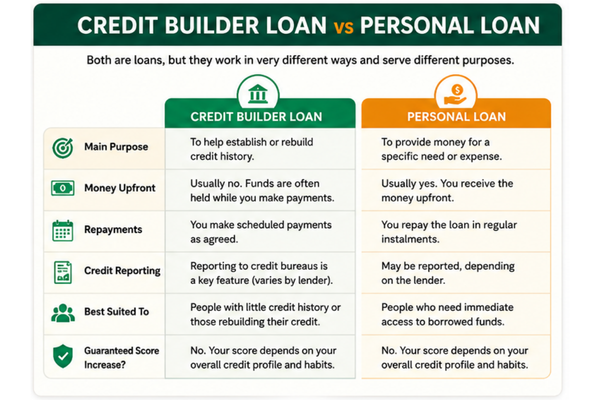
If you need money now, a traditional savings-style credit-builder loan may not solve your problem.
For borrowing options when your credit is already damaged, see our Bad Credit Loans Canada guide.

Credit Builder Loan vs Secured Credit Card
A secured credit card is another product some Canadians may consider when establishing or rebuilding credit.
With a secured card, you generally provide a security deposit and receive a credit card with a credit limit.
You can then use the card for purchases and repay the balance according to the card agreement.
A traditional credit-builder loan works differently because you’re generally making scheduled payments under a loan or savings-style arrangement rather than using revolving credit for purchases.
| Credit Builder Loan | Secured Credit Card | |
|---|---|---|
| Credit type | Usually instalment or credit-building arrangement | Revolving credit |
| Security | Depends on product | Security deposit normally required |
| Can you use it for purchases? | Usually no | Yes |
| Regular payments | Yes | Depends on card usage and balance |
| May establish credit history | Potentially | Potentially |
| Guaranteed score improvement | No | No |
Neither is automatically better.
The right choice depends on the individual product, its cost, your existing credit profile and whether you can manage the account responsibly.
Watch Out for “Credit Repair Loans”
This is an important distinction.
A legitimate credit-building product shouldn’t be confused with a company promising to quickly repair or fix your credit.
FCAC has specifically warned Canadians about companies that offer loans while suggesting that making payments on the loan will repair their credit.
With some of these arrangements, FCAC says the consumer may never actually receive the loan money because the amount is instead used to cover the company’s services or programs. The consumer then has to make regular loan payments while continuing to pay their existing debts. FCAC warns that these loans may carry high interest and could leave the borrower with more debt without improving their credit score.
FCAC also makes clear that accurate information in your credit history can’t simply be removed because it’s negative. Improving a credit score takes time.
Be wary of claims such as:
- “Guaranteed credit-score increase”
- “Fix your credit instantly”
- “Erase bad credit”
- “We can remove all negative information”
Those promises are very different from a provider simply offering a credit account and reporting payment activity.
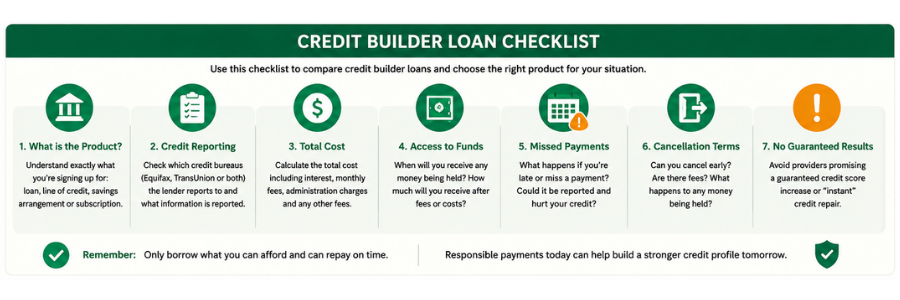
How to Compare Credit Builder Loans in Canada
Before choosing a credit-builder product, check:
- What the product actually is: loan, line of credit, subscription or savings arrangement.
- Credit-bureau reporting: whether it reports to Equifax, TransUnion or both.
- Total cost: including interest, monthly charges and other fees.
- Access to funds: when you’ll receive any money being held and how much you’ll receive.
- Missed payments: what happens if you’re late or miss a payment.
- Cancellation: whether you can leave early and what it will cost.
- Credit claims: avoid providers promising a guaranteed score increase.
FCAC recommends looking beyond the monthly payment when assessing borrowing. Interest, fees and the length of the term can all affect the total cost.
Are Credit Builder Loans Worth It?
They can be useful for some people, particularly if you have little credit history or you’re trying to rebuild your credit and the provider reports your account to a credit bureau.
But consider the total cost, reporting arrangements and affordability before signing up.
A credit-builder loan may be less attractive if fees or interest are high, you’re already struggling with existing debt, you need immediate access to money or the provider makes unrealistic credit-repair promises.
The key question isn’t simply “Will this build my credit?”
It’s “Does the potential credit-building benefit justify the cost and commitment?”
A credit-builder loan also isn’t your only option. See our Build Credit in Canada: Smart Ways to Start guide for other credit-building tools and strategies.

Frequently Asked Questions About Credit Builder Loans in Canada
What is a credit builder loan in Canada?
A credit-builder loan is a credit product designed primarily to help establish or rebuild credit history. With some products, funds are held while you make scheduled payments, and account or payment activity may be reported to a credit bureau. Structures vary between providers.
Do credit builder loans actually improve your credit score?
They may help add payment information to your credit history if the provider reports the account, but there is no guaranteed score increase. Your credit score depends on the information in your overall credit file and the scoring model being used.
Can you get a credit builder loan with bad credit?
Some credit-building products are designed for people establishing or rebuilding credit, but eligibility varies between providers. Having bad credit doesn’t mean you’ll automatically qualify for every product.
Do credit builder loans give you money upfront?
Not always. With some traditional savings-style credit-builder loans, funds may be held while you make payments and become available after completing the agreement. Other Canadian credit-building products may use different structures.
Is a credit builder loan better than a secured credit card?
Not necessarily. They work differently. A secured credit card provides revolving credit backed by a security deposit, while a traditional credit-builder loan generally involves scheduled payments. Compare costs, credit-bureau reporting and how each option fits your circumstances.
Can a credit builder loan hurt your credit?
Potentially. If payment activity is reported and you miss payments, that negative information may affect your credit history. You should only take on payments you can comfortably afford.
The Bottom Line
Credit builder loans in Canada can be one way to establish or rebuild credit history, but they aren’t a shortcut to a better credit score.
Before signing up, compare the total cost, credit-bureau reporting, access to any funds being held, missed-payment consequences and cancellation terms.
Be particularly cautious about companies promising to quickly “repair” your credit through a loan. FCAC warns that some credit-repair loan arrangements may leave consumers with additional debt without improving their credit score.
If you’re looking to borrow money rather than build credit history, see our Bad Credit Loans Canada guide.
This article is for informational purposes only and does not constitute financial advice. FatCat Loans is a loan comparison platform, not a lender. We don’t make lending decisions or guarantee credit-score improvements, loan approval, rates or terms.

The FatCat Loans Editorial Team delivers clear, accurate, and unbiased guidance on loans, credit, and personal finance in Canada. Our writers follow strict editorial standards to ensure every article is trustworthy, well-researched, and easy to understand, helping readers make confident financial decisions.