What Counts as a Bad Credit Score in Canada? (TransUnion & Equifax Tiers Explained)
June 24, 2026
What Counts as a Bad Credit Score in Canada?
Last Updated: August 2026
If you’ve ever been declined for a loan, credit card or financing application, you may have wondered whether your credit score was the reason.
What counts as bad credit in Canada isn’t quite as simple as saying that every score below one particular number is bad.
Canadian credit scores commonly range from 300 to 900, with higher scores generally indicating lower credit risk. However, Equifax, TransUnion and individual lenders may use different credit-scoring models and different thresholds when assessing an application.
That means there isn’t one official Canadian number at which your credit suddenly changes from “fair” to “bad.”
If your score is low and you’re considering borrowing, our Bad Credit Loans Canada guide explains how bad-credit borrowing works, what lenders may consider and what to compare before accepting an offer.
What Is a Credit Score?
A credit score is a number calculated using information in your credit report. Lenders may use it to help assess the risk involved in lending you money.
In Canada, consumer credit scores commonly range from 300 to 900. According to the Financial Consumer Agency of Canada (FCAC), the higher your score, the lower the lending risk you generally represent.
Canada’s two major credit bureaus are:
Your credit report may contain information about your credit cards, loans, lines of credit, payment history and other credit activity.
Credit bureaus use information in your credit report to calculate credit scores. However, they don’t necessarily use identical information or identical scoring models.
Lenders may also use their own internal scoring systems and lending criteria when deciding whether to approve an application.
You can learn more about how credit reports and scores work from the Financial Consumer Agency of Canada.
So, What Is Considered Bad Credit in Canada?
There is no universal bad-credit cutoff that applies to every Canadian lender or every credit-scoring model.
You’ll often see Canadian financial websites divide the 300–900 scale into categories such as poor, fair, good, very good and excellent. These ranges can be useful as a general guide, but they shouldn’t be treated as official approval thresholds.
TransUnion makes this particularly clear. It explains that each lender decides what credit-score range it considers a good or poor credit risk. Your credit score is also only one piece of information a lender may consider.
So instead of asking:
“Is my score officially bad?”
it can be more useful to ask:
“How might a lender view the risk associated with my credit profile?”
A lower score may make it more difficult to qualify for some products or obtain favourable rates, but the outcome depends on the lender, loan and the rest of your financial situation.
TransUnion Credit Score Tiers in Canada
TransUnion provides one useful example of why generic credit-score charts should be treated carefully.
In current TransUnion Canadian CreditVision research, consumers are grouped into the following risk tiers:
| TransUnion CreditVision Risk Score | Risk Tier |
|---|---|
| 300–639 | Subprime |
| 640–719 | Near prime |
| 720–759 | Prime |
| 760–799 | Prime plus |
| 800+ | Super prime |
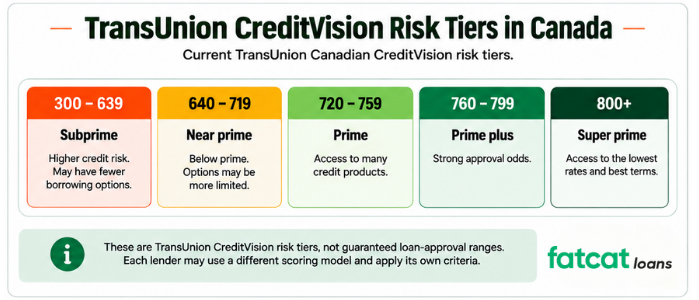
These are TransUnion CreditVision risk tiers, rather than universal Canadian definitions of “bad,” “fair” or “good” credit. A particular lender may use a different scoring model or different criteria when assessing an application.
For example, a score of 620 falls within the subprime range in this TransUnion model. That doesn’t mean every Canadian lender will automatically decline someone with a 620 score.
Likewise, being in a higher tier doesn’t guarantee approval.
Important: Credit-score ranges describe risk categories. They should not be interpreted as guaranteed loan-approval or rejection ranges.
Is a Credit Score Under 500 Bad in Canada?
A score below 500 is at the lower end of Canada’s usual 300–900 credit-score scale and would fall within the subprime tier under the TransUnion CreditVision ranges above.
That can make accessing some forms of credit more difficult, particularly from lenders with stricter credit requirements.
However, having a score below 500 doesn’t tell you by itself whether a particular loan application will be approved.
What About Equifax Credit Score Tiers?
You’ll find many Canadian websites publishing an “Equifax” score table using ranges such as 300–559 for poor credit, followed by fair, good, very good and excellent categories.
These ranges should not be treated as universal Equifax approval tiers.
Different credit scores and scoring models may be used for different purposes, and a lender may receive a different score from the one you see through a consumer credit-score service.
The practical takeaway is:
Don’t assume that an online credit-score chart tells you exactly how Equifax — or a lender using Equifax information — will classify your application.
Instead, use your score as one indicator of your overall credit position and pay attention to the information contained in your credit report.
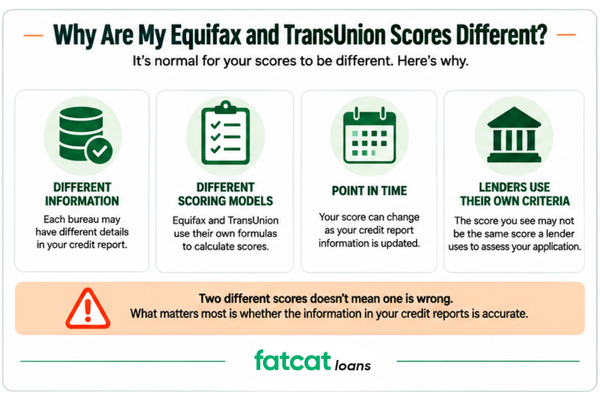
Why Are My Equifax and TransUnion Scores Different?
It’s completely possible to check your credit through two sources and see different numbers.
That doesn’t necessarily mean one of them is wrong.
The Bureaus May Have Different Information
Credit bureaus rely on information reported to them. Your Equifax and TransUnion credit reports may therefore not contain exactly the same information at exactly the same time.
Different Credit-Scoring Models May Be Used
There isn’t just one credit-score formula.
FCAC explains that each credit reporting agency uses its own formula to calculate scores, while lenders may also calculate scores using their own formulas.
Scores Represent a Point in Time
TransUnion describes a credit score as a calculation based on the information in your credit report at a particular point in time.
If account balances or other information have recently changed, the score you’re viewing may change as credit-report information is updated.
You May Not Be Looking at the Same Score as the Lender
This is particularly important.
The score you see through a consumer service isn’t necessarily the exact score a lender will use when you apply.
TransUnion says lenders may use different scores or their own internal credit scores when evaluating applications.
So don’t panic because two scores aren’t identical. What’s more important is whether the underlying information on your credit reports is accurate.
What Can Affect Your Credit Score?
The exact formulas used to calculate credit scores aren’t generally disclosed publicly, but the information in your credit report can affect your score.
TransUnion identifies factors including:
- Your payment history
- Balances on your accounts
- Credit utilization
- Length of credit history
- Types of credit you use
- Recent credit applications and new accounts
Late or missed payments, high balances and other negative credit information can therefore affect your overall credit profile.
If you’d like to work on your score rather than simply understand where it sits, read our How to Improve Your Credit Score in Canada guide.
Does Bad Credit Automatically Mean You’ll Be Declined for a Loan?
No.
A low credit score may affect your borrowing options, but a score alone doesn’t determine the outcome of every loan application.
TransUnion says lenders may consider the score alongside other information and can apply their own criteria when measuring creditworthiness.
Depending on the lender and loan product, an assessment may also consider factors such as your income, existing financial commitments and information contained in your credit report.
Borrowers with weaker credit may:
- Have fewer borrowing options
- Face higher borrowing costs
- Qualify for smaller amounts
- Encounter different eligibility requirements
Having bad credit also doesn’t mean you should accept the first loan you’re offered.
Compare the APR, fees, repayment amount, loan term and total borrowing cost before agreeing to a loan.
For a more detailed look at the factors lenders may consider, see our Personal Loan Requirements Canada guide.
Need to Explore Bad Credit Loan Options?
If a lower credit score is limiting your options, learn how bad credit loans work and what participating lenders may consider beyond your score.

What Credit Score Do You Need for a Personal Loan?
There is no universal minimum credit score required for every personal loan in Canada.
Each lender sets its own eligibility and underwriting criteria.
A higher score may improve your access to certain products or rates, but lenders can consider more than your score when making a credit decision.
We’ve covered this question separately in our Credit Score for Personal Loans Canada guide.
That distinction is important:
This article explains where your score may sit.
The personal-loan credit-score guide explains how your score may affect a personal-loan application.
How Can You Check Your Credit Score in Canada?
You can obtain credit information directly from Canada’s credit bureaus.
As of August 2026, FCAC says:
- Equifax provides consumers with access to a free credit score across Canada.
- TransUnion provides a free credit score with a Consumer Disclosure for residents of Ontario and Quebec.
- Some federally regulated financial institutions may provide free credit scores through their banking apps.
- Other companies may also provide credit scores, sometimes as part of paid services.
You can use FCAC’s credit report and credit score guide to find official Equifax and TransUnion access options.
Checking your own credit score is generally considered a soft inquiry and does not affect your score in the same way as some lender-initiated credit checks.
What Should You Do If Your Credit Score Is Low?
First, don’t assume that a low number means you have no financial options.
Start by checking your credit reports and making sure the information is accurate.
If you’re trying to improve your credit profile, focus on the fundamentals:
- Make payments on time
- Reduce outstanding balances where possible
- Avoid unnecessary applications for new credit
- Review your reports for errors
- Use available credit responsibly
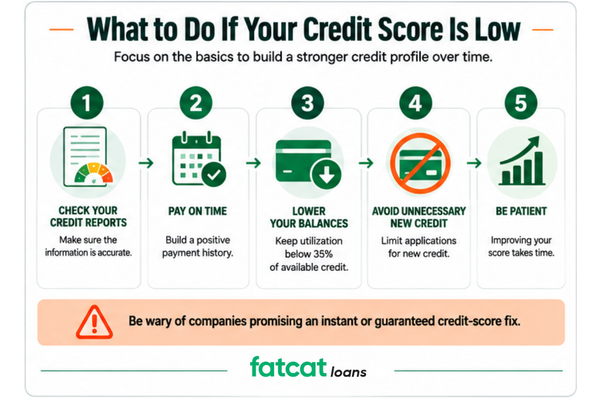
TransUnion recommends trying to keep account balances below 35% of available credit as part of its credit-health guidance.
Improving a credit score generally takes time. Be wary of companies promising an instant or guaranteed credit-score fix.
If you need to borrow while your score is still low, understand the costs and make sure repayments are affordable before accepting an offer.
Frequently Asked Questions About Bad Credit Scores in Canada
Is a 600 credit score bad in Canada?
A score of 600 falls within the subprime range of 300–639 under TransUnion’s current Canadian CreditVision risk tiers. However, there is no universal Canadian cutoff that every lender uses to define bad credit. Lenders can use different scoring models and their own approval criteria.
Is 650 a bad credit score in Canada?
Under TransUnion’s Canadian CreditVision risk tiers, 650 falls within the near-prime range of 640–719. That doesn’t guarantee approval or rejection for any particular credit product because lenders can apply their own criteria.
What is the lowest credit score in Canada?
The commonly used Canadian consumer credit-score range runs from 300 to 900, making 300 the bottom of that scale.
Is there a minimum credit score for a loan in Canada?
There isn’t one minimum credit score that applies to every Canadian loan. Different lenders and products have different eligibility and underwriting requirements, and lenders may consider information beyond your credit score.
Why is my Equifax score different from my TransUnion score?
Equifax and TransUnion may hold different information and use different credit-scoring models. The score you see may also not be the same score a particular lender uses when assessing your application.
Does checking my credit score lower it?
Checking your own credit score generally does not lower it. This is different from certain lender-initiated credit inquiries made when you apply for credit.
The Bottom Line
There isn’t one universal number that officially defines bad credit in Canada.
Canadian credit scores commonly range from 300 to 900, but credit bureaus can use different scoring models and lenders set their own criteria.
Current TransUnion CreditVision ranges classify 300–639 as subprime, followed by near prime, prime, prime plus and super prime tiers. These ranges can provide useful context, but they aren’t universal approval thresholds.
Your credit score is also only part of your financial picture. The information in your credit report, the lender’s criteria and other aspects of your application may all affect the outcome.
If your score is low and you’re considering borrowing, our Bad Credit Loans Canada guide explains the options, costs and risks to consider.
Ready to See Your Loan Options?
If you’ve reviewed your budget and decided borrowing is appropriate, you can explore loan options from participating lenders.

Disclosure: This article is for informational purposes only and does not constitute financial advice. FatCat Loans is a loan comparison platform, not a lender. We don’t make lending decisions or guarantee approval. Credit scores, eligibility requirements, rates and terms vary by lender and credit-scoring model.

The FatCat Loans Editorial Team delivers clear, accurate, and unbiased guidance on loans, credit, and personal finance in Canada. Our writers follow strict editorial standards to ensure every article is trustworthy, well-researched, and easy to understand, helping readers make confident financial decisions.